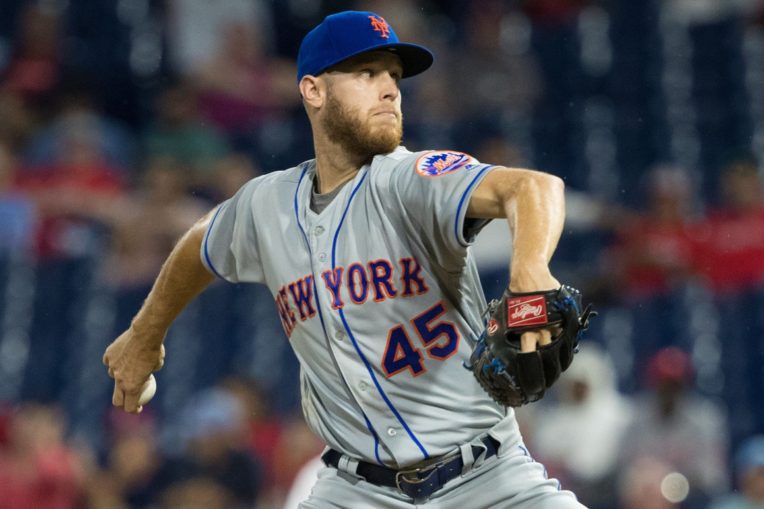
The strides Zack Wheeler took over the course of 29 starts in 2018 for the New York Mets were significant. Finally healthy and with a new pitch added to his arsenal, the now-28-year-old experienced what could really only be referred to as a rebirth.
After missing over two full seasons after undergoing ulnar collateral ligament reconstruction surgery, then dealing with the ongoing setbacks in the aftermath of the procedure (including receiving bone-strengthening Forteo shots directly into his abdomen during the last offseason), Wheeler came into camp last February in arguably the best shape of his young, tumultuous career.
His 17-start, rehab shortened campaign in 2017 (5.21 ERA, 5.03 FIP, and 8.44 strikeouts, 4.17 walks, and 1.56 home runs allowed per nine innings, respectively), despite the circumstances, left many wondering if the former first-round pick would ever truly make his way back to the cusp of the upper-echelon of major-league pitching.
Before last season, many could argue that Wheeler’s 3.54 ERA, 3.55 FIP, 187 strikeouts, 79 walk season in 2014 (32 starts; 185.1 innings) was his high-water mark and could argue even further that, after such an extreme detour in his career path, the revitalization of such a promising career was teetering on the edge of impossible.
Though like a phoenix rising, over the course of the 2018 season and under the tutelage of Mets skipper Mickey Callaway and pitching coach Dave Eiland, Zack Wheeler — slowly at first, then with considerably more authority — put those doubts to rest.
Over the first half of the season, the Georgia native performed admirably, putting up a 4.44 ERA, 3.75 FIP, with 8.89 strikeouts, 3.35 walks, and 0.92 home runs allowed per nine innings, respectively.
Wheeler’s 1.7 wins above replacement over the first half ranked 12th in the National League among qualified starters. Not too shabby for a hurler who’d made just 49 starts from 2014 through 2017.
Over the course of the second half of the year, Zack Wheeler kicked himself into another gear, showing off his new toy in the will-shattering split-fingered fastball he’d developed and inserted into his repertoire, replacing his seldom-used sinker.
Over his 29 starts, Wheeler dropped — quite literally — a 90 MPH splitter on a hitter with two strikes after showing him an average 96.5 MPH heater and a devastating array of sliders and curveballs which has to be one of the most lethal weapons in all of baseball.
With two strikes, he struck out 51.2 percent of the hitters he faced (compared to 41.9 percent over the same situations in 2017), walked just 1.8 percent (3.5 percent in 2017), and, when contact was made, it was only hit hard 22.7 percent of the time. Tough to hit a ball that falls off the end of a table at around 50 feet, huh?
Speaking of avoiding hard contact, by the end of the season, Zack Wheeler’s 24.8 percent hard-hit rate was the lowest among all qualified major league starting pitchers. Let that sink in.
The guy most of us feared would never return to form actually found his name ranked above guys like Jacob deGrom, Aaron Nola, Dallas Keuchel, Justin Verlander, and the rest of the game’s elite in an extremely important advanced metric. That is just mind-blowing.
Back to Wheeler’s second half. Over his final 11 starts (18 in the first half), the right-hander put up extraordinary numbers, pitching to an NL-leading 1.68 ERA with a 2.53 FIP, 2.5 fWAR, with 8.76 strikeouts, 1.80 walks, and 0.36 home runs allowed per nine innings.
In what seemed like the snapping of fingers, Zack Wheeler went from treading water, giving his all to get — and stay — healthy to announcing his presence among the cream of the National League’s starting pitching crop.
Like the rest of the Mets starting rotation — Jacob deGrom, Noah Syndergaard, Steven Matz, and Jason Vargas — the progress being made under this new regime is substantial and things only seem to be getting better.
With a revamped lineup and a reinforced bullpen, Wheeler, along with the rest of his starting compatriots, could and should be the cement pylons on which this Mets team rests upon. If the Mets are going to be playing in postseason games this season, it’s going to be because — among other reasons — the starters continued to blossom.
Zack Wheeler’s success and development have great bearing on whether this group takes the strides it took last year. To borrow a cliche from across town, at least through this writer’s eyes, Wheeler is the straw that stirs this ridiculously talented drink.