Mandatory Credit: Mary Holt-USA TODAY Sports
The New York Mets’ bullpen has been a surprisingly strong area of the roster through the first two months of the 2021 regular season. Entering Thursday’s off day, manager Luis Rojas‘ relief corps owns a cumulative 3.1 fWAR. That’s the best in baseball, and it’s even more impressive when realizing it’s been done in the second-fewest innings (192, to be exact).
This group has been tested quite a bit over the past month or so, too. They had to withstand short trips to the injured list for Jacob deGrom and Taijuan Walker, along with picking up the slack when either Joey Lucchesi or David Peterson struggled to be effective.
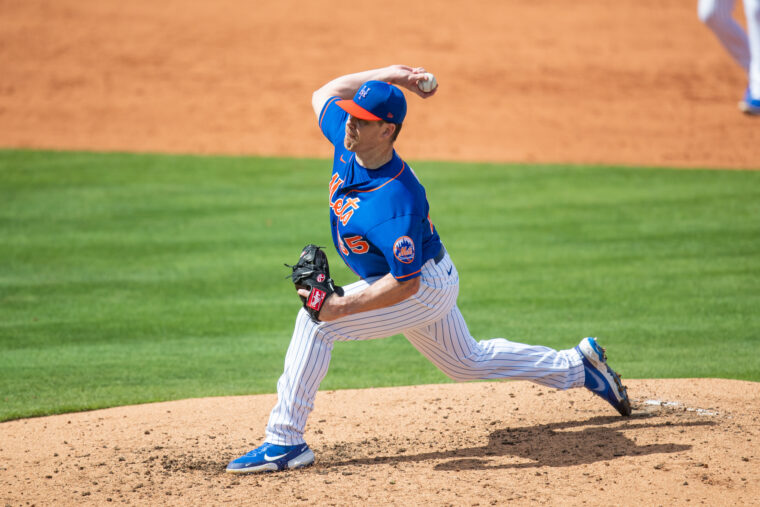
When looking at how the Mets’ relievers have performed individually over the past month, a name that stands out on the negative side of things is Trevor May. In his last 8.2 innings pitched, he’s struggled to a 7.27 ERA and -0.3 fWAR. And while his 6.49 FIP isn’t much different, other advanced ERA estimators, like xFIP (3.60) and SIERA (3.66) say he’s pitched better than his numbers suggest.
Still, it’s interesting to look into what May has done throughout this season to see if any adjustments should be made moving forward. Just because something worked at the beginning of the year doesn’t mean it’ll continue working for the long haul. After all, big-league hitters make their own adjustments, too.
We’ll be starting with the 2018 season for any comparisons discussed below because that’s when May returned from Tommy John surgery. And, according to his stats, that’s when he came into his own as a reliever while with the Minnesota Twins.
Change in Quality of Contact
There’s been an interesting trend within May’s batted-ball profile over recent years. This includes a steady increase in line drives and fly balls, along with a decrease in fly balls leading up to 2021. That area of his profile has seemingly normalized a bit, but the quality of contact he’s produced has stayed relatively similar. Except for what he’s done so far this year.
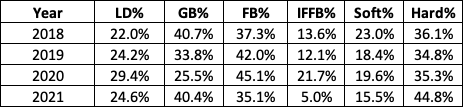
The sample sizes are different between these four seasons, but at the moment, three of the four are actually rather similar. His workload from 2018 through 2021 (as of Thursday, at least) is as follows: 25.1 innings, 64.1, 23.1, and 21.0. So, this makes the difference in his quality-of-contact numbers stand out a bit more.
With this in mind, I was curious as to whether these numbers have been consistent throughout 2021, and more specifically before he started to struggle. When May’s current performance is split between what he’s done through May 11 (2.03 ERA in 13.1 innings) and everything after that (7.04 ERA in 7.2 innings), here’s how his quality-of-contact numbers looked:
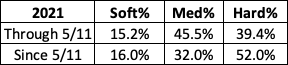
Although it was only a few ticks above normal, we can see that even when things were going well, opposing hitters were making solid contact off him more often than usual.
Leaning on the Wrong Pitch?
Upon peeking at the right-hander’s pitch mix and how it’s changed from 2018 through the present day, there are a couple of trends to point out.
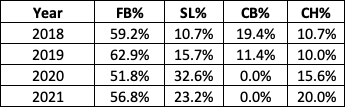
The most obvious trend is the drastic decrease in curveball usage before he completely scrapped the pitch, but we’re not talking about that one. There’s been a consistent rise in changeup usage since 2019, along with a drastic rise in slider usage (until this year).
While the value of his slider, according to FanGraphs, has decreased when compared to 2020 (2.39 to 0.82 on a per-100-pitch basis), the value of his changeup has taken a nosedive into the wrong side of zero (1.62 to -1.37). The results also just aren’t there for him when looking at how hitters are performing against that offering.
Historically speaking, May has enjoyed a lot of success with his changeup. Between 2018 and 2020, opposing hitters have posted a wRC+ of -27, 18, and 85. Each of those numbers is good in its own right, but when put together in succession, it’s going in the wrong direction, which has continued in 2021. Hitters have produced a 138 wRC+ and a .842 OPS against this pitch.
The results with his slider, though, have been going in the opposite direction. From 2018-20, opposing hitter wRC+ has gone from 393 to 104 to 26, with the last two seasons producing a strikeout rate north of 30.0%. Despite not striking out as many hitters with his slider so far this year (18.2%), it’s still produced a 36 wRC+ and .465 OPS.
From the look of these statistics, it seems as if May’s changeup is more effective when he’s not leaning on it as much as he has been over the past season-plus. And if he leans more heavily on his slider again, that could help his quality-of-contact numbers head in a more familiar direction. That’s especially the case since May’s slider spends a lot more time out of the strike zone (44.6% for career, 29.5% in ’21) than his changeup (55.9% for career, 59.2% in ’21).
Having Seth Lugo back in the bullpen is helpful for a crew that’s carried the load for the majority of this season, and May is part of that group. However, for the backend of the bullpen to remain as effective as it has been thus far, May will need to be involved. So, getting himself back on track sooner rather than later will be crucial, especially since New York has precisely one more off day (June 24) prior to the All-Star break on July 12.