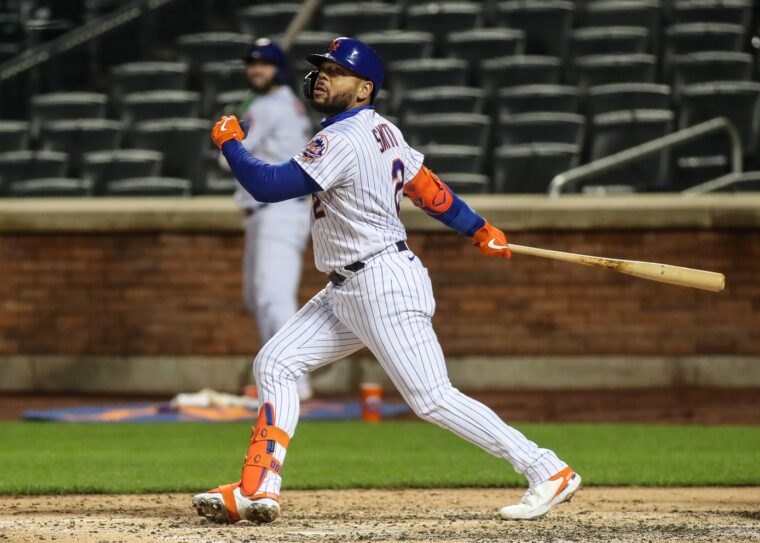
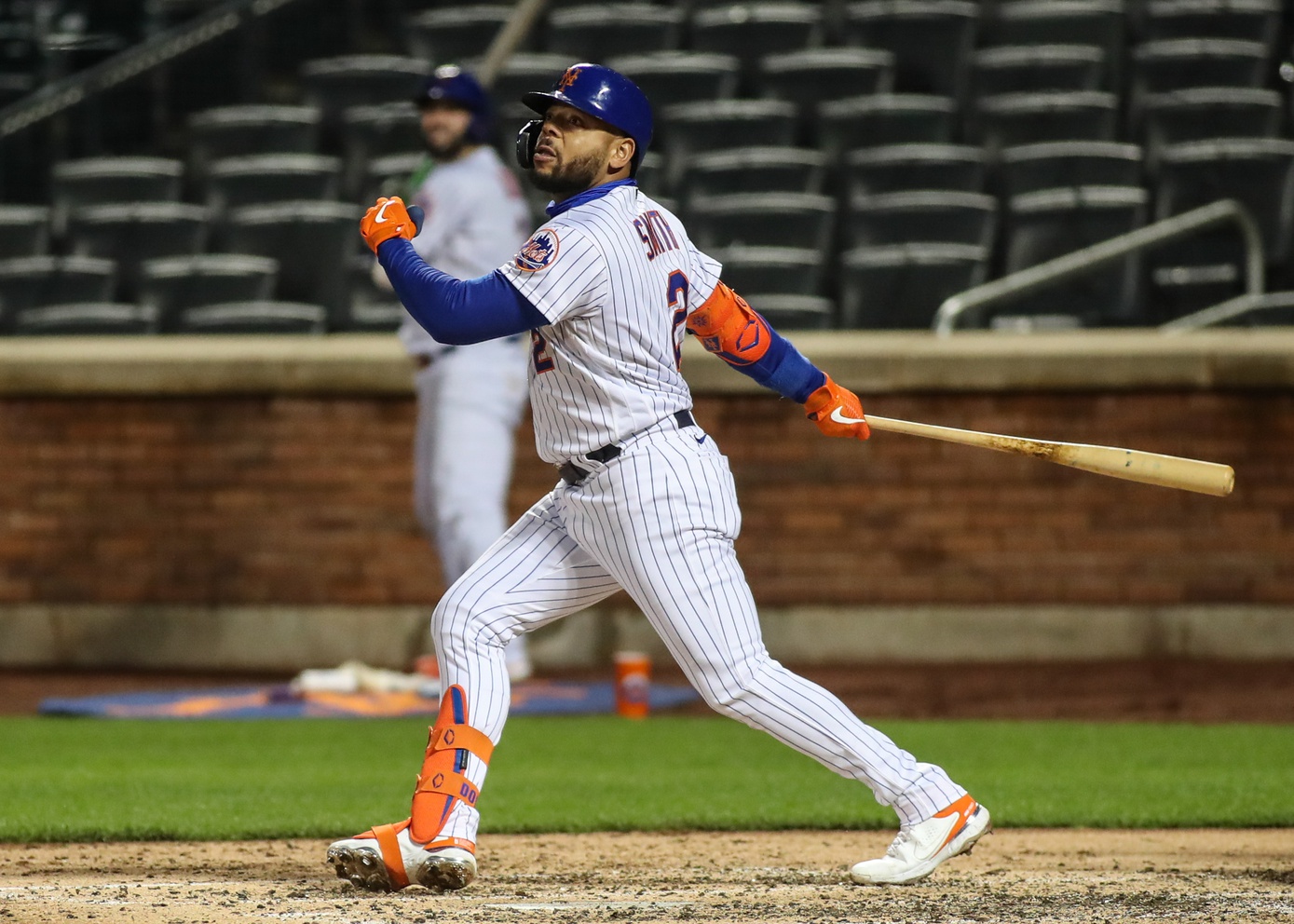
Mandatory Credit: Wendell Cruz-USA TODAY Sports
Although the New York Mets couldn’t beat the San Diego Padres before they skipped town on Sunday afternoon, it was a positive weekend in Queens. Manager Luis Rojas watched his club take two of three from one of the National League’s best teams, and New York’s 32-25 record is still comfortably atop the NL East standings.
One thing that’s been impressive about the Mets in 2021 is despite slow starts, injuries, and seemingly everything else in between, they’ve gotten enough production from their entire roster to remain successful. While he’s had some moments where the production was there, a player who fits into one of these unfortunate buckets is Dominic Smith.
After being one of baseball’s best hitters last year thanks to a healthy .316/.377/.616 line with a 164 wRC+ in 199 plate appearances, he’s struggled to keep that going. Smith suffered his fifth consecutive 0-fer on Sunday, making him hitless in his last 17 plate appearances. This recent skid has lowered his triple slash to .237/.303/.337, to go along with an 83 wRC+.
When compared to last year’s breakout performance, here are three areas where Dom has struggled thus far in 2021.
Plate Discipline
Last year, Smith swung the bat at a 51.9% clip, which was the second-highest it’s ever been during his young MLB career. But the biggest difference between 2020 and the seasons that came before was his aggressiveness both inside and outside the strike zone.
Yes, his chase rate went up nearly three percentage points from the year prior to 37.1%, but his 73.1% swing rate on strikes was a career-high mark, and it was the third straight year that number increased. He paired that with a career-high 84.6% contact rate on strikes, which led to good things when seeing he had a 37.8% hard-hit rate.
So far this season, though, there’s been one noticeable change in his plate discipline — he hasn’t been as aggressive in situations where he can hypothetically do the most damage. His 37.9% chase rate is nearly identical to last season, but his 68.7% swing rate on strikes is an obvious decline. The corresponding 79.3% contact rate on strikes isn’t a huge difference, but Smith’s 30.9% hard-hit rate is a clear indication he’s not making the same kind of quality contact.
Secondary Pitches
Dom was good in just about every situation last year. He saw seven different pitches in 2020, and the only one where he didn’t post at least a 111 wRC+ was the cutter. His performance against four-seamers is still respectable (163 wRC+, .214 ISO) even if it’s a significant step back from last year, especially in the power department (208 wRC+, .473 ISO). What really jumped out at me, though, was how he’s performed against sliders, changeups, and curveballs. After four-seamers, those are the pitches Smith has seen the most often to this point in 2021.
Here’s a look at how his production has dropped against each of these offerings:
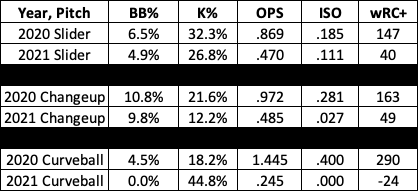
These are all eye-popping progressions — and not in a good way — from last year to the current campaign. Compared to 2020, Smith has unsurprisingly seen a decrease in fastballs (51.8% to 43.0%) and an increase in sliders (15.5% to 20.2%), curveballs (8.5% to 11.3%), and changeups (12.5% to 17.5%).
Hitting at Home
Looking back on last year’s 60-game season, Smith’s opportunities to play at Citi Field were full of production. In 98 plate appearances, he put together an impressive 145 wRC+, which was powered by a .297/.327/.582 line with five home runs and 19 RBI.
Through 79 plate appearances in 2021, Dom has struggled to a .205/.253/.260 line with just one homer and 11 RBI, good for a 51 wRC+. It’s not as if he’s been lighting the world on fire as a visiting player (99 wRC+ and .718 OPS in 132 plate appearances), but it’s still been head-and-shoulders better than his performance in Queens.
What’s interesting to note here, though, is Smith has historically been a better hitter on the road than at home. Even in 2020 when he produced that 145 wRC+, he was better as a visiting player (183). If we look back at previous years, like 2019 (155 on the road vs. 102 at home), 2018 (90 vs. 75), and 2017 (78 vs. 68), it’s the same story.
Regardless of whether or not he’s just a better hitter on the road than at home, his current numbers at Citi Field are just a fraction of what they were last season.
What’s Next?
As the calendar continues creeping toward July, the Mets might be getting significantly healthier. No, J.D. Davis and Brandon Nimmo still don’t seem to be close to returning, but Jeff McNeil and Michael Conforto are making their way back.
McNeil will take a spot back in the infield, and Conforto returning to the outfield will create some decisions for Rojas if things continue progressing as is. Kevin Pillar will probably keep getting some consistent level of playing time, and if Billy McKinney keeps producing the way he has since getting traded, he’ll also continue finding his way into the lineup.
Maybe that means Dom’s playing time gets a little more sporadic, and he’ll need to make the most of the opportunities given to him. We’ve seen Rojas play the hot hand on a number of occasions, so that’s not out of the realm of possibility.
Although he did have a tremendous year in 2020, we can’t forget this is Dom’s first crack at a full season in the big leagues — his current number of plate appearances (211), is already a career-high mark for him. There are still adjustments for him to make, especially with how opposing pitchers have clearly adjusted to him. The raw talent is there and he’s managed to still produce in important spots, he just needs to find a way to get more consistent.