
More than any other sport, baseball’s draft is just a series of dart throws. Plenty of first-round picks never even play a game in the majors, and plenty of late-round, unheralded picks go on to have great MLB careers.
Even from last year’s draft, Will Watson (seventh round), Ryan Lambert (eighth), Brendan Girton (10th) and R.J. Gordon (13th) are looking like legitimate possible future contributors, and they’re far from the only ones.
How can you tell which late-round picks will play above their draft stock? You can’t—but what we can do is look at them now and see what stands out. A couple of weeks out from the draft now, here are the most interesting traits among the Mets’ selections on Day 2 of the 2025 MLB Draft. If this list appears pretty pitcher-heavy, that’s because it is. The Mets made 17 selections on Day 2, and 14 were pitchers.

Peter Kussow. Photo from The Freeman
RHP Peter Kussow – 4th round, 133rd overall
Peter Kussow’s standout pitch is his slider. Both Baseball America and MLB Pipeline describe it as a “high-spin” slider that he runs into the upper 80s. It’s easily a plus pitch. His fastball sits in the low-to-mid 90s, but he’s run it up as high as 97. As a high school arm, there’s a lot of room for him to add some velocity as he gets older.
Pipeline described Kussow as someone who flew under the radar, and said if he didn’t end up turning pro this year, “he could become one of the best college pitchers in the 2028 class after three years at Louisville.”
RHP Peyton Prescott – 5th Round, 163rd overall
A fireballing righty who has hit triple-digits in the past, Peyton Prescott was mainly a reliever for the Seminoles, coming out of the pen for 23 of his 24 appearances. Most expect him to be a reliever in pro ball, but with a four-pitch mix that includes a splitter, slider and curveball, he could be given a chance to start. The Mets haven’t been afraid to stretch college relievers out to start if they believe they can handle it. The power fastball is the star of the show, and Baseball America doesn’t have any of the secondaries as anything more than average at this point.
Mets fans won’t see Prescott immediately shoot through the minor leagues like some recent draft picks, seeing as he underwent Tommy John Surgery in June. It wouldn’t be surprising to see him not pitch at all in 2026—there’s no harm in playing it safe coming off the injury—so keep your eyes on 2027 for Prescott’s first full season of pro ball.
And to boot, Prescott grew up a Mets fan.
RHP Nathan Hall – 6th round, 193rd overall
Like Prescott, Nathan Hall is a pitcher with big stuff who missed most of the 2025 season after undergoing elbow surgery. Hall had the internal brace procedure, not Tommy John, but it obviously still knocked him out for most of the year.
A former catcher, Hall sits in the low-to-mid-90s with his fastball with a solid slider and a curveball. In his one game with publicly available pitch data last season, his fastball averaged 18.2 inches of induced vertical break (IVB).

Nathan Hall pitch data. Courtesy of Thomas Nestico @TJStats on X.
He’s a very inexperienced pitcher, and when he was on the mound, he was doing so against Division II competition. That said, there are some legitimately interesting things about his arsenal, and with the Mets’ pitching development, Hall is someone to keep a real eye on.
RHP Cam Tilly – 7th round, 223rd overall
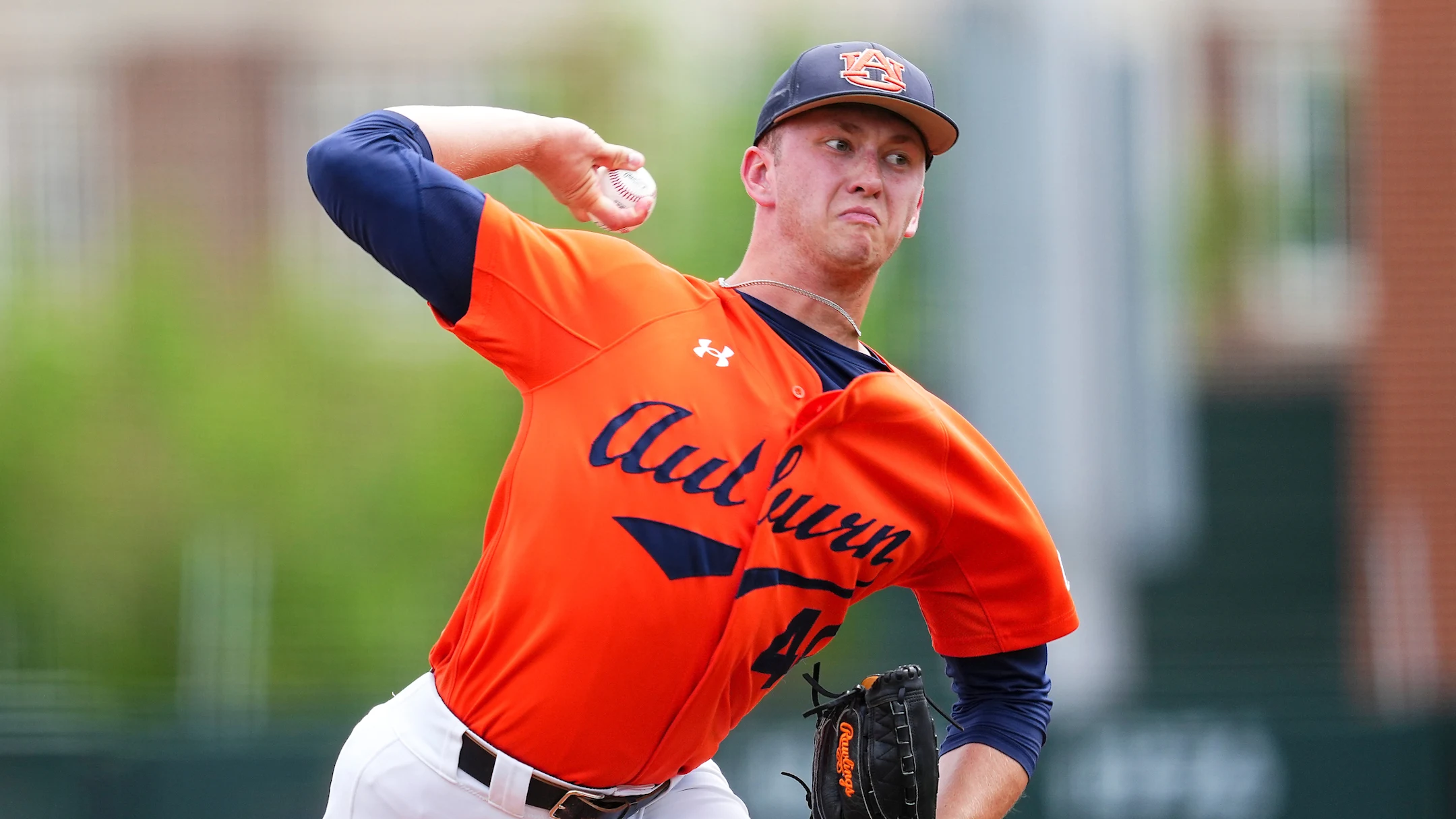
Cam Tilly is one of the pitchers with the best stuff in this entire Mets’ draft class. Don’t take my word for it, take Baseball America’s. The publication had Tilly as the most interesting Mets’ selection from rounds 4-10, thanks to his mid-90s fastball, slider, splitter and curveball.
Strike-throwing is the question with Tilly. He walked 12.6% of the hitters he faced in his first year for Auburn and 13.9% in his second, so whether or not he can stay in the zone enough to let his stuff shine is the biggest question. Like Prescott, Tilly is probably best suited to be a reliever, but with four pitches coming out of college, the Mets may give him an opportunity to start.
RHP Camden Lohman – 8th round, 253rd overall
Camden Lohman is notable here because the Mets went significantly overslot to sign him. The Mets signed Lohman for $797.5k, more than half a million over the slot value for the 253rd overall pick. MLB Pipeline is higher on him than Baseball America, ranking the right-hander over 250 spots higher in its pre-draft rankings. The former has Lohman, with four 50-grade pitches—a fastball, slider, curveball and splitter—highlighted by the heater that has reached 95 mph. The latter is less bullish on the breaking pitches.
The fastball touching 95 mph is what makes Lohman stand out. There’s plenty of opportunity for him to add more velocity as he gets older, too. If his secondaries can keep up, he could be a legitimate top-end starting pitching prospect. A prep arm, it will be a while before Mets fans see Lohman even sniff the major leagues, but there’s a reason the Mets went so far overslot to sign him.
OF Wyatt Vincent – 11th round, 343rd overall
A rare position player in this Mets draft, Wyatt Vincent might be the best athlete in this Mets draft. In football, Vincent caught 64 passes for 1,494 yards and 18 touchdowns from his sophomore to senior year, according to Wyatt D. Wheeler of the Springfield News-Leader. In baseball, he’s known for speed and defense in center field, and hit .403 with a 1.194 OPS in his senior year.
The Mets went overslot to sign Vincent, giving him $272,500 to lure him away from his commitment to Missouri State. A little over $100k of that signing bonus will count towards the bonus pool.
RHP Truman Pauley – 12th round, 373rd overall
Back to the pitchers, Harvard righty Truman Pauley might have the single best pitch of anyone the Mets drafted. His fastball sits in the low-90s but can hit 95-96, and it gets an absurd 22.5 inches of IVB—a bona fide elite mark. For comparison, Alex Vesia leads baseball this year with a four-seam fastball that has 21.2 inches of IVB, and he’s the only pitcher above 20 inches.
His control is spotty, and his arsenal isn’t very deep, so he screams reliever, but that fastball could carry him to the major leagues. And, the same Baseball America article that listed Tilly as the most interesting Mets selection from rounds 4-10 named Pauley the most interesting Mets selection from rounds 11-20.
LHP Conner Ware – 15th round, 463rd overall
A lefty! Ware is the only left-handed pitcher the Mets selected in 2025. His fastball sits in the low-90s and can reach 95 mph, and he has a curveball, changeup and slider. His most interesting pitch is his curveball, which he spins well. Baseball America listed the curve, along with his “seldom-used slider,” as “areas to build upon as a later-round flier in pro ball.”
RHP Joe Scarborough – 19th round, 583rd overall
This deep in the draft, there’s obviously not going to be any blue-chip prospects with multiple plus pitches. Usually, the best course of action is to draft someone with one plus pitch and go from there, and that’s what the Mets did with Joe Scarborough. His fastball has hit 98 mph, and regardless of anything else, that’s notable.