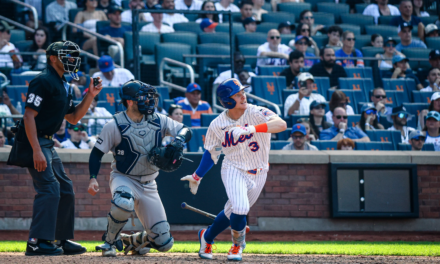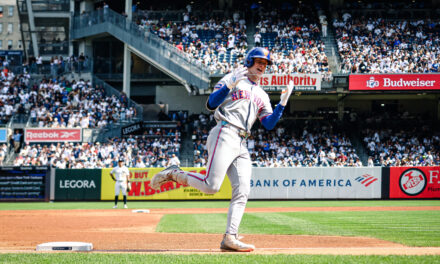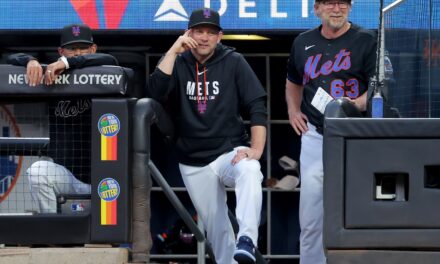

To Mets fans Ralph Kiner has been one of the voices who has brought us both the highlights and lowlights throughout our team’s history. He’s been in the broadcast booth since 1962 and has witnessed everyone from Felix Mantilla and Don Zimmer to Jose Reyes and David Wright. Teamed with Lindsey Nelson and Bob Murphy for 17 years, he was not as polished as his colleagues in the booth. But he still managed to find his way into our hearts. He did not share the colorful styling of Lindsey Nelson, nor the smooth cadences of Bob Murphy. But still, he held his own. Kiner would frequently make on-air gaffes, using words in the wrong order. But we knew what he meant. (See ‘comments’ for some classic Ralph-isms) Each broadcaster had their own unique flavor. Nelson, fully clad in bright sports jackets that tested the limits of color TV’s, would welcome viewers by saying, “Hello again everybody.” Murphy would please fans with a “Happy Recap” after a Mets win as opposed to a “Recap” after a Mets loss. But Ralph created his own signature HR call: ‘That ball is gone. Goodbye.’ And Home Runs was definitely something Ralph knew about. In his day, he was the most feared HR hitter in the National League.
Born in New Mexico, his mother moved to California when Ralph was 4 just after his father died. He grew up in Alhambra and although he was gifted at football and track, his heart belonged to baseball. He idolized Babe Ruth. After graduating High School in 1940, he was recruited by several teams, including the Yankees. However, the Pirates outbid the Yankees by $3000 and Kiner chose to play for Pittsburgh. After fighting in WW II and flying countless missions in the Pacific, Ralph showed up for Spring Training in 1946. Manager Frankie Frisch was well known for preferring veteran players to unproven rookies. However, he was impressed by Ralph’s physique. At 6’2, 195, Frisch took notice. His physical prowess along with a great Spring made it impossible for the Pirates to leave Kiner behind when the team headed north.
His rookie year, 1946, Ralph hit 23 HR’s which was enough to win the NL HR crown. Had there been a Rookie of the Year award in 46, he most likely would have won it. However, his 23 round trippers and 81 RBI’s was just the calm before the storm.
The summer of 46, the Pirates were sold to John Galbreath and Bing Crosby. Crosby befriended the rookie. You would never see owners developing a close friendship with their players but Kiner was ‘a charming kid.’ Crosby introduced Ralph to some of his Hollywood friends. Ralph built a home in Palm Springs and would frequently be spotted hobnobbing around tinsel town with the likes of Crosby, Lucille Ball and Frank Sinatra.
In 1947, Ralph proved himself worthy of being in the majors. He complied almost Ruthian-like stats: 127 RBI’s, 313 BA, 417 OBP, 639 slugging percentage. Oh, and blasted the unheard amount of 51 HR’s. He was just 24 and already amassed 74 Home Runs. Warren Spahn stated, “Ralph Kiner can wipe out your lead with one swing.” Forbes Field, the Pirates home, was known as a pitcher’s friendly park. But that didn’t matter to Ralph. Fans began to refer to LF as ‘Kiner’s Korner.’
Over the next several years, Ralph was a one man wrecking crew. He led the NL in HR’s for 7 straight seasons. He once hit 8 round trippers over 4 games. He was an All-Star for 6 straight seasons. In 5 years, from 47-51, Ralph compiled 234 HR’s and 604 RBI’s. (Even good by today’s standard.) In 49, he hit 54 HR’s and that stood as the highest single season HR total in the NL from 1931 to 1997. He became the first NL player to hit 50 HR’s twice. In 1951, he became the highest paid player in Baseball, earning $90,000. It was Ralph who said, “Home Run hitters drive Cadillacs. Single hitters drive Fords.”
The Pirates, however, were an awful team and fans would file out of the stadium after Kiner’s final AB. Amidst a contract dispute, Ralph was sent to the Cubs as part of a 10 player trade. Pirates GM Branch Rickey stated, “We finished last with you. We can finish last without you.”
Ralph played for the Cubs in 53 and 54. In 1955, he was traded to Cleveland when he was starting to develop back problems. This was unusual since Ralph was one of the few major leaguers who would work out in the winter. Most players would use Spring Training to get in shape. Ralph already was. During the season, however, his back problems became worse. He considered surgery but DR’s gave it only a 50% chance of succeeding. Ralph could be cured of his back pain. Or he could become paralyzed. He’d made a lot of money, had been good with investments due to his friendship with big stars and had left his mark on the game. He decided to retire. He was only 32 years old.
In a career that was relatively short, just 10 years, Ralph compiled 369 Home Runs, 1015 RBI’s, and a solid 279 BA. He was 6th on the HR list at the time of his retirement. His 548 career slugging percentage is higher than Frank Robinson, Mike Piazza, Duke Snider, Mel Ott and Ken Griffey, jr, just to name a few. He averaged 7.1 HR’s for every 100 AB’s, 2nd only to his boyhood idol, Babe Ruth. He was elected to the Hall of Fame in 1975. His #4 was retired by the Pirates.
Ralph accepted a job for the Indians and became the GM for their AAA team, the San Diego Padres. In an effort to save money he decided to do the play-by-play himself. As much of a natural as he was on the field, he seemed equally at ease behind the microphone. His story-telling ability and personal charm made up for his frequent misstatements.
In 1962, Ralph was hired to do color commentary for a new team in NY. Alongside Lindsey Nelson and Bob Murphy, Ralph would serve as part of the longest broadcasting trio in history.
Ralph McPherran Kiner will be 87 years old this year. He has lived a charmed life. He spent his life doing something he loved. And making a good living at it. But more importantly, he has a special place in the hearts of fans in two cities: Pittsburgh where he played and New York where he announced. Ralph once said, “I try to hit the ball as hard as I can every time I swing.” He lived his life the same way.