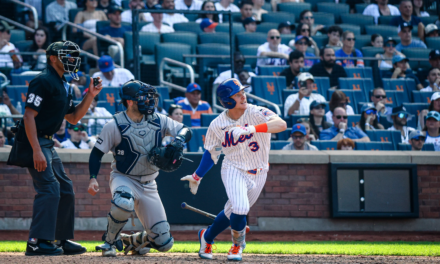

At just under .500 (20-22), the Mets have largely underwhelmed a quarter of the way into the season. A month ago, the offense had been on fire while the pitching—the backbone of this team—had squandered leads on a nightly basis. Still, despite their aces’ struggles, the Mets found themselves at 9-4 on April 12.
If you’d told me, having seen the early domination by the revamped Mets lineup, that the Mets would have a 2.48 ERA two weeks into May and still be under .500, I’d have laughed and chalked it up to some bias. Well, that’s the reality this team finds itself in, even after a couple of decent offensive showings against a historically bad team (Marlins) and a hobbled Nationals roster.
Maybe it was the early-season cold that welcomes Northeast teams every April. Maybe it was bad luck. Maybe, it was just a bit of rust. Whatever the case may be, just about every pitcher the Mets had counted on, including their reigning Cy Young, struggled mightily into late April. Steven Matz, undoubtedly the biggest question mark of the Mets’ “Big 4” starters, ended up carrying the load to just about everyone’s surprise. But, even then, I wasn’t that worried, because I saw a lineup that, once the pitching turned around, looked like it could overwhelm opponents. I didn’t just believe the pitching would turn it around, I expected it.
The stats supported that, too. Jacob deGrom, Noah Syndergaard, and Zack Wheeler consistently ranked in the top 20 in baseball in just about every predictive metric, even throughout their struggles (namely, SIERA and xwOBA). And, to an extent, I was right. Seth Lugo’s pitched 12.1 consecutive scoreless, Robert Gsellman’s been as reliable as reliever’s come (2.88 ERA), Wheeler’s seventh in baseball pitcher’s fWAR, Syndergaard’s ninth in baseball in xwOBA. I could go on and on about how the Mets’ pitching is real. But, what gave me hope through the struggles—what made me believe this team could be a contender—was the offense. And for just as long as they looked incredible, they’ve looked listless.
Of course, you have those saying, “They always start hot, this was predictable!” or “Here we go, it’s 2018 all over again.” As a fan, I get it. It’s frustrating. But, as frustrating as the scuffling offense is, remarks like that are also lazy. This team is not last year’s team.
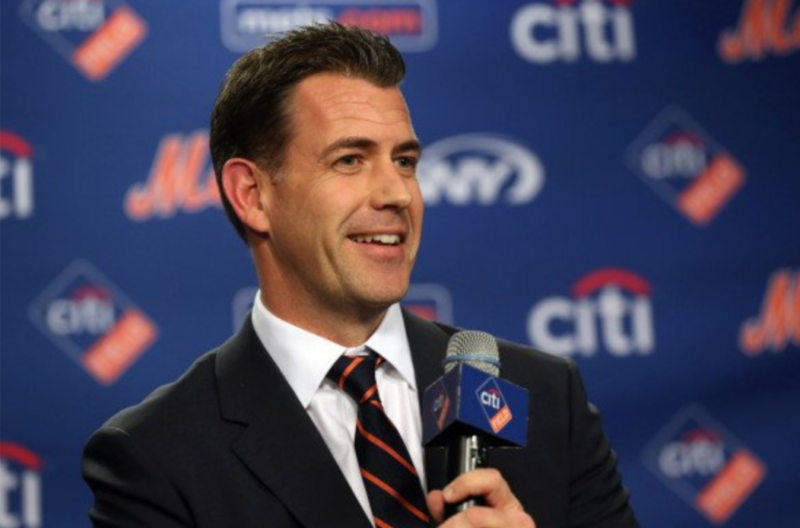

I’ll be honest, I’ve been a big fan of Brodie Van Wagenen’s vision early on in his tenure as GM. Baseball’s such an interesting game for so many reasons, but something that I’ve always loved is how, over a long 162-game season, teams need to balance winning now while also preparing to win in September and October. That’s also a microcosm of a GM’s job, as they have to deal with the juxtaposition of winning now while also preparing to win in the future—the delicate balance of keeping that “window” of contention open is the core of being a great GM. During the offseason, he won fans over with three quotes:
“My goal is that we try to eliminate as many ‘ifs’ as possible.”
“[The team] will take the best 25 players.”
“We will win now; we will win in the future.”
As a fan or a member of the organization, you can’t ask for much better soundbites, and I believe Brodie meant what he said. But, those words mean absolutely nothing unless they’re backed up for the entire season. Putting Alonso on the Opening Day roster was a great start. Since then, we’ve seen the following:
- After batting about .400 off the bench, Dominic Smith was temporarily optioned to Triple-A to make room for Adeiny Hechavarria, a defensive standout but offensive liability
- Keon Broxton, who has one hit since April 14 and has looked underwhelming in the outfield, has remained with the team while Carlos Gomez rakes in Triple-A (coming up now only because of Michael Conforto’s concussion)
- Gio Gonzalez, who has a 1.69 ERA through four starts, was allowed to sign with the Brewers for $2 million, while Jason Vargas and Wilmer Font have a 5.92 and 7.08 ERA, respectively (Reports said that the Mets did not see Gio as an upgrade over Vargas)
- Dallas Keuchel remains unsigned
Granted, those final two bullets concern players not currently on the Mets’ roster, but if the team’s serious about fielding the best 25 they can this season then they need to prove it because they’ve been laughably incompetent at doing so lately.
For starters, Keon Broxton, who struck out Thursday to end the game with the bases loaded and down by one run, needs to be DFA’d. Sure, the front office is probably wary of doing so since they gave up prospects(!) for him and he’s been an unmitigated disaster, but (un)fortunately for them, he’s been so inept this year that he may clear waivers and get optioned to Triple-A.
It goes without saying, I don’t mean to kick a guy when he’s down, but the Mets need a jolt and, for whatever reason, Keon’s been a glaring weakness. Maybe he figures things out at Triple-A or with another team, but the Mets can’t afford to weigh down their 25-man with players “figuring things out.” What makes it even more of a no-brainer is that if they want a capable defender with speed and some pop off the bench, they have someone that fits that exact profile in Triple-A.
Carlos Gomez, yes that Carlos Gomez, is hitting .361 with five home runs over his last 11 games. Keep in mind; he doesn’t have to be great for the move to be worth it. All he needs to do is provide above-average defense and give you professional at-bats, and he becomes a valuable piece off the bench. Anything beyond that is the icing on the cake. Sadly, Broxton hasn’t even come close to providing that, so Gomez doesn’t have to do much to be an upgrade. It shouldn’t have taken a Conforto concussion to bring up Gomez.
Overall, what seemed like one of the deeper benches in the league coming into the season has been a major letdown. Jed Lowrie still doesn’t appear that close to making his debut. Todd Frazier’s been fine in the field and—to his credit—has handled his struggles as a seasoned veteran should, but he’s also been one of the worst hitters in baseball (.164 OBP). Hechavarria has a .182 on-base percentage. Juan Lagares’ number dwarfs that but still isn’t very good at .278. We’ve already gone over Broxton’s struggles. Even starters like Wilson Ramos (62 wRC+), Brandon Nimmo (96wRC+), and Robinson Canó (97 wRC+) haven’t been as expected.
However, even after an embarrassing series loss to the Nationals, I believe there’s light at the end of the tunnel. And, once again, the numbers back it up. Take a look at the top 15 NL position players in fWAR: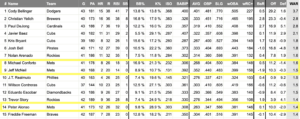
The Mets have threeplayers in the top 15: Michael Conforto (8th, 1.6 WAR), Jeff McNeil (9th, 1.5 WAR), and Pete Alonso (14th, 1.4 WAR). The only other team with three in the top 15 is the Cubs (Javier Baez, Kris Bryant, and Willson Contreras). And, when you consider the Mets’ three ace pitchers, you could argue that no team has as talented pitching and hitting trios as the Mets do. Despite so many disappointments early on, that’s a heck of a core to keep the team treading water when times are tough—like right now.
DeGrom, Syndergaard, and Wheeler will be more than fine; all of their expected metrics say they’ll be aces. The same goes for Díaz, Lugo, and Gsellman. The pitching should be our strength. The pitching needs to be our strength. And I trust it will be. But, how do we get back to that elite offense that posted 6+ runs every game? Better decisions and some positive regression.
As far as better decisions go, we already mentioned one: Gomez needs to come up. Once Conforto’s back, Broxton needs to be DFA’d, because the team can’t afford to carry any dead weight. Along with those transactions, J.D. Davis needs to be the Mets’ third baseman. He’s been elite in two of the metrics most predictive of offensive production, exit velocity (91.4 MPH) and hard-hit rate (50%). His expected batting average, according to Baseball Savant, is .320. Sure, his defense has been weak, but it’s not poor enough to outweigh his offensive potential. With his bat, take the chance that he improves the glove.
I know nobody wants to hear it, but the Mets have suffered from some bad luck: Both the pitching, as mentioned before, and the hitting. Robby Canó, for example, is still Robby Canó. Yeah, he’s striking out much more than usual, but every other metric’s been in line with his career numbers. He’s hitting the ball hard; he’s lifting it; he’ll be fine. We’re not watching the degradation of an older player; we’re watching a slow start to a season. Yes, he needs to get it going if the Mets’ offense is going to reach its potential, but if he gets the contact rate up a little bit—and I believe he will—then in August we’ll all be wondering what we were so worried about in May.
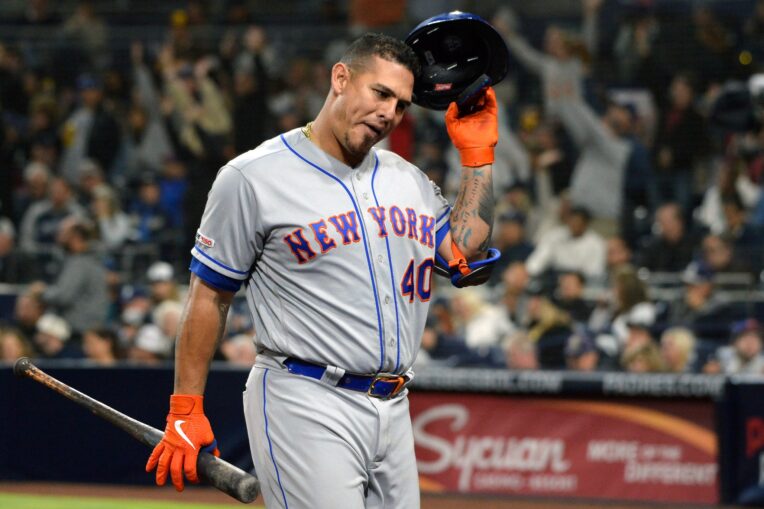
Wilson Ramos, on the other hand, is a more compelling case, if only because it’s not as simple. He’s smashing the ball. The exit velocity (91 MPH) and hard-hit rate (46.3%) support that. The issue with Ramos is he’s smashing it into the ground. Ground balls tend to be bad news in general, but they’re especially useless for one of the slowest players in all of baseball.
Interestingly, he’s always hit lots of ground balls; the MLB average is 45.7%, and his career average is 55.8%. Of course, he’s also been a good hitter for his career, but the difference this season is he’s hitting grounders at a rate that’s absurd even for him, 64.2%. And, with a launch angle of -1.0°, it’s easy to see why. The good news is he’s been hitting all pitch types well, walloping them, and spraying the ball to all fields. If he can lift the ball even a little bit, he’ll be a tremendous offensive advantage—especially at catcher. Until then, Tomas Nido, the far superior defender, needs to be given his chance and split the playing time a little more.
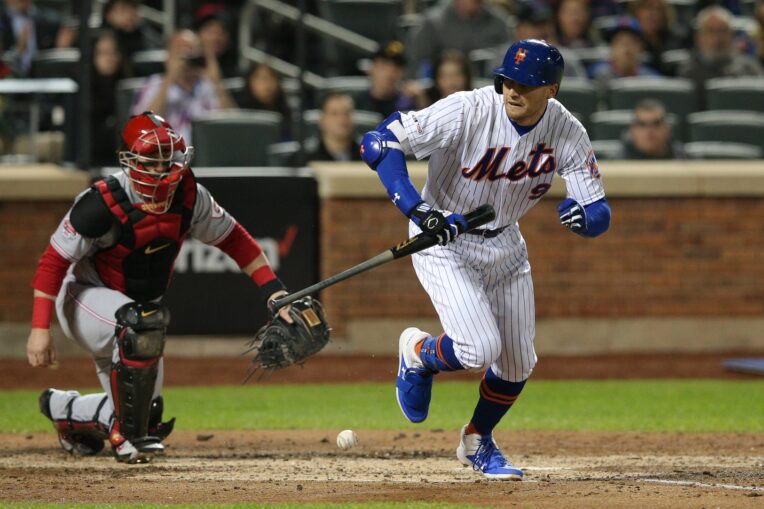
One guy that concerns me is the happiest man in baseball, Brandon Nimmo. Although, I don’t know how happy he’s been lately, considering his struggles across the board. He’s making soft contact (86.1 MPH exit velocity), has a low hard-hit rate (31.5%), and is striking out at an alarming rate (32.2%). To his credit, Nimmo’s taking his walks, which has kept his on-base percentage at a respectable .345, but he hasn’t seen pitches well otherwise.
He’s been downright awful against breaking (.201 expected batting average against) and offspeed pitches (.126 expected batting average against). Most likely, his struggles with those pitch types are the reason behind his inflated whiff rate (35.6% this season vs. 26.9% in his career), but he’s had all-around contact issues all year. Remember, just because the metrics spell doom doesn’t mean hitters can’t correct their problems, but there’s no sugar coating or silver lining for this one. Either Nimmo adjusts and works through this, or things could get worse before they get better.
Listen, the Mets’ offense can be good. Fortunately for them, this team was built on its pitching, so as long as the hitting can be above-average, they should be legitimate contenders. As for Lowrie and Yoenis Céspedes, don’t expect anything, but be mindful that this team is yet to be at its best. One thing is for sure: The Mets cannot let 2019 be 2018. At this time last year, a great start turned to dust, and by July, they were toast. This team is too good for that, too talented for that.
The Mets have ten games against the Marlins, Nationals, and Tigers before beginning a four-game set with the uber-talented Dodgers on Memorial Day. It’s no secret that Memorial Day is typically the litmus test for judging legitimate contenders versus fraudulent pretenders. If they want to be contenders, they need to overcome their struggles and fatten up on these next three series, where their opponents have a combined record of 46-80, before taking on the defending NL champs. To do that, they need their best available in the lineup, they need their best 25, and they need to play to their potential. They have the talent. They need to prove it now.