As baseball fans, especially those more into the esoteric new age stats, we are used to judging players both on their careers and on their individual seasons with letters or numerical grades. It helps us keep things ordered.
If you wanted to use school grades we might say that David Wright has been an A- player in his career but he only gave us a C+ performance in 2014. With better health and the good vibes caused by Matt Harvey’s return and the free agent signing of buddy Michael Cuddyer we are hoping he’ll return to that A- level but we’d be satisfied if he gives us a B+ year.
For simple offensive performance I like to look at OPS (on-base percentage + slugging percentage) and I’m from the school that simplifies it by multiplying the result by 1000. Generally speaking if a player gives you an 800 OPS he has performed very well thank you. But OPS ignores defensive contributions and liabilities. It doesn’t tell you whether the player is a good baserunner and it ignores the differences between home ball parks. Player A who has given you an OPS of 780 playing half his games at CitiField has done a nice job offensively. If he does it playing half his games at Coors Field then he’s more like Omar Quintanilla.
So the most popular all-encompassing stat these days is WAR which tries to put everything together – offense, defense, baserunning. This gives you Wins Above Replacement player. The problem here is mostly quantifying the defensive side and different sites, FanGraphs and Baseball Reference, end up assigning players different WAR ratings for the same season.
All this is to say that it is in our nature to slap some number or grade on a player just to see how he rates in comparison to other players.
This doesn’t work well if we turn our attention to the manager or the GM. Here we look at a variety of skills, and how we weigh them differs greatly from person to person. I won’t discuss Terry Collins much here except to say that most Mets fans rate him as a fair to poor manager overall. Quite a few think he lacks the skill set to get the most out of what talent he is given to manage.
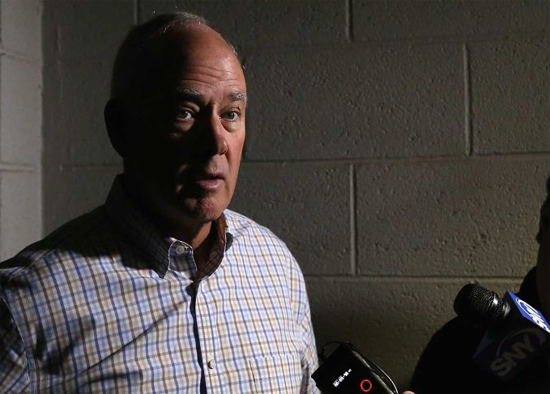
But Sandy Alderson is a fascinating case since clearly there is much to like or dislike depending on your expectations.
One has to admire how much he extracted in trades for Carlos Beltran and R.A. Dickey. We could generalize and say he is very good at trading valuable Major League assets for prospects.
But then you look at this offseason and see almost nothing to like. He needed to address the shortstop position and hasn’t, although I do applaud him for not trading our top prospect Noah Syndergaard for one year of Ian Desmond.
Sandy has been unable to trade Dillon Gee despite obvious interest by a number of clubs at the winter meetings. He has signed the 36-year old, injury-plagued Michael Cuddyer and forfeited the 15th overall pick of this June’s draft to do it, a signing that has been universally panned by the national baseball writers.
We have to give him credit for taking a moribund farm system and making it one of the better ones in baseball. One has to wonder whether that is just his nature or whether he saw it as the only thing he could do when told by the owners to bring the payroll down to the barest bones. One can’t ignore that elephant in the room.
But then he ends up possessing what other teams want – young, inexpensive, players with potential – and instead of cashing in some chips to give the big club what it desperately needs he just sits on them.
I can understand therefore why some people think Alderson has done a poor overall job as Mets GM while others, loving those prospects, think he has performed quite well.
My gut feeling is that if the Mets had hired Billy Beane or Andrew Friedman instead of Alderson AND, very importantly, kept ownership intrusion to a minimum, that the team would be much farther along at this point than it currently is.
I’ll give Sandy a B-. What would you grade him and why?