

Hello, my fellow Mets fans.
This is an article series I’ve been wanting to do for sometime.
I was born in the year 1995, and I started playing tee ball five or so years later in 2000. I remember my team was the Cincinnati Reds and my parents took me to Modell’s to buy red Franklin batting gloves which I didn’t grow into probably for another couple years.
Then, I started to slowly learn the names of professional players and my family’s beloved Mets. Mom and dad would have the games on at night after work, and though I was still grasping the game, I already knew I’d love it.
I slowly moved on to baseball card packs, and in specific I remember a vivid moment sitting in the pizzeria down the street from my house with my grandpa, and him handing me a pack of cards.
I opened it and got a Mike Piazza and I screamed in the restaurant, “It’s Mike Piazza!”
The rest, from there, was history.
Then, several years ago when I joined Mets Merized to write about my love for the game and my favorite team, I was introduced to following the minor leagues.
Growing up, I always knew who the big prospects were, but didn’t put nearly as much emphasis on prospects as I do now.
So this is a series I came up with to go back and revisit old Mets’ drafts.
I figured 2000 would be a good starting point, since it was the beginning of a new century and the first year that I began to like baseball.
Without further adieu, let’s hop in a time machine and go back 18 years ago.
In 2000, the Mets had the No. 16 pick in the draft after a strong 1999 season. They also had a supplemental pick sandwiched between rounds one and two after John Olerud left New York in free agency.
After that, they had picks in rounds 2-51.
The Picks
- William Traber
- Robert Keppel
- Matthew Peterson
- Joshua Reynolds
- Brandon Wilson
- Quenten Patterson
- Christopher Basak
- Jeffrey Duncan
- Chad Bowen
- Nicholas Mattioni
- Travis Veracka
- John Wilson
- Joseph Faulkner
- Collin Perschon
- Luis Robles
- Wayne Ough
- Brett Benik
- Christopher Nunez
- Michael Cox
- Travis Rios
- Chad Elliott
- Scott Shoemaker
- Stephen Nicholas
- Anthony Coyne
- Jonathan Craig
- Skyler Fulton
- Jose Castaneda
- John Raffo
- Justin Wendt
- Christopher Davis
- Timothy Flannigan
- Thomas Hepworth
- Tim Lavigne
- Freddy Jimenez
- Tanner Osberg
- David Byard
- Luz Portobanco
- Nathen Vicari
- Ryan Danly
- Brendan Winn
- Joseph Jiannetti
- Verissimo Pereira
- Gregory Burke
- Cristian Cajigas
- Justin Harris
- Brett Harper
- Jody Roughton
- David Housel
- Daniel Rubino
- Edward Cannon
- Jamar Hill
Don’t recognize a lot of the names in this draft? Yeah, me neither.
This was actually a pretty rough one.
But let’s go through the guys who did end up making it to the majors, or had notable careers elsewhere.
Round 1: Billy Traber, LHP
Traber was shipped off in 2001 to the Cleveland Indians in the deal that brought Roberto Alomar to Queens, so he never even appeared in a game for the blue and orange.
The pitcher debuted with the Tribe in 2003, appearing in 33 games (starting 18 of them). He saw mixed results, and finished the year with a 4.41 FIP and 84 ERA+ across 111.2 innings.
He missed the ’04 campaign after undergoing Tommy John surgery, and upon returning, inked a deal with the Boston Red Sox prior to the ’05 season.
The southpaw was then bounced around on waivers, and ultimately landed up with the newly relocated Washington Nationals who he spent the 2006 and 2007 seasons with.
In ’08 he spent 19 games with the rival New York Yankees and in 2009, pitched one game with the Red Sox before hanging up his cleats.
In five big league seasons, the California native registered a 5.65 ERA, 4.73 FIP, 77 ERA+, 1.591 WHIP and 6.4 K/9 in 96 games (215.0 innings)
Career WAR: -0.7.
Round 2: Bobby Keppel, RHP
After being drafted, Keppel remained in the Mets farm system for six seasons, but never reached the Major League level.
Prior to the 2006 campaign, he inked a minor league deal with the Kansas City Royals, pitching in eight games that year.
In 2007, he pitched four games for the Colorado Rockies, and ended his big league career in 2009 appearing in 37 games for the Minnesota Twins out of their bullpen.
The Missouri Native played four years over seas in Jappan with the Hokkaido Nippon Ham Fighters and attempted a major league comeback, but failed to accomplish the feat.
He finished his career appearing in 49 games (92.1 IP) with a 4.98 FIP, 1.657 WHIP, 85 ERA+ and 5.2 K/9.
Career WAR: 0.2
Round 6: Chris Basak, IF
Chris Basak was selected by the Mets in the sixth round out of University of Illinois Urbana-Champaign, but only had a brief cup of coffee in the majors.
He bounced around through different levels of the minors with the Mets organization until 2006, after which he became a free agent.
The infielder then signed with the Yankees, and finally reached the MLB in 2007.
However, it was short lived as he went just 1-for-5 at the dish over the span of less than two months with the Bombers.
The Nebraska native also spent time in the Minnesota Twins organization, but retired professionally after the 2008 campaign.
Career WAR: 0.0
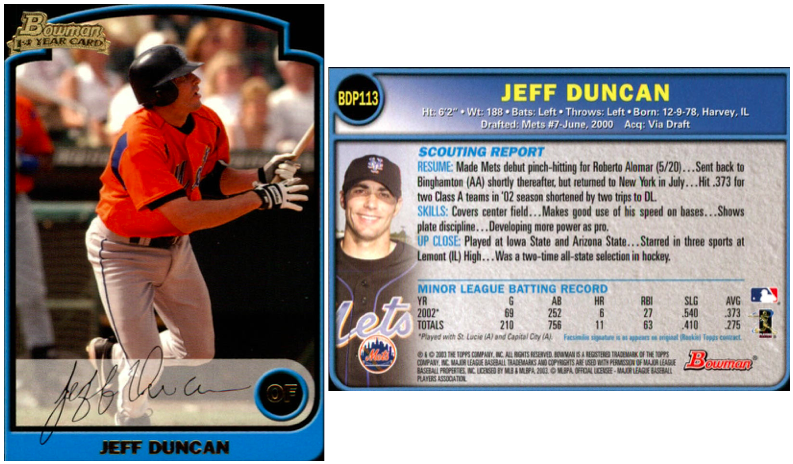
photo courtesy of Home Run Hockey
Round 7: Jeff Duncan, OF
Finally, a player drafted in 2000 who actually debuted with the Mets…even if he wasn’t all that good.
Duncan, a center fielder by trade out of Arizona State University, debuted with the Mets in 2003, and appeared in 56 games for them that year.
However, he hit just .194/.291/.245 with one home run and 10 RBI.
The next season, Duncan appeared in 13 more games for New York, batting .067/.125/.067 in 17 plate appearances, after which he wouldn’t make it back to the show.
The Illinois native spent time in the minors with the San Diego Padres, Los Angeles Dodgers and Toronto Blue Jays before making the switch to indie ball briefly in 2008, soon after, he retired.
He now coaches in college, and as of 2014, was coaching at Kent State.
Career WAR: -0.9
Round 42: Greg Burke, RHP
We had to jump over 30 rounds to find the next player who made it to the big leagues after Jeff Duncan, and it’s a semi-familiar one.
Greg Burke, while drafted by the Mets, actually debuted with the San Diego Padres in ’09, but had a cup of coffee with New York out of the bullpen in 2013.
Burke made 32 appearances that year with the Mets, but registered a 5.68 ERA, 3.93 FIP, 63 ERA+, 1.832 WHIP and 8.0 K/9.
After the ’13 campaign, Burke signed a minor league deal with the Colorado Rockies, but didn’t crack their bullpen out of Spring Training. He then played in the Toronto Blue Jays system in 2015, and the Phillies minor league system in the beginning of 2016 before being released.
Career WAR: -1.3
***
My overall draft grade: F
This draft was just a downright stinker for the Mets. They drafted no one significant, and the guys they did draft that had major league careers were not even the slighest bit successful.
Jeff Duncan was the only man from it to actually break the majors with the Mets. Jeff Duncan.
Next time, we will take a trip back to ’01, and see who was in that draft for New York, and I have a feeling it’ll be much better thanks to a certain captain who dons No. 5 🙂
Until then! LGM!