
On Sunday I did an article highlighting position players on the Mets roster that made a name for themselves over the course of the 2018 season and blossomed into potential building blocks.
Today, my focus will turn to the pitching side of things where I will highlight two members of the starting rotation and one reliever that proved to be quite important over the duration of the season.
Jacob deGrom obviously was phenomenal this season, but to put him on this list seems a little unnecessary given the fact he was largely recognized throughout the game as one of the best pitchers in the league before this season. When and if he wins the Cy Young Award in a few weeks, it will only cement that status further.
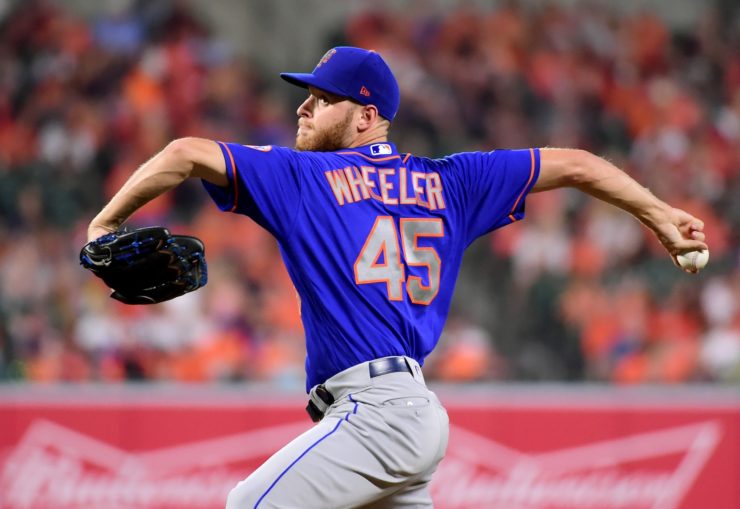
Zack Wheeler
Coming into the season, the Mets decided to go with a starting rotation that included Jacob deGrom, Noah Syndergaard, Steven Matz, Matt Harvey, and Seth Lugo as their starting five. Notably missing from that was Wheeler, who was instead optioned to Triple-A Las Vegas to start the season.
However, Wheeler was called up later in the month of April, as the team liked Lugo using Lugo out of the bullpen which left a void in the rotation to be filled.
Wheeler, 28, would make four starts before the end of the month in which he compiled a 4.09 ERA, 1.32 WHIP, and 21 strikeouts in 22 innings of work.
Things would take a turn for the worst for Wheeler in May, though, as he saw his ERA hit 5.92 and his WHIP reach 1.55 at his worst point of the season.
The right-hander would make up for all of that the rest of the season as work with Dave Eiland started to really pay off for him from there.
By the end of the month of June, Wheeler would see his ERA dip by over a full run as it fell all the way to 4.47. He only improved from there as it fell to under 4.00 on August 4 after he threw seven shutout innings against the Atlanta Braves.
From July 24 through the end of August, Wheeler actually only allowed seven runs in a span of 53 innings (1.32 ERA) while striking out 53 batters.
Wheeler followed that up with a strong month of September that spanned three starts before being shut down in which he went 3-0 with a 2.86 ERA, 0.68 WHIP, and 20 strikeouts in 22 innings.
His second half saw him go 9-1 with a minuscule 1.68 ERA and 0.81 WHIP in 75 innings of work (11 starts). After June 1, Wheeler tossed six innings or more in every start besides three of them.
In total, Wheeler finished with a 12-7 record, 3.31 ERA, 179 strikeouts, and a 1.12 WHIP in 182 1/3 innings pitched (his highest total since 2014) that covered 29 starts.
Wheeler is bound to continue this success as he enters the last year of his contract before hitting free agency for the first time next offseason. Many teams tried to pry the Georgia native from the Mets at the MLB Trade Deadline in July, but were not impressed by the offers. His stock has certainly risen since then.

Steven Matz
The other starting pitcher who stood out in 2018 was Matz, who also had a similar season, albeit with a little more hiccups in between.
Matz, 27, had a horrific month of April that saw him go 1-2 with a 4.98 ERA while not pitching six full innings once and only recording an out in the fifth inning three times.
However, he managed to collect himself in May as he went 1-1 with a 2.25 ERA and 1.25 WHIP to lower his overall ERA to 3.55 and his WHIP to 1.27.
The left-hander followed that up with an even stronger month of June in which he pitched into the sixth inning every time and tossed a quality start in every one besides his start in Colorado on June 21. He would take that success into the break as his ERA fell to 3.31 in his final start against the Washington Nationals.
Matz would not carry that into the latter half of July, though, as he started dealing with forearm tightness which he attempted to pitch through, much to the torture of his statistics which saw his ERA wart to 4.35 before he went on the disabled list.
When he returned, Matz struggled against the Philadelphia Phillies who he allowed six runs (four earned) against in two innings of work which allowed his ERA to rise to its highest point since April, at 4.60.
From there though, Matz got back in his midseason groove as he had a 2.51 ERA for the remainder of the season (eight starts) and had his lowest WHIP of the season in September (1.02). He recorded 53 strikeouts in his final 46 1/3 innings.
In total, Matz finished with a 5-11 record, 3.97 ERA, 1.25 WHIP, and 152 strikeouts in 154 innings (30 starts). While its easy to sit here and say the overall stat line is not too impressive, it was significantly hurt by his decision to pitch through injury in the second half of July. The lefty made significant strides working with Dave Eiland and Mickey Callaway that should not go unnoticed and hopefully will become permanent changes.

Seth Lugo
The last guy on this list is the true embodiment of a super-reliever in Lugo.
Coming into Spring Training, it was expected that Lugo would compete for a starting rotation spot, in which he did and he won as he beat out Zack Wheeler for the fifth spot.
However, a rainout against the Philadelphia Phillies April 2 would allow the team to avoid using a fifth starter until April 11, which prompted the team to start Matt Harvey in place of Lugo on April 3.
Lugo would pitch in that game, but as a reliever. He made such a strong first impression in that game (four strikeouts, no hits, and no walks in two innings of work) that he did not end up making a single start until May 31.
Up until that point, Lugo the 28-year-old had a 2.48 ERA, 1.01 WHIP, and 34 strikeouts in 32 2/3 innings of work (20 appearances). That is seriously impressive given the fact that his last outing saw him give up three runs in only 1 1 1/3 innings. Prior to that, his ERA was a mere 1.72.
As he entered the rotation, so many were questioning whether or not Lugo should be a starter or remain a reliever, given his success out of the bullpen.
Many quickly started to really ponder that thought as he allowed no runs in his first two starts against the Chicago Cubs and the New York Yankees (which was televised on ESPN). Lugo also only allowed five hits and walked nobody while striking out 11 batters in 10 innings between the two starts.
However, his next three starts saw that debate die down as he allowed 14 runs (11 earned) in 13 innings of work to make his ERA rise to 2.91.
After he moved back to the bullpen, he found his groove again for the remainder of the season with only a few rough patches lasting no more than three straight outings blemishing it.
Lugo finished the year with a 3-4 record, three saves, 2.66 ERA, 1.08 WHIP, and 103 strikeouts in 101 1/3 innings pitched.
Mickey Callaway told the press at the end of the season that Lugo will enter next season as a starter, but time and time again he proved that he can theoretically do whatever the Mets need him to as he had 22 relief appearances that required him to pitch multiple innings.
Given the Mets dire need for relief pitching, I would expect the team to decide to keep Lugo in his niche role as a super-reliever when it’s all said and done.