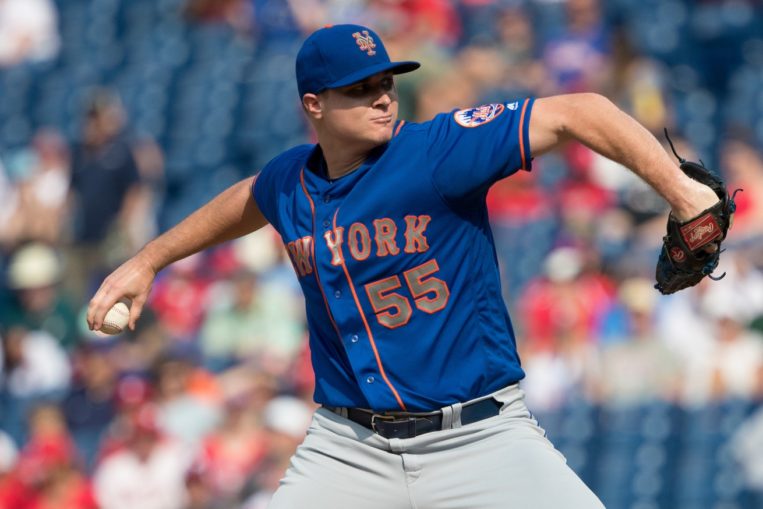
Corey Oswalt has now made eight starts this season. For the first time since his first big-league start on June 29 in Miami, the 2017 Minor League Player of the Year allowed more than three runs. In the team’s 24-4 stomping of the Philadelphia Phillies, Oswalt allowed four home runs (all solo shots) and nine hits in six innings.
Macroscopically speaking, this was not a particularly impressive showing from the righty. But considering he kept his team in the ballgame and turned in a handful of efficient innings, there isn’t much reason to question Oswalt’s capabilities as a back-end starter through (at the very least) the rest of the season.
The day began for Corey with a nine-pitch first, extending his streak of scoreless first innings to eight. While he didn’t strike anyone out (and notched only four altogether), his ability to spot his fastball and force weak popouts and jam-shot grounders nonetheless guided him through a few tight spots.
Oswalt entered the game averaging just 5.9 strikeouts and 1.6 homers per nine innings for a reason, though. Without the spot-on control that he had flashed in prior starts, he struggled mightily to get outs, perhaps coming to a head in a brutal 29-pitch second. The inning began with a home run for Rhys Hoskins and saw just two of the next six hitters receive first-pitch strikes. The first was the opposing pitcher, Ranger Suarez, and the second, Cesar Hernandez, drew a walk on four pitches immediately afterward.
The other four hitters all made solid contact, with Nick Williams‘ opposite-field lineout the only remote reprieve for Oswalt. Maikel Franco homered on a laser to left field before Odubel Herrera and Jorge Alfaro each ripped singles to bring pitching coach Dave Eiland out to the mound for a quick, ultimately useful pep talk.
Having taken a breather, Oswalt made the same path for himself, just as the team’s more successful starters have done through most of the season. He retired Justin Bour with a popout behind the plate on the very first pitch, and promptly returned for a nine-pitch third inning. Even with a hanging curveball landing into the bullpen to tie things up (this one courtesy of Williams), Oswalt showed the same moxie he has through most of his short time in the majors, striking out Hoskins and negotiating his other two outs on just four pitches – all for strikes.
The weak fastball again cost Oswalt in the fourth inning, when Alfaro blasted one into the deepest crevice of Citizens Bank Park to cut the Mets’ lead to one run. Even with the lethargic pitches, however, the rookie kept his team ahead while maintaining his composure and continuing to challenge his opponents, striking out Herrera on a fastball up and in before inducing two weak flyouts to keep his head above the water.
Whether it was a result of a heavy ten-run layover or a genuine change in approach, Oswalt came out for the fifth inning – now ahead 15-4 – and kept the Phillies in the yard with two scoreless innings. Even having allowed three hits and two runners in scoring position (one in each frame), he kept the ball on the ground and, thanks to some weak popouts the following inning, was able to leave on his own accord.
The final line itself may very well hurt just about every stat under Oswalt’s name, and it definitely does little to establish him as a consistent asset for the rotation. However, the responses and adjustments he made to keep his team ahead when he clearly had neither a resonant nor deceptive feel for his fastball dictate his value as a resilient, responsive arm the Mets would be foolish to stash in the high-minors, especially at this point in the season.