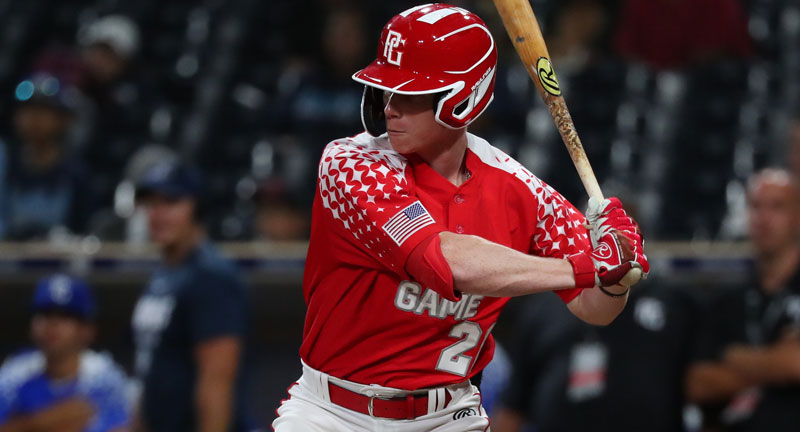
Photo via Perfect Game
MLB Pipeline writer and draft analyst Jim Callis spoke with Metsmerized in a phone interview this week, giving his thoughts on the Mets’ draft class this year.
“Like last year, they went big on their first three picks,” Callis told Metsmerized. “I thought Pete Crow-Armstrong was an interesting value at 19 as his stock has been a little up and down.”
“He was the best high school player entering last summer but didn’t play great and his stock took a hit. However, he was able to build his value back up this year.”
Crow-Armstrong took home the Los Angeles Times Player of the Year award as a junior in 2019 after hitting .395 with 47 hits, three home runs, 23 RBI, and 40 runs scored in 34 games. He started off his senior year batting .514 before his season was cut short due to COVID-19.
“Overall, he might be the best high school outfield defender and is a plus runner with the chance to be a plus hitter. His power is a question mark, but I think he could be a 15-20 home run guy. His floor and ceiling are both very high for a player coming out of high school,” said Callis.
Callis, who appeared on MLB Network’s live broadcast during the draft to give his analysis, also had high praise for the Mets’ next two selections.
“J.T. Ginn was a good pick in the second round. He was a first-round talent who would’ve been taken there if not for having Tommy John surgery in March. I think they’ll develop him as a starter, but he likely won’t be ready until 2023 because of the injury even though he is a college kid,” said Callis.
Ginn was selected 30th overall by the Los Angeles Dodgers back in 2018, but opted to uphold his commitment to Mississippi State. Ginn captured the SEC Freshman of the Year award in 2019, going 8-4 with a 3.36 ERA and striking out 103 batters in 16 starts (80 innings).
Unfortunately, his sophomore season was evidently cancelled due to COVID-19 restrictions. Instead, Ginn underwent Tommy John surgery in March, which saw him slide to #52, where the Mets grabbed him in this year’s draft.
The Mets received a comp pick from the departure of Zack Wheeler, which rewarded them with the 69th overall selection, where they took another high school outfielder from California in Isaiah Greene.
“Greene was another pick I liked. He’s not as polished of a high schooler as Crow-Armstrong but is still a really good player with plus defense in the outfield,” said Callis.
“It was definitely a similar approach to last year, where they took the best player available and then signed some guys at discounts to fit in the bonus pools. This year teams had to find ways to save money with only five rounds.”
So how does the Mets’ farm system shake up after their latest draft? Callis, who has covered the draft and prospects since 1988, believes their top talent is still a little bit of a ways away before they reach the majors.
“Most of their best-ranked players are still a couple years away and there isn’t going to be much development this year if the minor league season is cancelled as we are all expecting. Their best guys will likely be ready by 2022 or 2023 at the earliest,” said Callis.
“Crow-Armstrong will take some time to develop since he is a high schooler. We won’t see Ginn for a while either because of the Tommy John.”
With the minor league season likely being cancelled in 2020, Callis spoke about the impact this will have on young players.
“It’s huge. There are things you can work on without live games, but it’s not the same, especially for pitchers. It hurts everyone because they need live game action.”
“We will probably get some form of work for these players by finding ways to get them live at-bats and innings at their spring training facilities. But if you look at last year’s draft class, it was going to be their first full season in pro ball, which they are going to lose now.”
“For pitchers, they’ll throw 90, 120, and 150 innings in each of their first three years in the minors. Now they won’t get that, and it will slow down their development, which is the byproduct of what COVID has done,” said Callis.
If the minor league season does in fact get cancelled, there has been some discussion about having a “taxi squad” of players available to the major league roster.
“Advanced prospects in Triple-A might wind up getting some big league time. It sounds like we will have expanded rosters with possibly 15-16 pitchers. I believe we will use more pitchers and starters will go shorter in games.”
“You are likely going to have 10 pitchers on that taxi squad as a group of extra players you can use. Teams will have to be much more prepared this year given the circumstances,” said Callis.