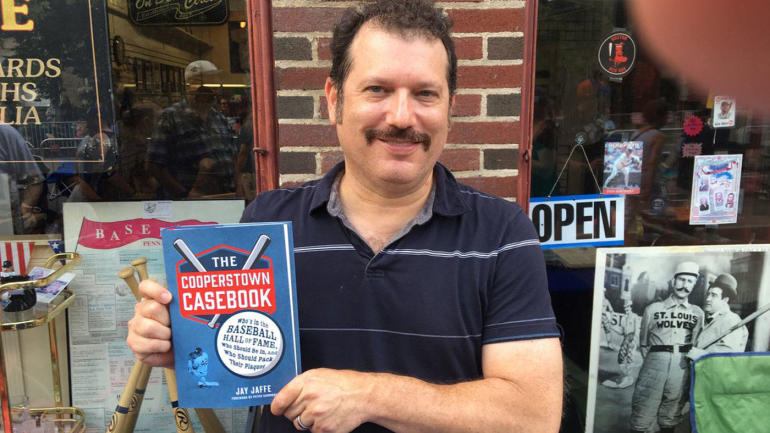
I had the pleasure of speaking with FanGraphs Senior Writer, developer of the JAWS (Jaffe WAR Score) system, and author of The Cooperstown Casebook: Who’s In The Baseball Hall of Fame, Who Should Be In, and Who Should Pack Their Plaques, Jay Jaffe, over the weekend.
With 2019 Hall of Fame voting results set to be announced on January 22, Major League Baseball’s hot stove simmering over (sort of), and baseball fans across America practically chomping at the bit for Spring Training to begin, we certainly had a lot to talk about. Enjoy!
MMO: In your Virtual Hall of Fame Ballot on FanGraphs, you alluded to a “split in the electorate”, referring to Hall of Fame voters choosing whether or not to include performance-enhancing drug users on their ballots. Do you see that gap continuing to expand or the voters eventually softening on the issue?
JJ: I think for the most part it’s extending. I think there are people who realize there’s some nuance to the situation. And I think there are voters who have some fatigue with regards to having to deal with the same thing every year.
We see people voting for Manny Ramirez despite the fact that Manny failed two [PED] tests, they’re just going completely performance-only. We see people who are never going to vote for Barry Bonds or Roger Clemens under any circumstance, let alone anyone who failed a test.
I think most people fall in the middle. I think it’s changing only very slowly, though. I don’t see a wholesale shift happening and I think it’s really an open question as to whether there are going to be enough people who change their minds, or who fall out of the electorate, so Bonds or Clemens can get to that 75 percent before they get to their final year of eligibility in 2022.
MMO: According to early returns, Ramirez appears to be experiencing another dip in support [Note: this is despite currently sitting at 26.2 percent in Ryan Thibodaux’s latest tally of public ballots; historically speaking, these numbers tend to drop once all ballots are counted] after his vote percentage dropped from 23.8 percent in 2017 to 22 percent in 2018.
With career numbers like his (.312/.411/.585, 555 home runs, 1,831 RBI, 2,574 hits, 154 OPS+ rating), do you see him eventually getting over that hump with voters?
JJ: No. I think Manny is screwed. There are multiple places you can draw the line but I think failing two tests is a hard hurdle to overcome.
I look at what happened before testing and suspensions were in place in 2004 as the Wild West era. You’ve got Andro (Androstenedione, which Mark McGwire admitted using in 1998), BALCO, the [2003] survey test; I think those were the three big things that happened before what we’ll call the relatively early stages of PED use as far as the steroid problem as we understand it goes. Though, if we want to talk about PED [usage], we’re really going back to the arrival of amphetamines in the 1960s.
But I think that Manny, and the two tests, that’s just a very hard hurdle to overcome. I don’t see him getting to 75 percent even though, as you said, he was one of the great hitters of all time, and I would say that too. But if I’ve got 15 people that I’d like to vote for, the first guy out is going to be the guy who’s got two failed tests — it just makes things a lot simpler.
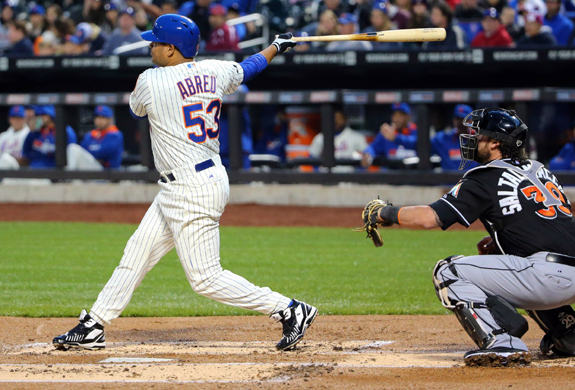
MMO: Jumping away from PEDs, Bobby Abreu is set to hit the ballot in 2020. What are your thoughts on his candidacy?
JJ: Bobby Abreu was a tremendously underrated player. Unfortunately, he did not get a lot of recognition in his day — I think he only made the All-Star team twice. I think that for as good as he was, he was so low-profile that I don’t think he’s really got much of a shot even though his career numbers are pretty good (.291/.395/.475, 128 OPS+ rating over 18 seasons).
You’re talking about a guy who’s got, if I remember correctly, close to 2,500 hits (2,470; good call, Jay), not a tremendous power profile, but a lot of stolen bases to go with the home runs, high on-base guy. Dreadful defense in his Yankees days but I believe he won a Gold Glove earlier in his career (2005, Philadelphia).
There’s not a ton of the types of things that call attention to his career like multiple Gold Gloves, a ton of All-Star appearances, league-leads, things like that. I think he’s going to be a guy that really struggles for attention. Unfortunately, I think he’s probably going to fall off the ballot in relatively short order.
MMO: Just from a fan’s perspective, that’s really a shame. He was a terrific ballplayer, but apparently, his slash line will only get him so far.
JJ: His is not a statistical profile, even in an era where we are appreciating more well-rounded players thanks to things like wins over replacement (WAR), Larry Walker being a good example of a guy who doesn’t have tremendous counting stats but we’re gaining an appreciation for his rate stats.
Abreu just doesn’t have the MVP award, he doesn’t have the batting titles, he doesn’t have a lot of the things that would help his candidacy stand out, and that’s just the reality.
The ballot is still going to be pretty crowded. Not quite as crowded as after we clear three-or-four guys this year, because there’s not a strong incoming class of first-year candidates. I wish I could say otherwise, but I don’t see him making much headway.
MMO: Do you feel like the current voting process (ten years on the ballot, era committees, etc) is here to stay?
JJ: I think that the ten years is here to stay. I think that the change from 15 years to ten seems to have created a little bit more urgency although what I’ve seen when I actually studied it this week is that we’re not seeing big jumps happen more frequently, which was a working hypothesis that I had but I don’t think we have enough evidence to suggest that.
But we have seen voters bring urgency to the cases of some guys whose time of eligibility was cut short in mid-stream; Tim Raines and Edgar Martinez being a couple of prominent ones, and Larry Walker now, as well. We’ll see if Walker gets to a point where he can get in next year. I think that would be fantastic.
I don’t know that any system that the Hall can come up with is perfect. I still think that the five-percent rule might be a bit draconian.
I think that the Hall is reluctant to change things too drastically and now when you look toward the committee votes, the fact they’ve gotten four living ex-players in over the past two years compared to none from 2002 through 2016, I’m sure the Hall likes this better even with the criticism of Harold Baines. You don’t create a committee to expressly keep people out.
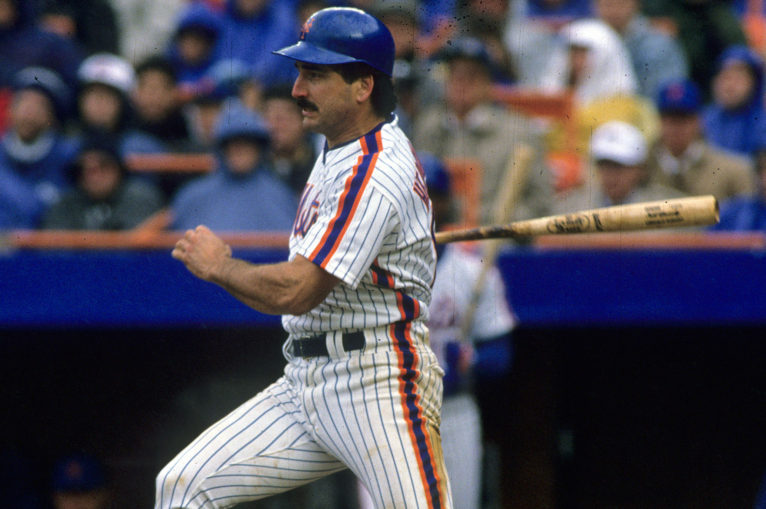
MMO: How about Keith Hernandez?
JJ: You know, Hernandez has some great defensive numbers. He gets a lot of credit for changing the way that first base was played in that era in terms of handling bunts and his ability to make throws.
I think the fact he had a fairly non-traditional offensive profile for a first baseman — fewer than 200 home runs, not quite 2,200 hits — did not help him, plus the fact his career was practically done at 36.
Guys who hang it up in their mid-thirties really tend to struggle because those counting stats are short. He never got a ton of support on the ballots. Actually, he never even got 11 percent and he somehow managed to stay on the ballot for nine years, topping ten percent just a couple of times.
I think if he did get on one of those committee ballots, he would probably do pretty well. But the barriers to getting on have generally been high. We’ve seen Baines do it and get elected after getting a peak of only 6.1 percent when he was on the traditional ballot.
So to that regard, I don’t see why there’s any real obstacle to Hernandez getting elected, but you’re going to have to get him in that room with somebody who’s going to be an advocate for him, and I think there’s a lot of politics that go along with who gets on those ballots in the first place.
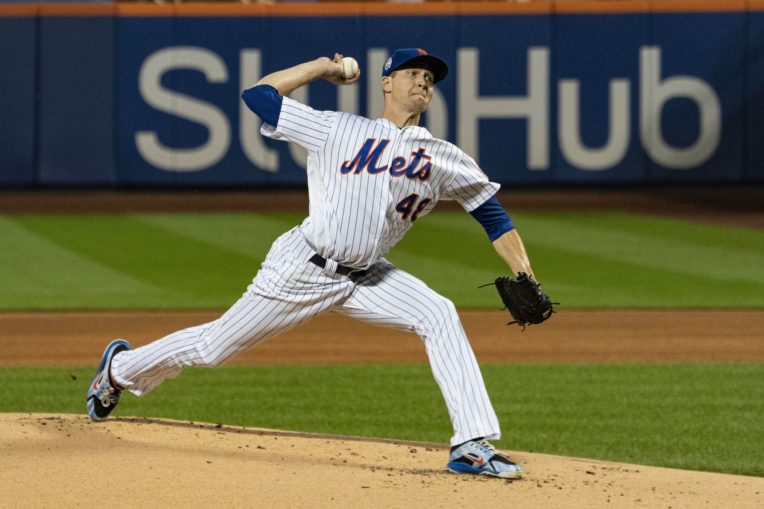
MMO: Major league pitching is as good as it’s arguably ever been and, as a league, the offense is suffering because of it. MLB hitters slashed .248/.318/.409 last season, the lowest league batting average since 1972 (.244).
Do you feel the influx of information available to pitchers through advanced stats and scouting provides them with, I don’t want to say an unfair advantage, but what is Joe Eight-Hitter supposed to do against Jacob deGrom armed with all of that information, as well as his repertoire, when all the hitter has to work off is pitcher tendencies?
JJ: Well, I think the hitters are armed with information too. I mean, you can study a guy’s delivery, look for tells, things like that. I don’t think it’s the information revolution, if you will, that’s giving one side the advantage.
I think where a lot of the advantage is coming from is that you’ve got fewer starters facing batters for the third time in a game when they tend to have less success. And more relievers throwing one-inning stints and able to throw at max-effort.
There’s a big difference between trying to hit 98 MPH and trying to hit 95 MPH and there’s a big difference in terms of facing a guy one time a game and facing him three times in a game. Those are pretty well-established statistical tendencies. I think that’s what’s really producing a good amount of the depression in offensive stats.
Now, there are changes in philosophy that are contributing to that. The reduction of the stigma against strikeouts on the offensive side over the past 15 years or so has contributed to that and we haven’t quite seen a corrective of it yet. And the emphasis on the pitching side of the guys who can miss bats is having an impact, too.
That’s information coming in on a team-building level, more so than just the player level. As far as the players getting information, it’s more of a level field because both sides have the ability to dissect with video and the advanced stats.
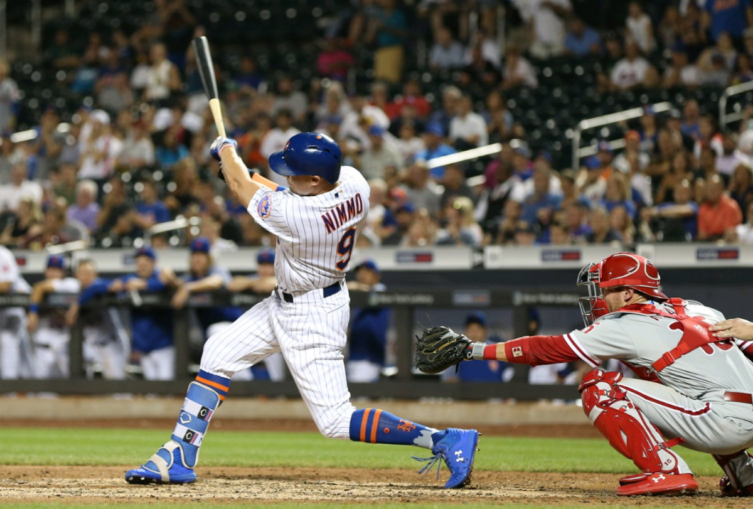
MMO: After being pegged as a probable fourth outfielder heading into his first full major-league season, the New York Mets’ Brandon Nimmo appears to be an advanced stats darling (.385 wOBA, fourth in NL; 149 wRC+, second in NL, 4.5 fWAR, 12th in NL). Do you see him sustaining last year’s level of productivity?
JJ: That’s a good question, actually. He really did show a lot more power than we’ve seen out of him before but this is a guy who’s always been able to get on base. When you look at his age and what he accomplished, there’s still room for him to maintain that or even grow a little.
I think the Mets have got a nice building block in him and for all the things that have gone wrong for their outfield and the way it’s been put together, I think it’s been a happy surprise for him to pan out. We’re talking about a first-round draft pick so it’s not that far-fetched that he would, but it’s nice to see it pay off.
MMO: Any thoughts on the Mets not showing any apparent interest in Bryce Harper or Manny Machado?
JJ: Yeah. They have a prime opportunity in front of them to really re-establish themselves as a financial force and they’re not taking it. We’re going to be able to rip 28 teams for not getting in on a greater extent on Harper and Machado, but I think if you look at the Mets, you can find room to fit either of those guys.
But we can bash the Yankees, we can bash the Dodgers. It’s not just the Mets who are gun-shy here, so I don’t want to single them out for criticism when it’s something we can knock just about any team for not being more aggressive in terms of pursuing a generational ballplayer.
I’d like to sincerely thank Jay Jaffe for taking the time to chat with MMO. Be sure to give Jay a follow on Twitter (@jay_jaffe) and do yourselves a favor and check out his entire 2019 Hall of Fame ballot profile series on FanGraphs.