
It’s funny how baseball works. Your favorite team may be at the lowest of the low, losing seemingly every game, making signings and acquisitions that don’t seem helpful to improve the team. But, it’s those same “good-for-nothing” signings that can turn an entire franchise around when put on the right path.
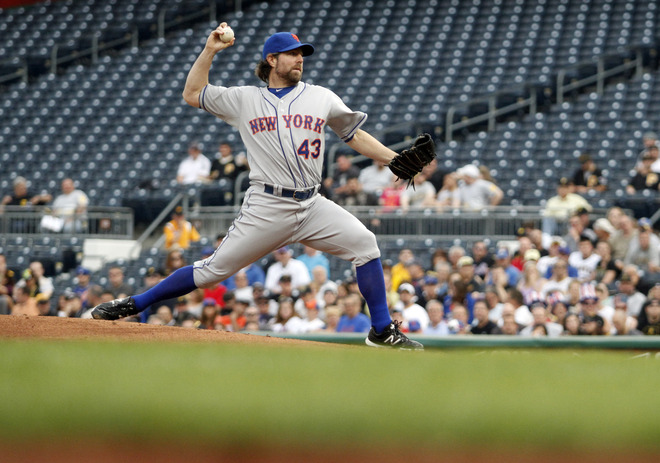
That’s exactly what happened with the New York Mets and right-handed knuckleballer R.A. Dickey.
Dickey was a phenom prospect. He was first drafted out of high school, but chose instead to attend college. Dickey was then selected in the first round of the 1996 draft by the Texas Rangers, inking him as a pitcher of the future in the eyes of the MLB and fans nationwide.
There was just one problem. Dickey was missing arguably the most important thing a pitcher needs; his UCL. Just before offering him a massive signing bonus, a physician discovered that Dickey was missing his ulnar collateral ligament in his throwing arm, something that should be necessary for a person to even open a door, let alone pitch in the major leagues. Dickey’s signing bonus was slashed into a fraction of what it was, and he was written off by many as a bust.
Fast forward 13 years. Dickey made quite the remarkable comeback, having made major league rosters for multiple teams. Still, he had never quite put together anything special. The Mets, on the other hand, were coming off of a horrendous 2009 season. They finished fourth in the NL East with a 70-92 record, and at the time had only one starting pitcher with an ERA under four, that being the injury-ridden Johan Santana.
So, in December of 2009, the Mets took a risk and signed Dickey out of free agency to a minor league contract with an invite to major-league Spring Training. He didn’t end up making the 2010 roster out of camp, and was instead assigned to Triple-A Buffalo.
In May, however, he was brought up and was quite dominant. He made a career-high 26 starts over the course of that season, and posted an ERA of 2.84, good for seventh in the NL.
That’s quite good for a minor league signing.
Dickey had proven that he could be a valuable asset to the team, and signed a two-year contract in the 2010-2011 offseason, cementing him into the team’s starting rotation. Despite an unfortunate 8-13 record in 2011, he did finish with a respectable ERA of 3.28 over 208.2 IP.
2012 was where Dickey really came out of his shell and proved he was much more than the minor league contract the Mets had signed him to initially.
Dickey rocketed out the gates to start the season, and was in dominant form by May. In June, he became only the second pitcher in MLB history to throw two consecutive complete game one-hitters. He was the NL Pitcher of the Month in June, posting a 0.93 ERA over six starts, winning five of them.
In July, Dickey made his first all-star team, and by the end of September, he had won his 20th game of the season. He finished 2012 with a 20-6 record, a 2.73 ERA, and an even more impressive 8.86 K/9 – coming in almost a strikeout and a half higher than it had ever been in his career.
Dickey’s efforts won him the 2012 NL Cy Young award, the first and only knuckleball pitcher to ever do so.
Despite this magical season, the Mets still finished fourth in the division, and change was necessary to rebuild towards a winning team.
Dickey was shipped off to the Toronto Blue Jays with two other players in December of 2012 in exchange for John Buck and some prospects. Two of those prospects were Travis d’Arnaud and Noah Syndergaard, both of which had never touched major league grass at the time of the trade.
As we know, that trade was immensely important in rebuilding the team, as both d’Arnaud and Syndergaard became important pieces to a 2015 team that won the National League Pennant.
It all came from a minor league signing in the dim winter of 2009, from a guy who was missing the most essential part of his arm needed to pitch.