
Irving Cota. Photo by Ed Delany of Metsmerized
The Arizona Fall League begins on Saturday October 3, and the New York Mets have a strong cohort of players attending. Teams will use the Arizona Fall League for a number of reasons. From getting players who spent most of the year on the injured list more work, to getting a look at potential 40-man adds, and even giving players more run to work through late season mechanical changes.
Here are the pitchers the team is sending:
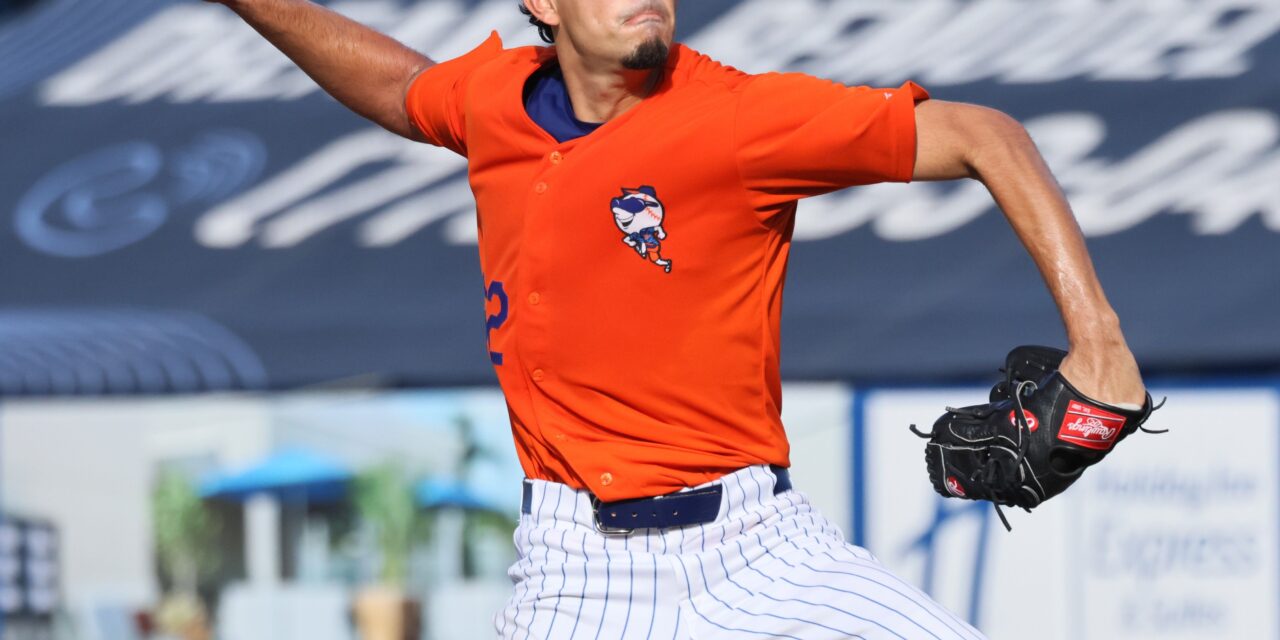
Irving Cota
Irving Cota had a fantastic start to his 2026 season throwing 31 1/3 innings to a 2.30 ERA and 0.99 WHIP. He made it all the way to Double-A but went on the injured list in early June and did not return until September 1. He only pitched two innings in September so the AFL will allow him to increase his season’s workload for him to build upon in 2027.
Cota throws four pitches, with his high-spin curveball arguably being his best pitch. He added 2,000 rpm of spin to the pitch in 2026 and throws it 79 mph. His sinker only comes in at 94 mph but that was roughly a 1.5 mph jump from 2025. He pairs that sinker with an 85 mph changeup that generates 16 inches of arm-side movement.
Worth noting, the above velocities and spin readings come from his rehab appearances at the end of the season. So, it is possible in High-A and Double-A he was throwing even harder. That will be something to monitor in the AFL.
Continuing to add velocity will be key to his future success and development. He does not have wipeout stuff, but he attacks the zone and limits hard contact. He does not walk many batters which should allow him to go deep into games. As a command and control based starter without a huge movement profile, getting those pitch velocities closer to league average could go a long way.
Things To Watch: Pitch velocity and spin rates.
Peyton Prescott
Peyton Prescott was drafted in the fifth round of the 2025 draft with the knowledge he recently had Tommy John surgery. This allowed the Mets to draft him later in the draft than he would have gone fully healthy. He made it into one game at the end of 2026 and flashed that upside. The AFL will give him the opportunity to get more reps in before his full professional season.
In that single outing Prescott ran his fastball up to 96.5 mph from a lower slot with good movement and spin. His cutter came in at 91.4 mph with good glove-side movement while both his slider and curveball looked like they could pair well together as big breaking pitches. His changeup looks like an average pitch but gives him an arm-side tool to work with.
Overall, this was a very impressive first look for a very exciting pitching prospect that could end up being a standout from the 2025 draft.
Things To Watch: Pitch command.
Brendan Girton. Photo by Ed Delany of Metsmerized
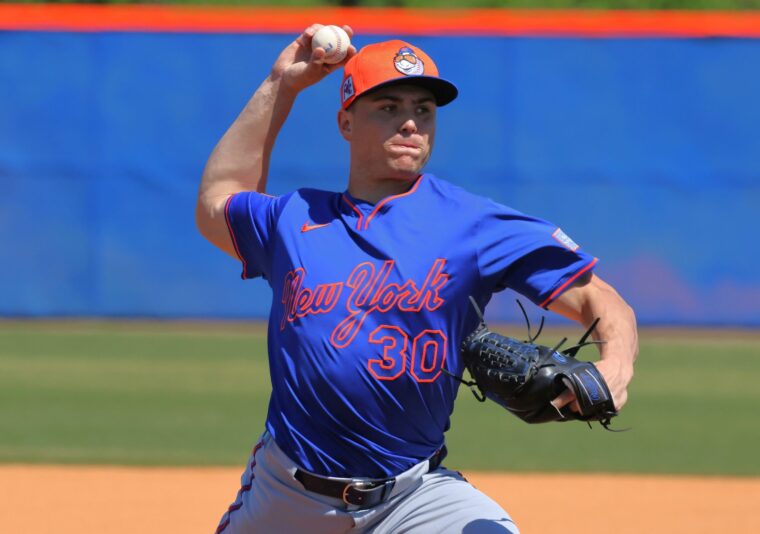
Brendan Girton
Brendan Girton had a bit of an up-and-down season initially struggling as a starter but performing better as the season went on as a reliever. By season’s end he had a 6.72 ERA and 1.66 WHIP, which is tough to look at but there were some positive takeaways from his season.
Girton, as a reliever, had one bad outing at the end of the season where he gave up four runs but the other 13 appearances he pitched to a 2.08 ERA. During this span he attacked the zone at a much higher rate, cut down his walk rate, and generated a high number of ground balls. He focused on pitch to contact utilizing his high spin rates to generate weak contact on the zone.
It will be interesting to see if they keep him as a reliever in the AFL or if they use this time to stretch him back out as a starter and give him another shot in the rotation in 2027.
Things to watch: Role (starter or relief pitcher).
Ryan Lambert
Ryan Lambert showed up to spring training throwing triple digits and bewildering fans and reporters alike with his stories of drinking excessive amounts of raw eggs to increase his velocity. He looked like he could force his way onto the Opening Day roster or at the least be a big contributor across the 2026 season. Unfortunately, things did not go that way.
He struggled with injuries, never hit 100 mph, and pitched to a 7.71 ERA and 1.91 WHIP across 25 2/3 Triple-A innings. He is not Rule 5 eligible until after the 2027 season so the Mets still have time to right the ship. Lambert pitching in the AFL could be a way to clean up his mechanics and get some more work in with the hopes he can contribute in 2027. Velocity was a big need for the Mets bullpen in 2026 and likely will be again in 2027.
Lambert is known for his fastball because of the velocity, but his best pitch may actually be his slider. It is a tight, high-spin slider that comes in around 2,600 rpm and he can ramp it up to the high 80 mph range. It profiles very similarly to Shohei Ohtani’s slider and in Triple-A that pitch generated a 47.2% whiff rate. His fastball is also a high whiff pitch with a plus-movement profile but he needs to keep that velocity consistent.
Lambert’s biggest issue is controlling his pitches. There are effectively wild pitchers like Edwin Díaz and then there are ones that are just wild. Unfortunately, Lambert falls into the second category. These control issues led to an extreme 22.4% walk rate in 2026. He will need to drastically improve that to have a real shot at making the majors in 2027.
Things to watch: Velocity and control.
Calvin Ziegler
Calvin Ziegler was drafted in the second round of the 2021 draft but since then injuries have limited him to only 53 2/3 innings. Specifically, 46 2/3 of them came in 2022. Ziegler pitched 13 1/3 innings in 2026 and while the results were not good at a 7.43 ERA and 2.70 WHIP, he flashed plus-stuff and it was just good to see him on the mound.
He also ended in Double-A. It could have been just to get more innings but it will be interesting to see what level he starts his 2027 season at. He will now have time in the AFL to increase that inning count heading into 2027.
Ziegler amazingly did not look like his stuff lost anything from his injuries. He was still throwing close to 96 mph, his curveball flashed plus spin rates, he paired his sinker and changeup well, and his tight slider looked like it could mix well with the curve. His control was nonexistent with a 31.2% walk rate in the minors in 2026, but that is to be expected after going so long without throwing in a professional game.
It will be interesting to see in the AFL how deep they let him go into games. In 2026 he did not throw more than 1 1/3 innings in any outing despite largely being used on a starter’s schedule.
Things to watch: Pitch count and control.