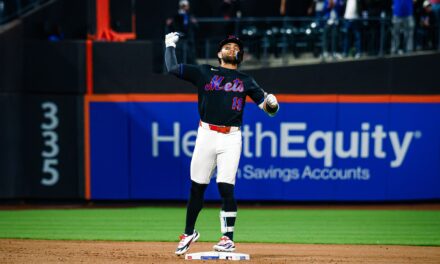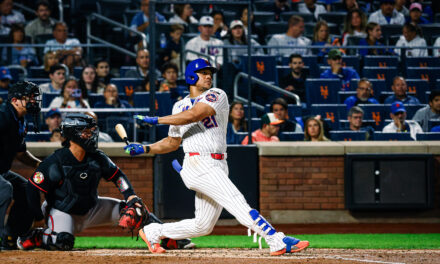

It’s impossible to jump to any conclusions based off 204 MLB plate appearances, but Jeff McNeil is doing his best to show us he’s pretty good at this baseball thing.
Just how good has he been since debuting for the New York Mets on July 24th? This will help put it in perspective: the 2.2 fWAR McNeil has accumulated is among the most in baseball during the second half, outpacing well-known players like Matt Carpenter (2.1 fWAR), Manny Machado (1.9), Javier Baez (1.9), Jose Ramirez (2.0), and Juan Soto (1.9).
Although he’s made some sparkling defensive plays, what stands out most about what McNeil has done over his first 54 big-league games revolves around his offense. After all, it’s hard to ignore a .335/.391/.486 triple slash that includes three home runs, 18 RBI, 30 runs scored, and a 143 wRC+. What stands out even more — and especially among the vast majority of his teammates — is that he hates striking out. If he qualified for the batting title, his 8.8% strikeout rate would be the league’s second-lowest mark.
McNeil has shown quite an ability to put his knob-less bat on the ball at a high frequency, but it’s also fascinating to see how his plate-discipline statistics match up (or, really, don’t match up) with his swing-and-miss numbers. Here’s a look at how his chase rate (O-Swing%), swing rate on strikes (Z-Swing%), overall swing rate (Swing%), and swinging-strike rate (SwStr%) stack up against the league’s average numbers so far in 2018.
| 2018 | O-Swing% | Z-Swing% | Swing% | SwStr% |
|---|---|---|---|---|
| Jeff McNeil | 35.4% | 83.9% | 55.9% | 8.0% |
| MLB Average | 30.9% | 67.3% | 46.5% | 10.7% |
He’s chasing balls out of the strike zone a little more than a hitting coach would like, which also helps explain a lower walk rate (5.9%) and higher soft-hit rate (22.5%). However, the outlier here is his swing rate on balls in the strike zone. Not only is it abnormally high compared to the MLB average, but it’d also be among the best in baseball if he had done it all year long.
Only Freddie Freeman‘s 84.8% rate in this situation would be better than McNeil. And if we’re looking at the top-20 hitters with regard to swing rate on strikes, nobody has a lower swinging-strike rate than New York’s current second baseman. In fact, only Didi Gregorius (9.3%), Yangervis Solarte (8.5%), and Miguel Andujar (9.7%) are below 10.0%.
The typical response to someone with a low walk rate and a high swing rate is that they better find a way to get on base by putting the ball in play — which is exactly what McNeil has done. Check out his contact rate on balls outside the strike zone (O-Contact%), contact rate inside the strike zone (Z-Contact%), and hard-hit rate, compared to the league average in 2018.
| 2018 | O-Contact% | Z-Contact% | Hard% |
|---|---|---|---|
| Jeff McNeil | 76.6% | 91.0% | 31.4% |
| MLB Average | 62.9% | 85.6% | 35.4% |
Again, if he had enough at-bats to qualify for the batting title, both of these contact rates would be among baseball’s 40 best hitters, along with a hard-hit rate that’s at least within an earshot of being league average.
Does he swing more than the average bear? Absolutely, but when a hitter is aggressive at the plate like this, it’s important to do it in the right situations. While his chase rate is a little high, his swing rate on balls in the strike zone — the ones he can likely do more damage with — is so much higher that it probably makes up for it in the end.
Will Jeff McNeil end up being the immediate answer for the Mets at second base? Can he keep channeling shades of Daniel Murphy, the player he’s seemingly being compared to more often than not? Regardless of what happens, he at least has a plate approach that’s situationally aggressive and fits well with his biggest strength — putting the ball in play.