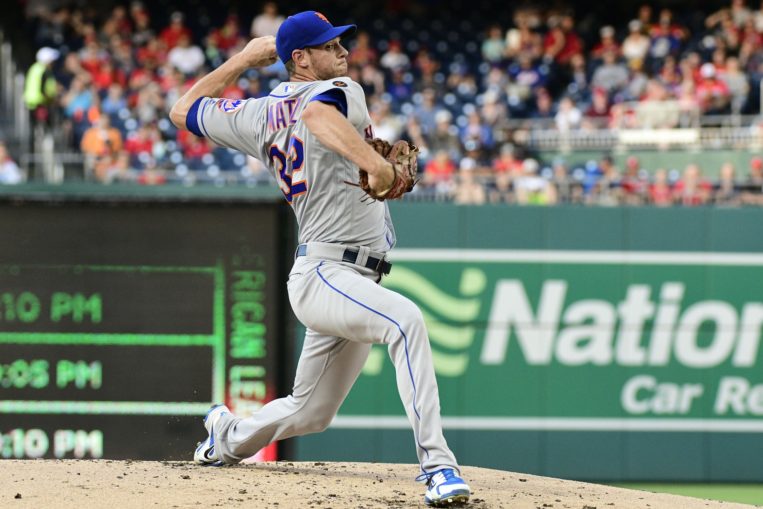
Even in a more successful 2018 campaign, the first inning has frequently given Steven Matz fits, as he owns a 5.40 ERA with a .911 opponent OPS. However, his struggles in last night’s 25-4 loss to the Washington Nationals took on a life of their own.
In a performance eerily reminiscent of his struggles picking up his feel and establishing control of the strike zone from 2017, Matz retired just two batters on 32 pitches. He threw 22 pitches for strikes, but notched just one swing-and-miss in an effort that ultimately brought in seven runs (all earned) on eight hits.
While his two strikeouts against one walk would suggest some degree of hard luck, nearly every hit off Matz was not only loud, but also a result of a missed spot. He left fastballs over the middle third of the plate against Bryce Harper and Ryan Zimmerman, who (as seasoned hitters are very capable of doing) laced hits into right field to plate Washington’s first two runs.
After singles from both Juan Soto and Daniel Murphy as well as a Matt Wieters intentional walk that loaded the bases, Matz left a fastball down the pipe to opposing pitcher Tanner Roark. Roark proceeded to double in three runs and turn Washington’s energetic rally into a flat-out carnage line that never stopped moving.
Manager Mickey Callaway thereby decided he’d seen enough, and called for Jacob Rhame to try digging the Mets as far out of the hole as possible, at least in terms of keeping pitchers rested early in the series.
“Everything was middle,” Callaway admitted after the game. “Everything was leaking back over the middle of the plate. It was up and they did some damage.”
Matz’s response was a little less convincing in terms of picking up the pieces and moving forward – something he’s otherwise made remarkable strides in this year:
“I am going through a thing and trying to work through it… this stuff comes up throughout the season and I just have to find a way to find a way to get through it and I wasn’t able to do that today,” he said. Matz didn’t clarify what he meant by “stuff,” however, perhaps a hint at a dead arm or potentially worse:
“It’s just stuff you go through during the season. Good pitchers find a way to get through it and that is just what I am trying to figure out right now.”
It was revealed later by Mike Puma of the New York Post that Matz has been dealing with “dead arm” his last few starts which might have caused him to struggle. He notes that this injury is not uncommon for young pitchers. The left-hander will see a doctor today to see if this is more serious than Callaway thinks it is.
Rhame wasn’t much of a remedy in this one, however. In fact, his six runs allowed on seven hits across two innings is also concerning. Once handed a bullpen role at the beginning of the year and even trusted to close out games a few weeks later, Rhame currently owns an 8.00 ERA and 1.67 WHIP in 18 appearances. Two Murphy home runs (one in the second inning and one in the third) accounted for four of the runs Rhame surrendered, though the righty’s average of 3.0 HR/9 suggests a much broader issue at hand than just a pair of dingers.
Now down 13-0, the Mets summoned Tim Peterson to cool things off. Peterson lasted just an inning and a third, allowing three runs on two hits, with a two-run homer from Zimmerman the final blow in a month that has all but eaten away at Peterson’s once intriguing credibility. Now crumbling beneath a 6.53 ERA, the 27-year old will look to turn the page on a month that saw 13 runs score on 17 hits and 5 home runs in just 9.1 innings.
Fortunately for both them and us, Rhame (46 pitches) and Peterson (29 pitches) will likely get a few days to recover and rebound, and with a season as far gone as this one, shouldn’t really necessitate demotions unless they continue on such a grating path as that of tonight.
Matz’s slip-ups early on buried the Mets before essentially anything could get going. It only made sense that the pileup would ensue and culminate with Jose Reyes pitching an inning of relief.