When the New York Mets were dealt the unexpected blow that was Noah Syndergaard‘s torn ulnar collateral ligament diagnosis in late March, the knee-jerk reaction was a heavy disappointment with a hint of anxiety.
The Mets’ starting rotation was set to be a strength of this ballclub in 2020 and the one they call Thor was supposed to be an integral part of that group. That’s an enormous — figuratively and literally — hole to fill.
After putting together a 2.93 ERA over his first four MLB seasons (573 strikeouts, 116 walks, 2.91 FIP, 14.4 fWAR in 86 starts), Syndergaard struggled in 2019.
Despite his 4.4 wins above replacement last season — 17th in MLB, per FanGraphs — the big righty put up career-worsts in ERA (4.28), FIP (3.60), and walks per nine innings (2.28).
When Spring Training was suspended on March 13 due to the COVID-19 global health crisis, the 27-year-old Texas product had struck out 11 over eight innings of work, walking none. Syndergaard clearly had his sights set on a reclamation season, as well.
Two-time reigning National League Cy Young Award winner Jacob deGrom, Syndergaard, right-hander Marcus Stroman, left-hander Steven Matz, and a combination of newly-signed right-handers Rick Porcello and Michael Wacha were supposed to lead the way, handing off comfortable leads to New York’s reinforced bullpen.
Sans Syndergaard, everyone moves up a spot and the potential competition for the fifth and final spot in the rotation between Porcello and Wacha becomes moot. While that may appear to be a damaging change of plans, the Mets might not suffer as much as we all fear they could.
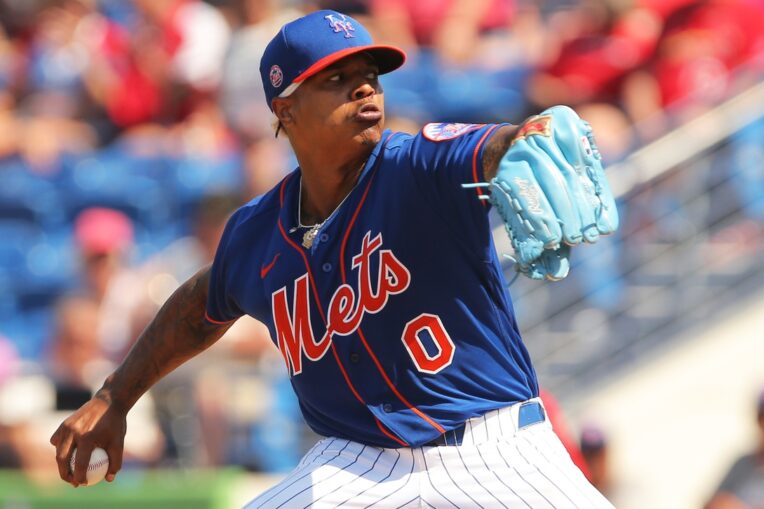
Prior to being acquired by the Mets last summer, Marcus Stroman had long since proven himself as a frontline major league starter. When healthy, the Medford, Long Island native shone, keeping hitters off-balance and always thinking in the box — not an ideal mindset at the plate.
From the start of 2017 through his trade to Flushing, Stroman pitched to a 4.12 ERA, but that doesn’t tell the whole story. His 2017 season was outstanding, compiling a 3.09 ERA with 164 strikeouts, 62 walks, and a 145 ERA+ rating.
Hampered by shoulder and blister issues in 2018, Stroman’s performance suffered as well, as evidenced by his career-high 5.54 ERA and career-low 77 ERA+ over just 19 starts that year.
By 2019, now healthy, Stroman experienced a strong resurgence, pitching to 12th-best-in-MLB 2.96 ERA over his first 21 starts of the season with Toronto.
After coming to New York, it took a bit for Stro to get reaccustomed to his local surroundings (4.91 ERA, .301/374/.524 slash line against over his first five starts with the Mets; 25.2 innings). But once he found his groove, the ace-level hurler and all-world competitor returned, as well.
Over his final six starts of the year, Stroman excelled. In 34 innings pitched, the 28-year-old racked up 35 strikeouts, 11 walks, a .258/.317/.371 line against, and a glowing 2.91 ERA to close out the year strong.
With his well-documented, rigorous offseason training program having been unexpectedly extended in recent weeks and the news that the responsibility he’ll be asked to shoulder this will be considerably increased, there’s no doubt Stroman will embrace this new challenge with open arms.
The energy he brought to this team as a middle-of-the-rotation guy was crystal clear. Now, as a team cornerstone — and with free agency looming after the 2020 season — one can only assume that Stro will be turned up to 11 once the season kicks off.
That should bode well for this roster and, hopefully, will ease the blow of losing such an important cog in Syndergaard.