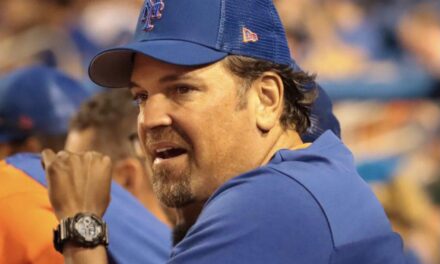
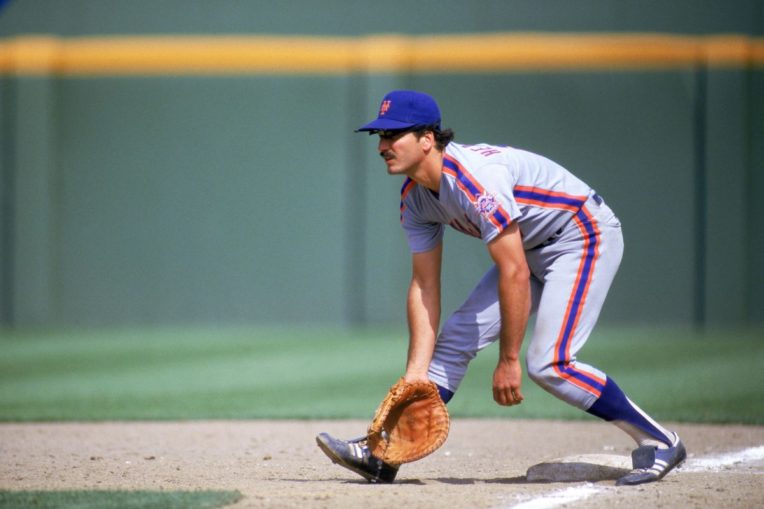
To commemorate the announcement of Keith Hernandez‘s number retirement this July, here’s a revised excerpt from my book “The New York Mets All-Time All-Stars,” released in February 2020, and how a June 1983 trade from St. Louis became a deal to remember in franchise history.
He knew what everyone else did in 1983: Shea Stadium was a major-league abyss. When Hernandez got word he’d be leaving the reigning champion St. Louis Cardinals for a moribund franchise mired in the cellar, the drastic change caused Hernandez to evaluate his future.
“The Mets deserved and received no respect,” said Hernandez, winner of a batting title and NL co-MVP in 1979. “And here I was, coming over from the world champions to a team with four last-place finishes in six years, and the other two next-to-last. Banished. Shipped to the Siberia of baseball.”
In Frank Cashen’s efforts to restore respectability, the GM had cultivated promising prospects that had reached—or were approaching—the big-league level. But no amount of veteran leadership would come from the farm system. At the 1983 trade deadline—ironically, six years to the evening from when the franchise broke with relevancy by shipping away Tom Seaver—Cashen pulled a coup that put the Mets rebuild on the accelerator.
Like a present from a heaven-sent carrier pigeon, the Cardinals first baseman was plopped in New York’s lap—and all the Mets had to give up was a declining relief pitcher and another arm which would make seven more big-league starts and win once. In short, this was grand larceny.
The Mets were elated to be getting a player of Hernandez’s caliber. Unfortunately, the feeling wasn’t initially mutual.
As Keith headed into free agency later that year, staying in New York was far from a certainty. He batted .306 over 95 games, maintained his streak of NL Gold Glove Awards, and quickly cemented himself as a team leader. But another last-place finish did little to allay Hernandez’s skepticism.
Cashen’s persuasion strategy centered on the promise in the minors, while Rusty Staub chimed in and spoke from experience about the benefits of playing and living in the Big Apple.
Keith was sold. The greatest trade in Mets history was about to reap its benefits.
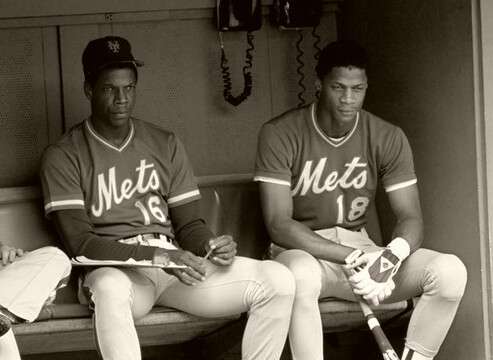
“Whitey thought he was going to bury my ass in New York when he traded me here,” Hernandez said. “He had no idea what the minor-league system was like. He thought he was going to stick me here to suffer for two years. Didn’t happen. There was such a wealth of talent.”
That talent needed guidance to grow into its potential and Keith was the perfect pilot. He possessed a sheer force of personality and keen awareness of his surroundings that established confidence in his teammates, often conferencing with pitchers on the mound or lending advice to hitters in the dugout. From this confidence eventually came respect from opponents and a winning attitude that hadn’t been felt in Queens for almost a decade.
During his first five full seasons, Hernandez participated in more victories and gained more MVP support than any other player in the National League. Said former Mets broadcaster Tim McCarver: “I’ve never seen a man ‘in the game’ as much as Keith Hernandez.”
He was a meticulous hitter who dissected at-bats the way he pored over a New York Times crossword puzzle in the clubhouse. His diligence didn’t go without reward. Keith finished with a batting average of .300 or better three times, had the highest batting average among Mets hitters with at least 3,000 at-bats, and drove in at least 83 runs each year from 1984 to 1987.
But what distinguished him as the most unique of first basemen was the way he expanded the capabilities of a position rarely noted for exemplary defense. Keith charged toward the plate on potential bunts, which directly affected the way opposing teams sacrificed. He displayed range rarely seen before and turned infielder’s bad throws into outs. Hernandez won the Gold Glove in each of his first six seasons in New York, extending his streak to a record 11.
His intangibles could also be measured—specifically in how the Mets improved in 1984. The swift organizational attitude adjustment Keith fostered took effect that year. As runner-up for NL MVP, he batted .311, smacked 15 homers, 31 doubles, and drove in 94, often using his cerebral knowledge of the strike zone to generate a key hit at will. The Mets kept pace with the division-winning Cubs into September. Ultimately, they ended with 90 victories—22 more than in 1983.
Before Hernandez, the Mets thought they could win. Now, they knew they would.
Keith couldn’t do it alone, though. His guidance wouldn’t mean much if more talented pieces weren’t in place. Enter Gary Carter, similar in leadership quality, yet vastly different in outward emotion. With the two veterans at the forefront, New York improved to 98 wins and was entrenched in an even tighter pennant race in 1985. But it was by no means a joyride for Hernandez.
While he posted stats comparable to 1984—leading the team in runs, walks, hits, doubles, and batting average—and became one of a handful of Mets to hit for the cycle, doing so in a zany 19-inning contest that began on the night of Independence Day, the comfort Keith felt on the field was negated by personal troubles.
Mere days after returning to action following testimony in the Pittsburgh Drug Trials, where he admitted to his cocaine use, Hernandez delivered a ninth-inning single to beat the Cardinals on September 12 and briefly put the Mets in sole possession of first place—a lead they wouldn’t hold, but would serve as motivation for what was to come in 1986.
Following retirement in 1990, Hernandez parlayed his intuitive baseball knowledge and general acerbic wit into a successful broadcasting career that has only enhanced his popularity—if his legendary Seinfeld cameo didn’t do it already. Keith Hernandez is an entertainment icon, but more importantly a Mets legend. No. 17 will be forever and hopefully the Hall of Fame isn’t too far behind.