

You can never have too much pitching. Unless you are the Mets apparently. With a growing crop of young arms, the Mets enter the 2015 season with a good problem to have. They have more starters than rotation spots, a log-jam that will only get more crowded as the season progresses and the likes of Noah Syndergaard and Steven Matz prove major league ready.
Therefore, Dillon Gee has been the topic of trade rumors throughout the offseason. After settling before arbitration on a $5.3 million price tag, Sandy Alderson will look to deal the right-handed starter, opening up his roster spot for a less costly arm.
Finances aside, which you can never say with the Mets, but for the sake of argument, if we forget the relatively low $5.3 million price tag for Gee, are the Mets missing an opportunity by chalking him up as excess rotation bait?
Could Dillon Gee be an effective long-reliever and spot-starter?
A key point to remember with the Mets maturing rotation is that they have a lot of young arms to protect. We already know that Matt Harvey is on an innings limit. The Mets will monitor Jacob deGrom‘s innings as well. And when Syndergaard and/or Matz arrive, they will most definitely be on tight inning counts. Having a veteran arm, who can provide long-relief in high pitch count games or space out starts, by pitching in a doubleheader or on a week without an off day, becomes practical. Dillon Gee can be that pitcher.
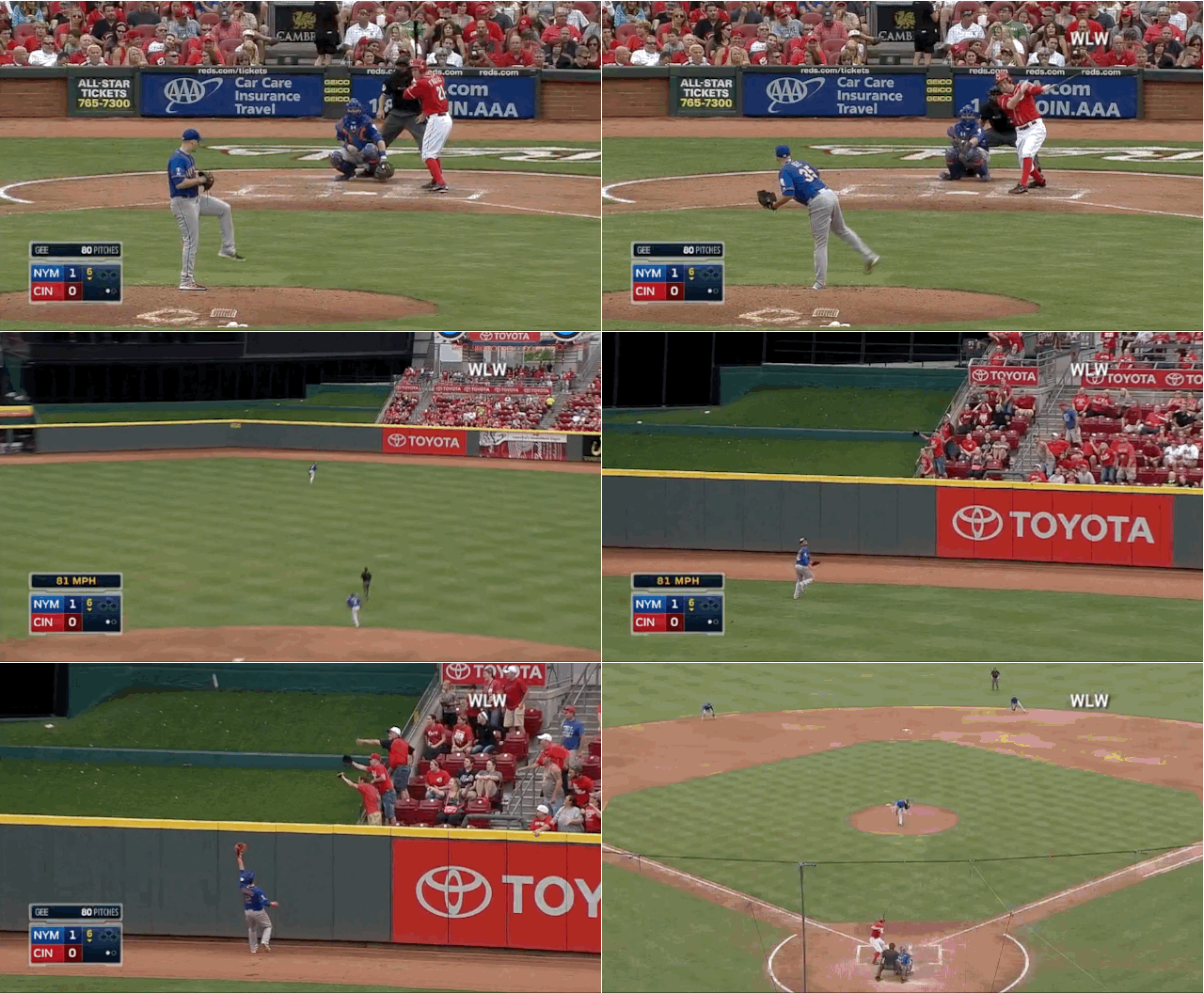
Ask any Mets fan about Dillon Gee, and the first thing they will summon from the annals of their memory will be a game when he was cruising along, everything going good, until BOOM, the 7th inning hits, and he loses it. Gee would be a pretty good starting pitcher if he only had to pitch a few times through the order.
Click to enlarge
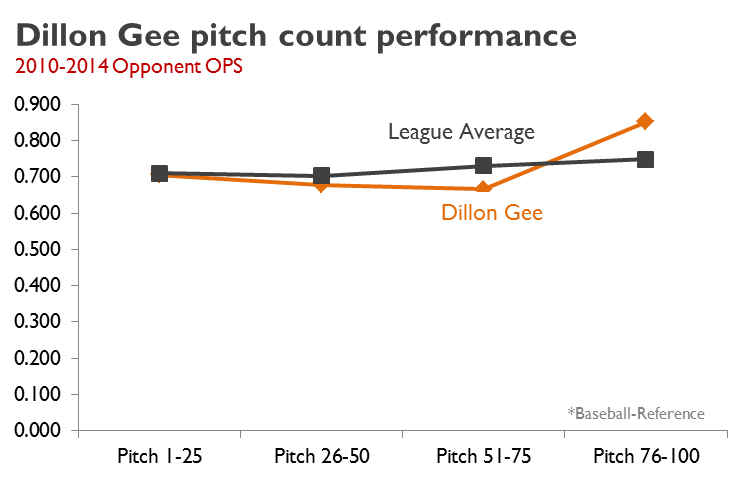
Through the first 75 pitches of a game, Gee is a better than average major league pitcher. Once he tosses pitch #76, everything seems to go haywire.
Now, this is not something that only afflicts Dillon Gee. All pitchers face what is termed a time through the order penalty. The more times that a pitcher faces a hitter in a given game, the greater the advantage to the hitter. This explains the league average uptick on the graph above. For Dillon Gee, his uptick is a major swing.
So what is the problem with Gee late in games?
Click to enlarge
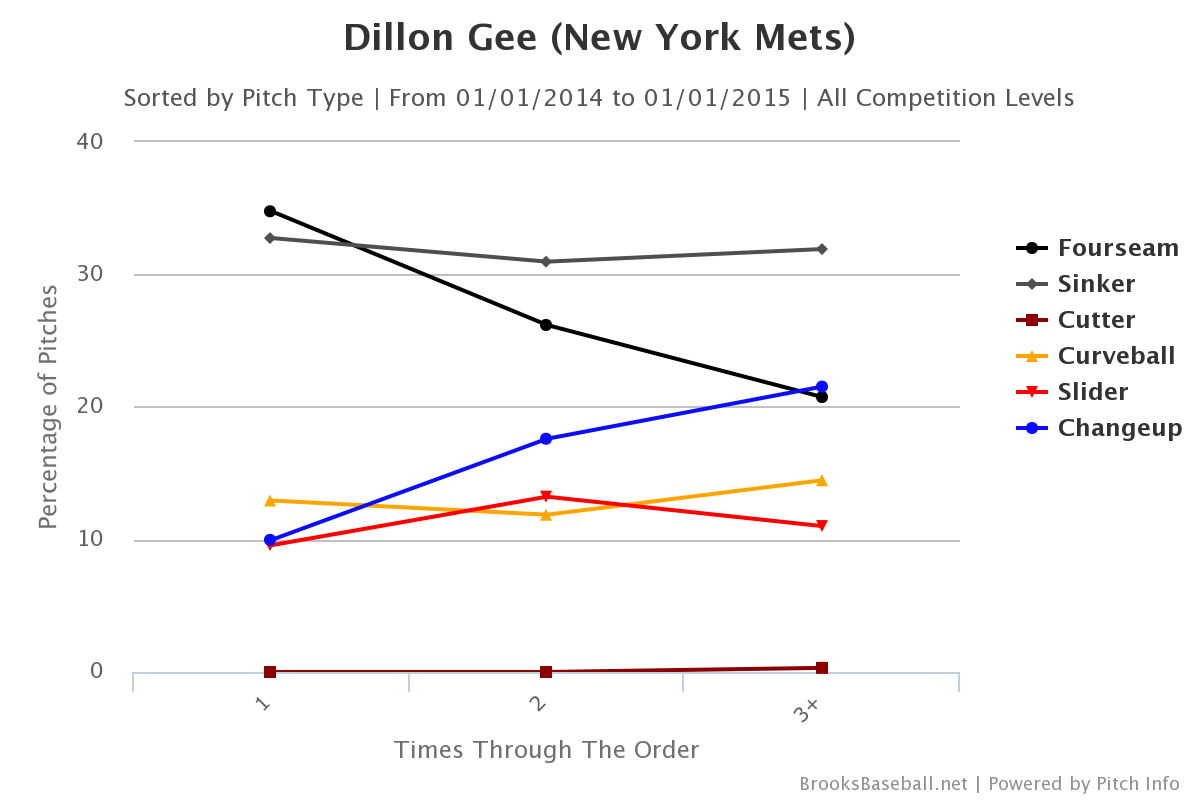
As the game progresses, Gee mixes up his repertoire of pitches by throwing less four-seam fastballs and more change-ups. And he does that for a reason.
Click to enlarge
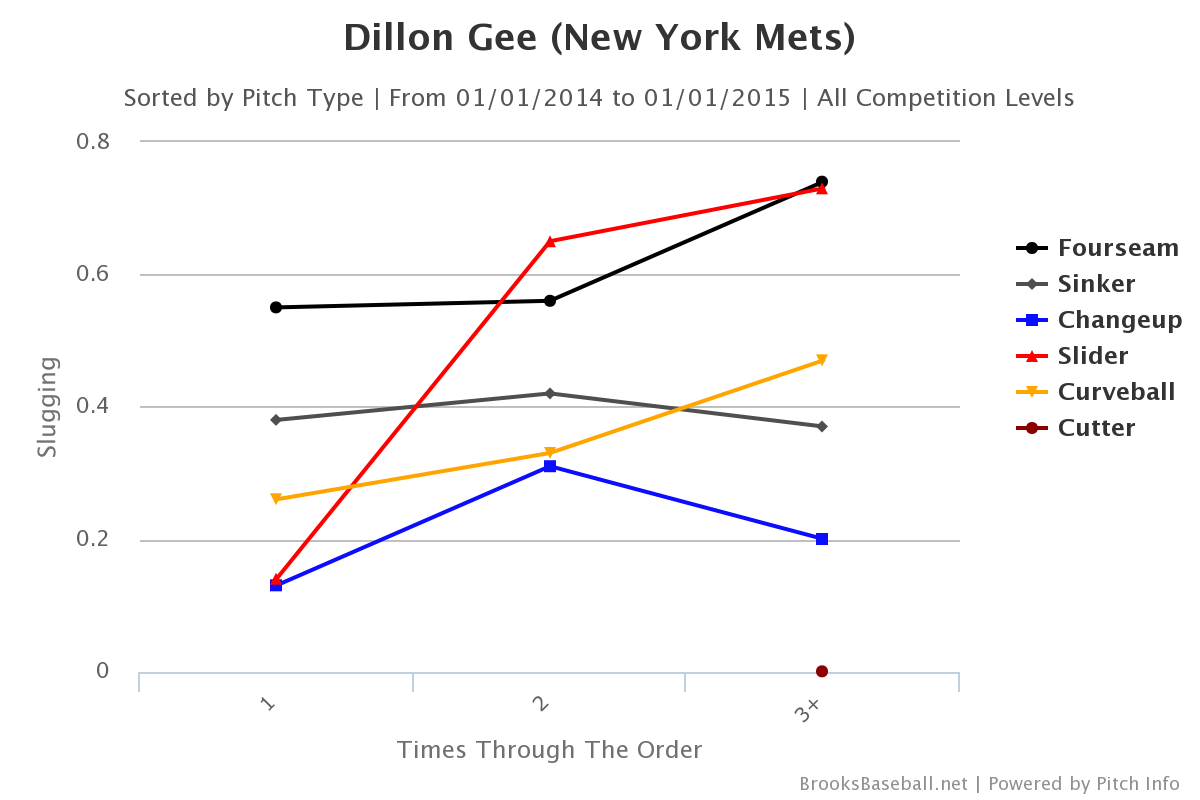
Looking at opponent slugging against each of his pitch offerings, we can see that hitters tend to feast off Gee’s four-seam fastball, the more times that they see it. Gee throws his change-up more often late in games because he has better success with it keeping hitters off balance, after they have seen a steady flow of four-seam fastballs earlier in the game.
Another pitch sticks out in the chart above. His slider. Gee only uses his slider sparingly throughout the game. He reserves it for right-handed hitters, particularly when he is ahead in the count. Of course, his change-up, on the other hand, quite literally, is used for left-handed batters. Gee seems to struggle late in games not because he uses more change-ups instead of fastballs, but because his go-to pitch against right-handed hitters, the slider, becomes essentially useless. Hitters send that pitch all over the ballpark.
A way for the Mets to use Dillon Gee most effectively would be in the bullpen. In that role, Gee would not have to worry about facing hitters a third time late in games, when he becomes less effective. As a one, or two, trip through the order pitcher, he has a strong mix of pitches. He can use his change-up against lefties and his slider versus righties.
Over his career, he excels in relief-like situations. First batters are slugging a measly .263 against him. He performs slightly better from the stretch (.712 OPS vs .728 when the bases are empty). He seems poised to take the ball out of the bullpen. Or in a spot-start when he is only expected to give the team five innings of work.
The Mets are investing hope in a young core of pitchers who could make their rotation 1990s Braves good. It seems silly not to invest $5.3 million in keeping Gee on the roster as an innings eater out of the bullpen. Looking at the way he pitches, it seems a good fit for him.
Statistics courtesy of Baseball-Reference and Brooks Baseball.
Another original article from Metsmerized Online!