When Mets fans see Juan Soto‘s name in the pregame lineup graphic, there’s a good chance they’ll see something special.
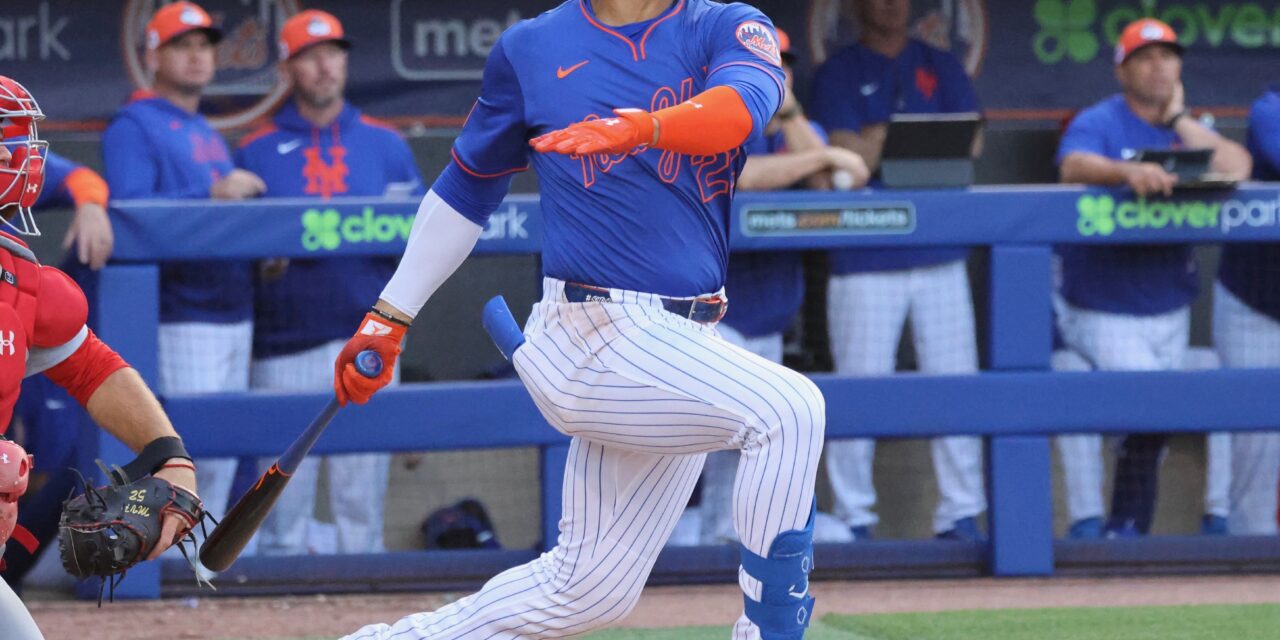
It was just another go-round for Soto in Friday’s tie with the Cardinals. Soto, who’s been playing roughly every other day as of late, went 2-for-3 with two RBIs and a homer — his fourth bomb of spring training.
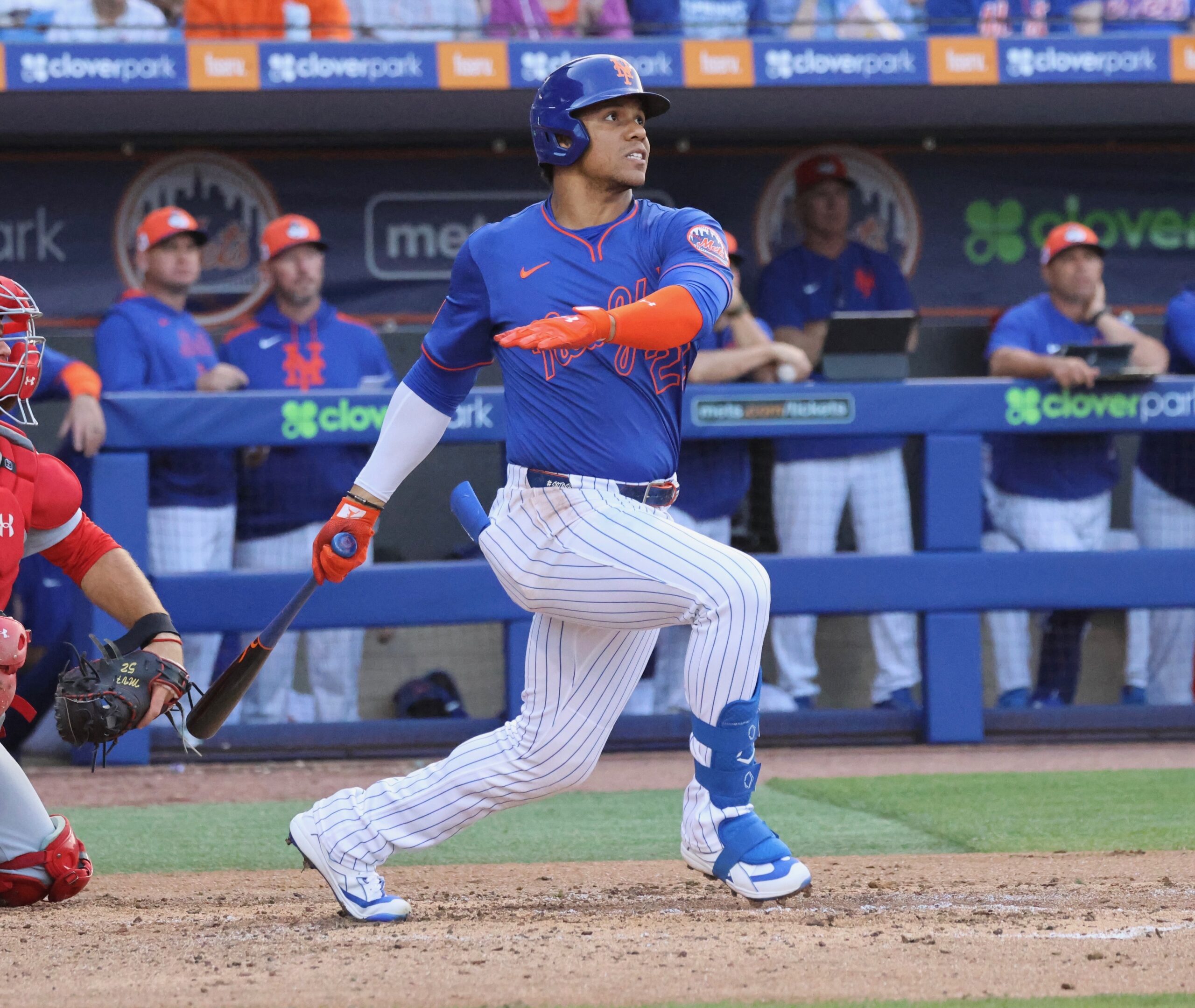
Soto’s home run came in just the Mets’ second at-bat of the game. He did what he does best, working the count and then finding a pitch he could pounce on. Facing right-hander Michael McGreevy, he fouled off a cutter and a sinker to stay alive at 1-2. He laid off a curveball and sinker low, then slammed an 89 mph cutter on the outer half of the plate, launching it over the right-center field fence at Clover Park.
The exit velocity on that shot registered at 111.4 mph, per Baseball Savant. That’s almost as high as his highest exit velocity during the 2019 season, which was 112.8. The high for his career is 116.6.
His second at-bat of the day featured an uncharacteristic three-pitch strikeout. McGreevy got Soto to budge on a sinker in the dirt — particularly rare for the ultra-disciplined Soto.
But he came up in an RBI situation in the sixth inning and capitalized. It was another three-pitch at-bat, with left-hander John King giving him nothing but 93 mph sinkers. King missed with the first two before Soto lined a hard ground ball up the middle for a single. It scored Francisco Lindor, who had hit his first double of the spring.
Soto didn’t get the elevation he would have liked, but he still hit it 108.4 mph. And it was another confirmation of what we already knew: Soto can handle himself in different sorts of situations, and can hit pitchers of either handedness. This is not a revolutionary discovery, but it’s something that Mets fans are getting to see firsthand for the first time — at least, the first time with Soto wearing a favorable uniform.
Juan Soto is reallllly good 🍎 pic.twitter.com/KJDRi3hHGi
— Metsmerized Online (@Metsmerized) March 14, 2025
Soto now has three multi-hit performances in the last four games he’s played in. He’s hitting .417 with exactly a 1.000 slugging percentage — giving him a shiny 1.462 OPS in his first 24 at-bats over 10 spring games with the Mets.
He held his own in the field, too. In the top of the fifth, Soto ran in on a ball blooped into right-center field and slid in for the catch. Soto wasn’t signed specifically for his defense, and his metrics aren’t particularly favorable with a total of -15 DRS over his career. But it was a solid effort, and all the Mets really need is for Soto to be a serviceable presence out there. How that’ll change as he ages over the course of his 15-year contract is a different conversation.
All 10 of Soto’s innings this spring have come in right field. In 1277 2/3 innings in right last year for the Yankees, Soto had a pedestrian -1 DRS — although he was a Gold Glove finalist, for whatever that’s worth. He only played 52 innings in left field last season and had a 1 DRS in that small sample size. His career numbers are technically better in right than in left — a 0 DRS compared to -15. He’s played more career innings in left than in right, but only slightly, at 4000 2/3 to 3845.
But defense, in any case, is not why the Mets gave Soto the largest contract in professional sports history. They gave him that money to hit, and to hit for a long time. He’s barely tipped the surface in orange and blue just yet, having only played a handful of spring training games with his first regular season still looming anxiously in the future. But his first impressions have been as advertised, which might not mean much in the long run, but nonetheless gives Mets fans some source of excitement here in mid-March.