
Jerry Blevins‘ 2018 season has been a mixed bag of sorts. Sure, Blevins had an absolutely awful stretch to start the season – pitching to a 13.50 ERA and 10.80 BB/9 through April 19th after being tagged for four ER against the Braves on that day. That one appearance has kept his seasonal ERA deceptively high, and he’s been a fairly effective reliever since then — entering Thursday, Blevins had just a 1.93 ERA as a reliever since that disastrous outing. But there’s a deeper issue, lurking beneath the surface — since April 20th, here are the FIP and ERA of relievers with at least 30 innings pitched.
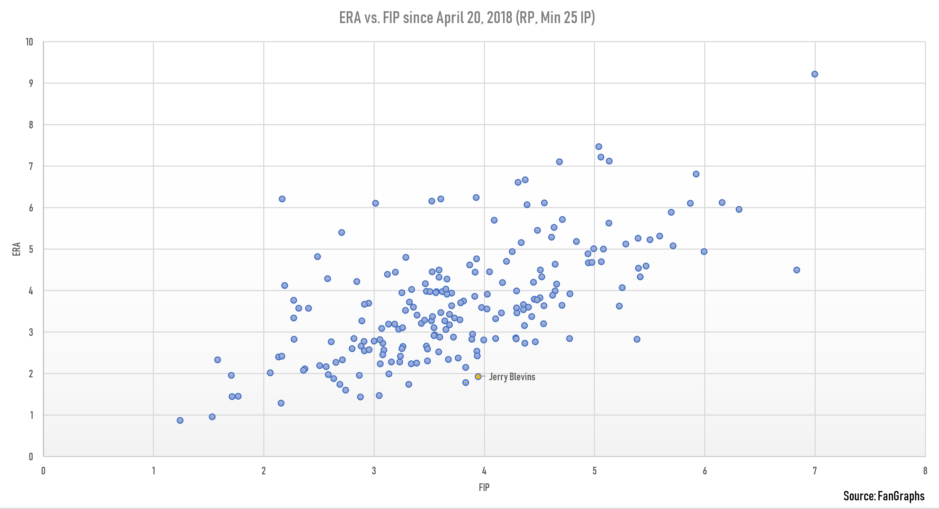
Blevins’ FIP has been precipitously bad. It’s not unusual for relievers to run ERAs much lower than their FIPs — a result of them frequently coming into the middle of innings with inherited runners — but jumps in peripherals to the extent that Blevins’ have jumped this season say that something might truly be wrong with Blevins.

It’s tricky to diagnose issues with relievers because relievers are always operating on fairly small sample sizes – Blevins has pitched only the equivalent of a month’s worth of games for a starting pitcher. Justin Verlander has a 5.42 FIP in the past thirty days, but that doesn’t mean that Verlander is having some kind of mechanical issue that needs to be addressed immediately. But still, pitchers generally see poor results for tangible reasons, and Blevins might have a tangible reason — curveball placement.
Blevins’ primary weapon is his curveball. While Blevins used to lean heavily on his fastball in earlier seasons, he’s lost about 5 MPH on the pitch since his debut, and instead throws his curveball as frequently as anyone in baseball. Since 2016, only Justin Grimm (45.5%) has thrown his curveball more frequently than Blevins (41.2%). For good reason! Blevins has a disgusting curveball. Here he is throwing one to strike out Daniel Murphy to earn his first career save.
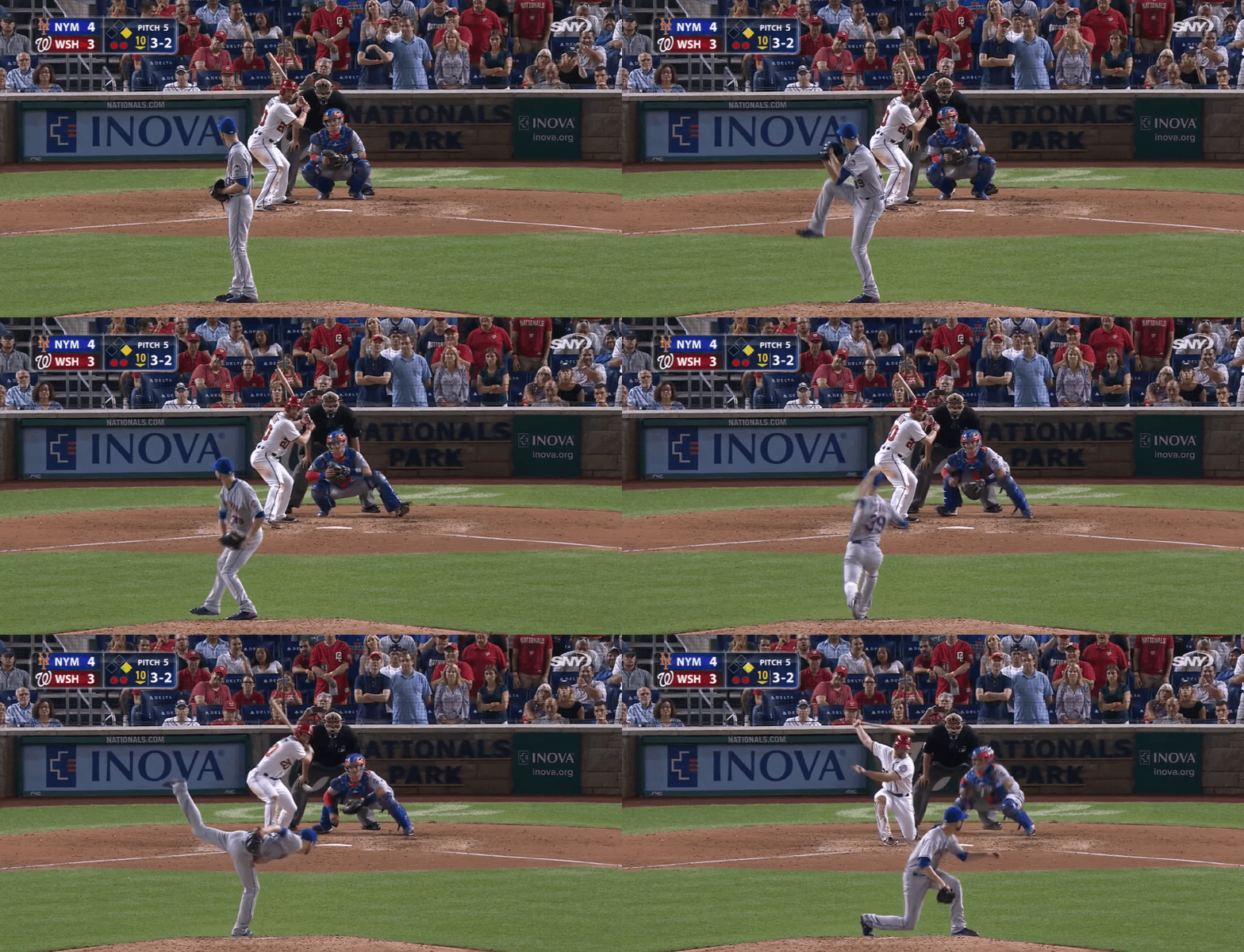
Blevins mixes his fastball and curveball rather effectively, and it works because Blevins tends to get a pretty good late-break on his curve. Batters have very little time to decide if the pitch coming is either a fastball or a curveball because the pitches look similar from release until they’re halfway to the plate — especially to left-handed hitters. Here’s an overlay of Blevin’s fastball versus his curveball again to his favorite victim, Murphy (Murphy is a career .111 hitter against Blevins in 20 plate appearances) — it’s a little tough to see, but the pitches follow similar paths until the curveball breaks away, while the fastball lands further in.
But Blevins’ curveball has not been the finisher that he’s needed it to be this year. In 2017, batters whiffed on Blevins’ curve 45.8% of the time (the fourth-best rate in the MLB among players who generated 100+ swings off of curveballs) and hit just .161/.132/.169 off the pitch. But this season? Batters are hitting .260/.229/.360, and are whiffing about 10% less frequently than last season on the pitch. Blevins’ curveball hasn’t been all that this year, and Blevins has seen his peripherals suffer as a result.
It’s not the curveball itself that’s the problem — Blevins is not throwing the pitch significantly less hard, nor is he generating a different amount of spin compared to last year. The problem is where the curveball is ending up. Here is where Blevins has placed his curveball against left-handed hitters this season (right) compared to last (left).
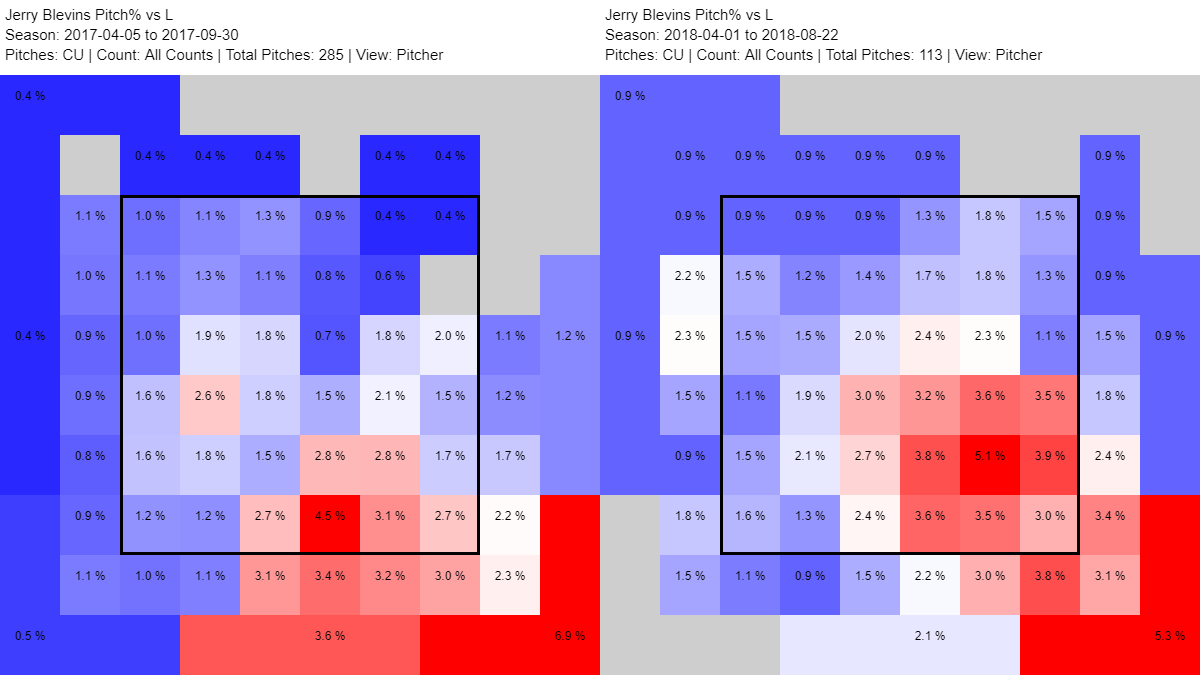
In 2017, Blevins usually threw his curveball in the dirt away (like he does to Murphy in the first GIF above) or buried it way down. But in 2018, Blevins is leaving his curveball in the zone far more frequently, especially right along the outside corner. When Blevins buries the pitch down and away, he’s fishing for a whiff and usually finds it because batters simply cannot reach that far. But if he leaves it over the plate, it ends up right in the batters’ swing plane — so hitters are being rewarded more for going fishing for that pitch than last season.
It makes sense, then, that lefties have been the ones doing damage against Blevins this season. Last season, lefties hit .195/.250/.205 off of Blevins, but this year, they’re hitting .267/.362/.475. The “small sample size” caveat is still very necessary here — Blevins had faced just 69 left-handed-hitters this season entering Thursday — but Blevins is doing something tangibly poor, and receiving tangibly poor results. Blevins is seeing fewer whiffs and more hard-hits on his curveball, his primary weapon, against left-handed hitters, his primary target.
Blevins has signed with the Mets in free agency in back-to-back seasons, and he’s been a reasonably solid bullpen option for his entire career. If the Mets are looking for a veteran presence in their bullpen, it would seem likely that they may turn to Blevins this offseason yet again. But this feels like a big red flag — it’s a problem that Blevins must figure out if he wishes to remain as effective as he has been for his career.