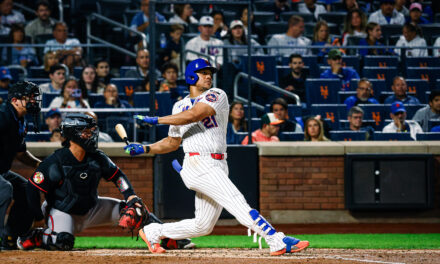
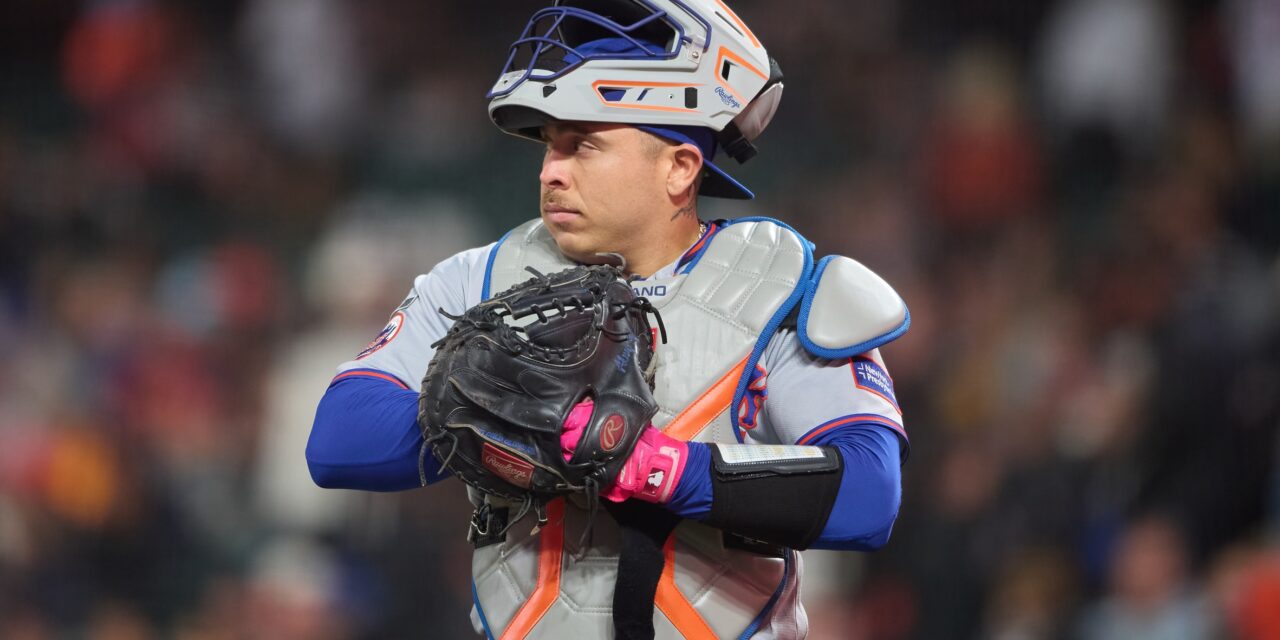
“While he clears the offensive bar at catcher, Alvarez has work to do behind the plate. He receives well and has an average arm he used to throw out 29% of 108 minor league base stealers.” “With time, he has the potential to develop into a near-average defensive catcher,” Baseball America, 2023
“He’s not a particularly good catcher, though.” “There are no out-and-out dispositive traits here, but Álvarez is fringy across the board. He’s a snatchy framer that lacks the kind of twitchy athleticism to block balls or hold a quiet setup/receiving position.” “Receiving is a teachable skill, and Álvarez has improved in that regard, but given his frame and recent lower-body injury, it’s reasonable to wonder if he can handle the rigors of everyday catching,” Baseball Prospectus, 2023
“While the Mets consistently note how Álvarez has improved his framing, he remains below-average defensively because of his limited athleticism,” Pipeline, 2023
Those were the scouting reports for Francisco Alvarez‘s projected defense heading into 2023 before he was called up. By the end of 2023, he ranked in the 95th percentile in fielding run value with his 97th percentile in framing leading the way. He rated as a roughly league-average blocker but struggled to throw out runners despite his plus pop time.
In 2024, he was still a plus-framer, but the blocking got markedly worse. Where he did improve was throwing out runners, grading out roughly league average in caught stealing according to Statcast. Overall, for the second season in a row, he rated out as an above-average defensive catcher, this time sitting in the 65th percentile in fielding run value.
2025 saw his defensive markers fall off a cliff, however. His plus framing dropped to the 16th percentile, and he continued to struggle with blocking, but he was well above-average in limiting base running.
Fast forward to 2026, and Alvarez was back to grading as an above-average framer, he still threw runners out at an above-average rate, and still struggled with blocking. Overall, his fielding run value placed him below average in the 37th percentile.
So, what can we make of this and what does it mean for his future?
Robert Edwards-Imagn Images
Francisco Alvarez’s Weird Defensive 2026 Season
So much has happened that it can be easy to forget that Alvarez began the 2026 season with a hamate injury on his glove hand. This seemed to have impacted his ability to grip the ball and frame pitches, and by mid May, he was ranking below average in framing and caught stealing. Then, on May 12, he tore his meniscus on a swing and his defensive metrics dropped further. A month after his return, he was averaging over two seconds on his pop time, going from the 70th percentile to the 18th. It would make sense that a knee injury would impact the ability to stand up quickly. As a result, he struggled to throw out baserunners.
As the season went on, though, his defense improved. The Mets changed Alvarez’s stance, and it seemed to help with his pop time, as it dropped back down to 1.92. Mark W. Sanchez of the New York Post touched on this, writing, “On the other side of surgery, Alvarez is more upright in his squat. A big part of the goal in adjusting the stance was to cut down on the amount his head moved as his left hand whizzed to catch and present the pitch.”
As the season came to a close, Alvarez was back to rating above-average in caught stealing.
Catching coach J.P. Arencibia spoke on this, stating, “Alvy has some of the quickest hands in baseball. And so once we were able to get to a good posture where his head wouldn’t move, essentially all the leverage was going onto the glove — into the movement of the glove — and so that’s really what’s changed the game for him.”
Per Baseball Prospectus’s Fielding Leaderboard, from August 15 on, Alvarez ranked fourth in framing runs at +2.5. His blocking runs at -0.3 was still below average, though.
One area Alvarez has struggled heavily in is ABS challenges. Only Samuel Basallo had a worse Overturns vs. Expected, per Statcast. In terms of net runs, Alvarez rated essentially the same at third-worst instead of second.
So, what does this mean for 2027?
Alvarez’s Defensive Future
Alvarez has yet to turn 25. The closest he has had to a healthy season was 2023, where he began the season returning from ankle surgery. Since then, he has torn his UCL in both thumbs, broke his hamate, had a minor wrist injury, a minor shoulder injury, and most recently tore his meniscus. A better defensive 2027 likely begins with a healthy 2027. To steal a line from James Schiano of NBC/Mets’d Up/The Windup, “You are injury prone until you’re not.”
Alvarez’s return as a plus framer in the second half is a good sign, even if ABS has somewhat lessened the impact it has. He has continually shown that he can utilize his plus pop time to throw out runners at an above-average rate, and we saw that in the second half of 2026 as well.
Alvarez’s biggest issue is blocking. He has graded out as a below-average blocker every year except 2023, and even in the second half where he looked better, he is still below-average.
How important is blocking compared to the other defensive metrics though? Michael Rosen of Fangraphs released a great analysis on catcher defense early in 2026, writing, “Blocking sort of falls between those two catcher activities. It’s somewhat visible, but the difficult blocks happen relatively infrequently. And the value is muted: Savant estimates each block above (or below) average grades out to a quarter of a run. Even Ramírez’s record-breaking season, then, only resulted in -7 runs of blocking value.”
His analysis found that while blocks impact the game on average more than caught stealing does, it does not impact the game nearly as much as framing. It would make sense then why the Mets have focused so much on improving Alvarez’s framing over the years. Ideally with a full year of ABS under his belt, Alvarez can see improvements in that area as well.
Could He Improve Further Removed From Injury?
Alvarez tore his meniscus during the 2026 season and it is likely that impacted his defense in the summer. The data backs that up too. As mentioned, his pop time was much worse and he rated in the bottom of the league in BP’s blocking and caught stealing metrics.
J.T. Realmuto is a recent example of a catcher who had meniscus surgery and has not bounced back to what he was before. Heading into 2024, he had previously ranked in the 96th and 97th percentile in blocking. In 2025, he rated in the 13th percentile in blocking and in 2026 he was in the 22nd percentile. One thing that Alvarez has on his side that Realmuto does not is age, as the latter is more than a decade older than Alvarez. That said, Manny Piña, who tore his meniscus at age 33, saw his blocking numbers return to normal the following season. That was also his second torn meniscus.
Salvador Perez tore his meniscus at age 22 in 2012. Unfortunately, the first year we had blocking data from Statcast was in 2018, but he boasted multiple above-average blocking seasons from then onwards.
The good sign is that meniscus surgery does not seem to be one that a catcher cannot bounce back from with time. Hopefully with an offseason to rest, Alvarez can return back to his above-average defensive form he has flashed over the years.