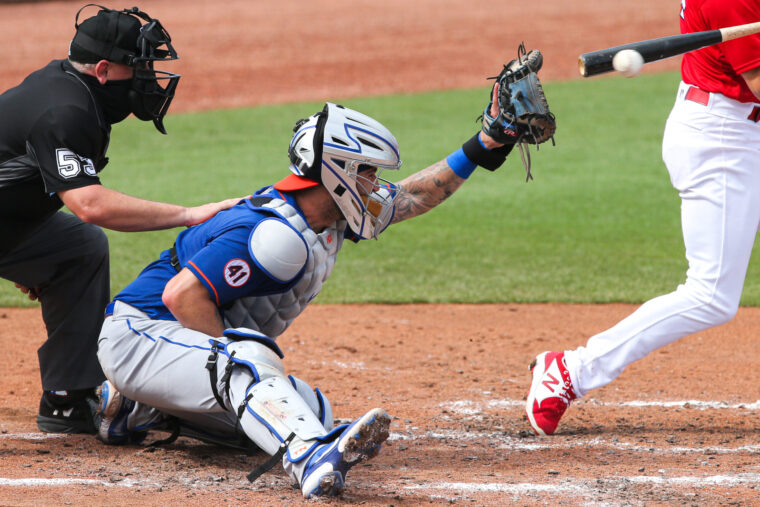
Credit: Sam Navarro-USA TODAY Sports
The future of the catching position is up in the air right now with Major League Baseball using the minor leagues to test out automated strike zones.
This season the automated ball and strike system AKA robot umps will be moving from the Atlantic League to multiple Triple-A ballparks.
Mets catcher James McCann spoke with James Fegan of The Athletic on the impacts this would have on catchers defensively and the art of pitch framing.
“If there’s an automated zone, you’re gonna see guys that have that big (throwing) arm and can really swing it,” McCann said. “When you take into account now every young catcher is headed out to the field with a wrist band on his arm on how to call the game, they have essentially taken away the necessity of a catcher to understand swings, understand their pitching staff and use their eyes. And you’re gonna see teams that think we can just get someone who can throw and can hit and we’ll take care of everything else from inside. I think that takes away from the game a lot.”
McCann believes the move would be counterintuitive to the league’s initiative toward more action of the basepaths. If a catcher is solely focused on receiving the ball and not trying to steal a strike then they can be more aggressive in their pre-pitch setups. Additionally, he anticipates a decline in one-knee catching stances that have become more popularized in recent seasons.
“When you’re on a knee and the ball is directly in front of you, you can block those typically fine,” McCann said. “But it’s the ones that may get away from a pitcher that’s a little bit outside your body, and you don’t block it. Now, that’s a free base for the base runner. Especially if he’s in scoring position, that really hurts. Especially if you’re talking about how good pitching is nowadays, and how hard it is to really manufacture runs. You don’t see a ton of single, single, single (leading to) scoring runs. It’s the big hits. If you’re giving away free bases, because you’re not in a position to block that slider in the dirt, that adds up over the course of the season.”
How would this affect the Mets?
The Mets used three catchers last season between McCann, Tomas Nido, and Patrick Mazeika. Let’s just focus on the first two.
McCann faced more than double the pitches (2,603) to Nido (1,147) last season. When it came to pitch framing, Nido blew McCann out of the water.
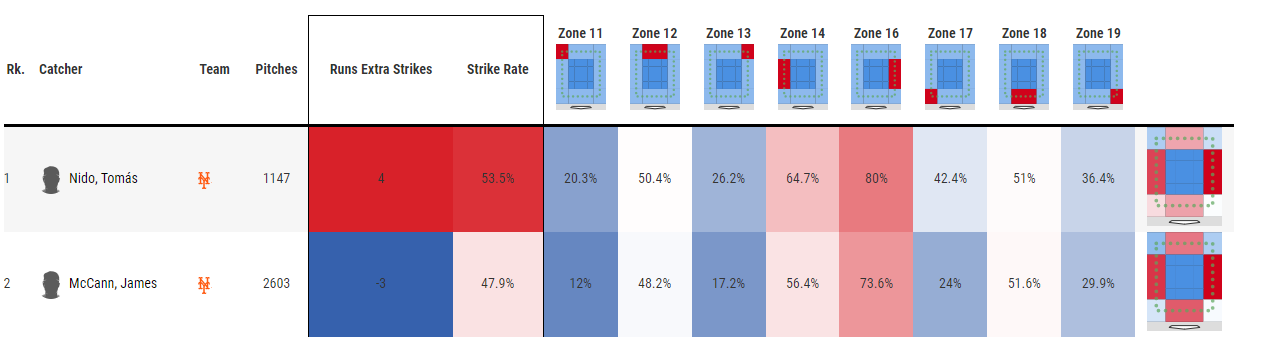
Nido excelled at stealing pitches on the black while both were about the same on pitches high and low. Nido also finished ninth among catchers with four runs extra strikes, a metric that converts strikes to runs saved. McCann was tied for 47th with Yadier Molina with -3.
McCann had a -2.9 framing score from FanGraphs and -5 defensive runs saved. Nido had a 5.1 framing score with 10 defensive runs saved last season.
Statcast hasn’t measured catcher pop times since 2019 but it’s another win for the defensive value of Nido. In 2019, Nido was fifth in the majors with an average pop time of 1.93 seconds to second base. McCann was 57th at 2.05. That’s a monumental difference on plays that come down to centimeters. Although not measured in 2021, the difference in arm was evident last season with Nido throwing out 12 runners on 21 steal attempts while McCann threw out 17 runners on 63 attempts.
To summarize, the current system allows for a catcher like Nido to gain extra value to a team with his defensive prowess. But, an automatic strike zone will lead to more aggressive catcher stances and ultimately better chances at throwing out runners stealing, placing a future emphasis on offensive-minded catchers.
Catchers like Jeff Mathis who couldn’t hit the broad side of the barn but could steal runs for their team through adept pitch framing will be eliminated. Salvador Perez was worst in the majors last season with -19 runs extra strikes, but he also hit 48 home runs and drove in 121 batters. That would be the goal of all teams in the future.
If the automatic strike zone is implemented in the majors one day it’s possible it could benefit the Mets with top prospect Francisco Alvarez. Álvarez has 70-grade raw power and hit 22 home runs in 84 games at High-A ball last season. Álvarez is a top prospect because he also is a plus defender but his bat will separate him from the weakest offensive position in baseball.
For now, umpires still have a job behind the plate. MLB will continue tinkering with the future of the strike zone and it’s on catchers and teams to figure out how to take the greatest advantage.