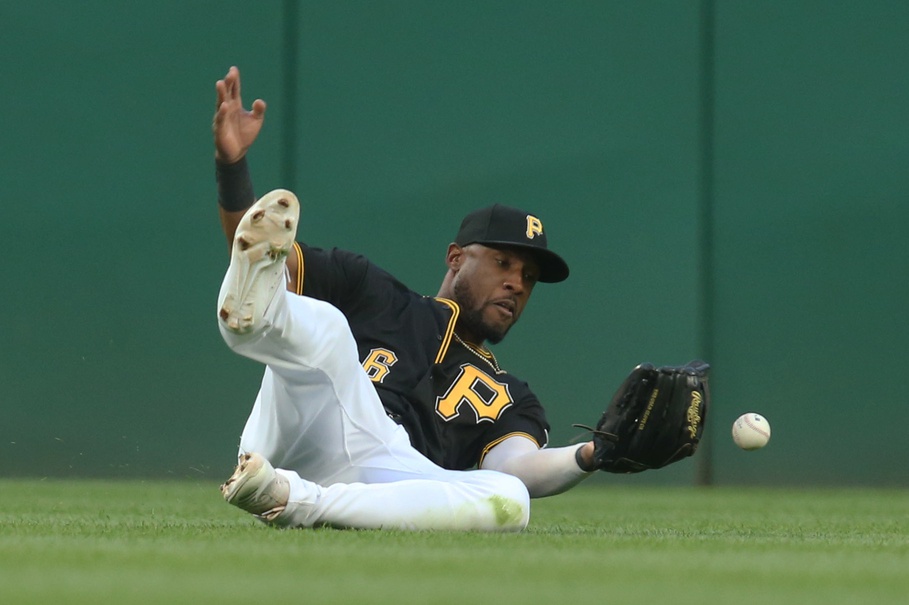
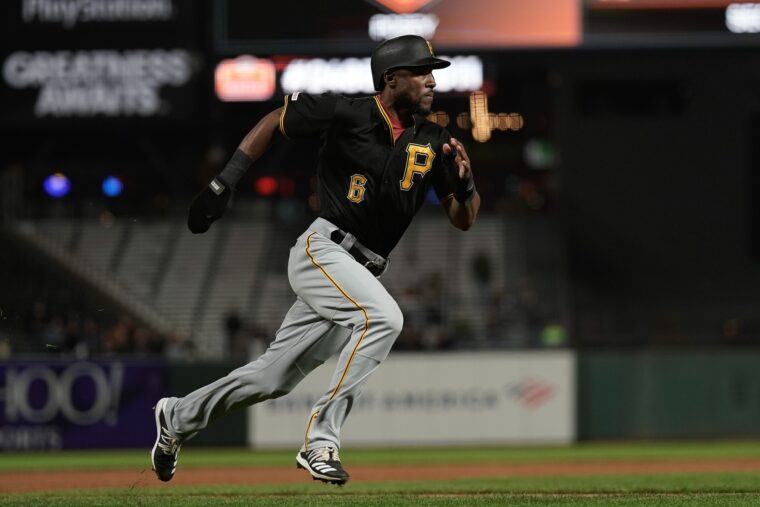
Though there appears to be little traction on the free agency front, the Mets seem to be engaged with the possibility of improving the club via trade. The scenario that has captured the interest of most local writers and analysts has been a potential deal with the Pittsburgh Pirates that would net outfielder Starling Marte, who, for what it’s worth, expressed interest in coming to Queens earlier in the week.
In the same conversation, Marte voiced discouragement with the organization’s current direction, and cited the Mets as one example of a contending team he would prefer to play for saying (translated), “[they] have everything” needed to make a run for a World Series title.
The 31-year old center fielder posted a 2.9 bWAR in 2019 – the fourth-highest on the team – while racking up career-bests in homers (23), RBI (82), OPS (.845), and strikeout rate (16%) in 132 games. Marte also managed to steal 25 bases for the sixth time in the last seven years, though it was one of his lower marks relative to the 37 he’d averaged from 2013 to 2016, and his defense in the past three years has quietly declined as well. His -9 DRS and -7.6 UZR in center this past year were both career-lows (but Baseball Savant and Baseball Prospectus both had him as above average defender), and with $11.5MM on the tab for 2020, landing Marte is a far riskier enterprise than most are willing to admit.
Marte has a 2021 option worth $12.5MM, but the Mets would leave themselves with about $4-5MM left in the budget before surpassing the competitive balance figure and subjecting themselves to the luxury tax. It remains unclear just how willing Pirates general manager Ben Cherington would be to eat some of the money, but considering how dry the current free agent market of center fielders is, it’s safe to assume that other, more financially flexible teams will also be in on the sweepstakes.
The Mets would almost certainly need to wring out their farm system a bit further – a process already complicated by the organization’s Fangraphs ranking at 22nd out of the 30 teams. With Jarred Kelenic, Justin Dunn, Simeon Woods Richardson, and Anthony Kay all purged from the organizational top ten in the last year, the Mets can only go so far advertising such chips as Ronny Mauricio (current number-one prospect and 80th among the top 100, per MLB), Andres Gimenez (number one ranked coming into 2019), Francisco Alvarez (third-ranked catching prospect in all of baseball), Brett Baty, Josh Wolf, and Matthew Allan (first, second, and third-round picks from the 2019 Draft, respectively).
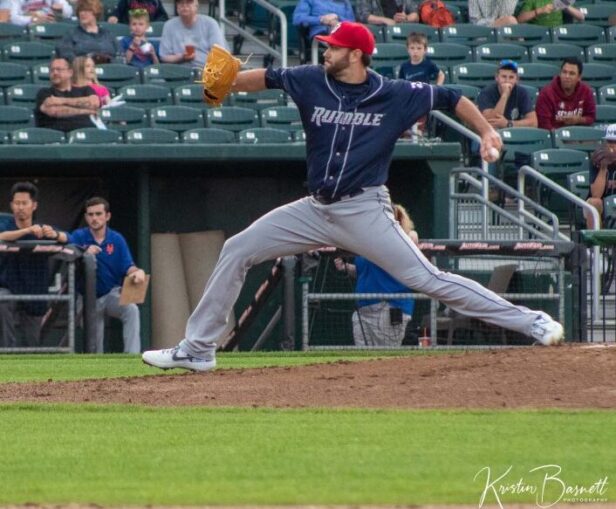
Photo by Kristin Basnett
Some prospects the Mets could more conceivably part with include left-hander David Peterson, right-hander Franklyn Kilome, third baseman Mark Vientos, and shortstop Shervyen Newton, though no one player here likely pushes the envelope, and the organization can only piece together so many packages.
It would probably behoove the Mets to wait for possible non-tender candidates like Jackie Bradley, Kevin Pillar, and Tyler Naquin to hit the open market and/or save farm resources for a trade that could snag a quality arm to replace Zack Wheeler, but it may be worthwhile to assess possible Marte deals anyway… at least those that would be fair for both sides.
It may be worth noting that Pittsburgh’s farm system currently ranks ninth via Fangraphs, as they entered the 2019 season with four of the league’s top 100 prospects, three being position players in Ke’Bryan Hayes (third base), Oneil Cruz (shortstop), and Travis Swaggerty (center field) – the lone pitcher being Mitch Keller. Moreover, the respective breakouts of young everyday bats like Bryan Reynolds, Kevin Newman, and Josh Bell, likely puts Pittsburgh in the market for more promising talent on the mound and behind the plate.
Either Alvarez or Ali Sanchez would probably be on the Bucs’ radar, with the latter option probably coming over as a secondary add-on alongside a closer, more a combination of mature starters like Peterson, Kilome, Kevin Smith, and/or Jordan Humphreys. Of course, this doesn’t mean the Pirates would ignore padding their infield with younger, more projectable assets, but it would probably make most sense for them if those assets had utility similar to Hayes and Cruz – who, as a point of reference, both rank ahead of Mauricio and Baty – the Mets’ best candidates – in the top 100.
Cherington definitely won’t bite if the bait isn’t tangibly improving his farm system. Put another way, There’s really no scenario where the Pirates pull the trigger and eat money unless the Mets include a headliner and one or two big-league ready/proximate pieces. After all, Marte is easily their most valuable trade chip, and the Mets’ farm system doesn’t boast the same appealing depth as most trade suitors. They could offer to sweeten the deal with more experienced young talent like J.D. Davis or Dominic Smith, but at that point would be cutting more controllable win-now components out of the equation while still forking over one or two prospects. Otherwise, they’d effectively be asking that Pittsburgh take a bath while parting with their most tradeable asset.
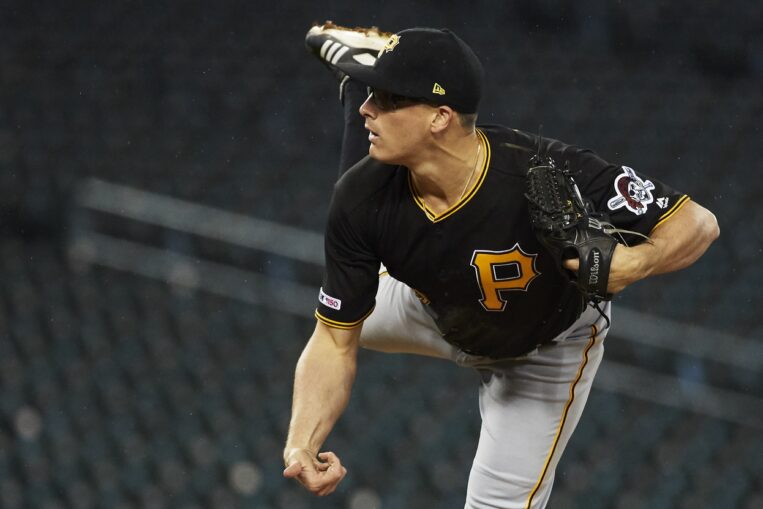
The alternative within this framework could be for the Mets to inquire about young talent, of either present or future value, so as to tip the scales. The Pirates have churned out a few intriguing relievers in recent years, but Richard Rodriguez, Nick Burdi, and Geoff Hartlieb are three such names that could be of potential value in next year’s bullpen.
Rodriguez, 29, is the most experienced of the group, but probably had the weakest overall peripherals in 2019, as his 5.22 FIP (nearly double from last season) and 1.8 HR/9 can attest. However, his numbers after being optioned in May were considerably better, as his groundball rate rose to 44.3% while opponents slashed just .237/.295/.367. His fastball spin rate sat in the 94th percentile through the season, registering the fifth-most horizontal movement above average at 6.4 inches. As a point of reference, Edwin Diaz‘s 3.9 inches above average was the most among Met pitchers. He’d likely serve the pen in a role similar to Robert Gsellman, but could present the Mets one extra option they wouldn’t need to worry about on the free agent market.
Burdi, who would be 27 next season, recently underwent surgery to relieve symptoms of thoracic outlet syndrome not too far removed from a Tommy John procedure that cost him the bulk of his 2018 season. Injuries have hampered the righty, but the promise he has showed when healthy is a sight to behold, at least statistically. Burdi averaged 97 mph with his fastball while striking out 17 and walking 3 in his first 8.2 innings with Pittsburgh before blowing his elbow out. His numbers somehow translated to a 9.35 ERA, though the 1.83 FIP and career 2.8 K/BB ratio in five minor-league seasons tell a far more encouraging story. His best orange and blue comparison, if it’s worth anything, would probably be Drew Smith, in that injuries and hazily developed breaking ball have distracted from his ceiling as a high-leverage reliever.
Hartlieb, like Burdi, ran into some bad luck en route to his 9.00 ERA in 35 innings. The 25-year old’s 5.56 FIP doesn’t help matters much, but he has managed plus movement on both his slider and changeup, and the spin rate on his fastball (88th percentile) certainly has potential. Like Burdi, his body of work in the minors is much more convincing, but his long relief work last year in particular was nothing to sneeze at, as opponents batted .212 with a groundball rate nearly triple the flyball rate, and only 3.4 walks surrendered per nine.
The Mets could also try inquiring about starters in Pittsburgh’s minor-league fold, given the organization’s abundance of further-away arms. Aaron Shortridge, Michael Burrows, and JT Brubaker are three righties crammed at the bottom of their top 30, the latter of the three closest to pitching in a big-league game and the former two projecting as stable options at the back of a big-league rotation by 2021/22. Brubaker, 26, was limited to just six starts last year, but won organizational pitcher of the year honors in 2018 on the back of a 2.81 ERA. He’s never been a strikeout pitcher like Shortridge or Burrows, but could give the Mets another possible fifth-arm to work with akin to a Walker Lockett, Corey Oswalt, or Stephen Gonsalves.
In the ideal scenario where Pittsburgh settles to trade with the Mets and agrees to pay half of Marte’s annual cost (about $6M) in 2020, the Mets would likely have to part with Alvarez and either Gimenez or Peterson, and depending on the quality of the two premier pieces, they would probably also need to give up either a presently valuable bat or one more of their top-10 prospects. Given how exacting Cherington’s standards would likely be with his best pawn, it’s difficult to envision the Mets winning out, even if they were to swipe back a pitcher or two, all of whom in themselves pose some risk or another.
It should also be understood that Marte’s price tag may not even justify his means, at least relative to what the Mets need to contend in 2020. Center field defense for the Mets was obviously a problem given how badly their -13 DRS ranked. By the same token, though, Pittsburgh, anchored by Marte, no less, finished just one spot ahead with -12, good for 27th in the league. Marte’s value with the glove in 2019 was no different from that of Brandon Nimmo, and his 119 wRC+, though productive, was still a far cry from Nimmo’s career mark of 130, Davis’ 136, or Smith’s 133 last season.
What’s more, and perhaps more forgotten for that matter, the Mets have far more pressing needs. Their infield defense, easily the worst in the National League by most measures, just got weaker with Todd Frazier‘s departure. Their rotation is forecast to take a hit as well with Wheeler’s current market too steep for the Mets’ pockets. This doesn’t even get into the questions that surround next year’s bullpen or the pitching staff’s general ability to work with Wilson Ramos – one of the game’s worst framers and blockers. Polishing an outfield that covered its tracks adequately last year by ranking fifth in the majors in wRC+ (117) and eighth in OPS (.816) is questionable in itself. With the Pirates’ asking price on Marte, it’s ill-advised. And with limited funds and a dissolving farm system, it’s irresponsible.