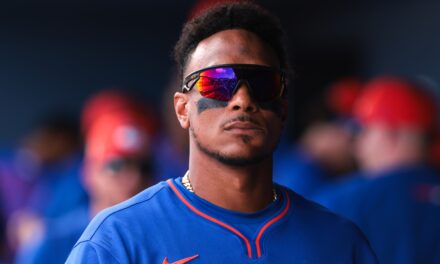

Munetaka Murakami
Position(s): 3B/1B B/T: L/R
Age: 25 (02/02/2000)
2025 Traditional Stats (Central League): 56 G, 224 PA, .273/.379/.663/1.043, 51 H, 7 2B, 22 HR, 47 RBI, 32 BB, 64 SO
2025 Advanced Stats (Central League): 210 wRC+, 14.3% BB%, 28.6% K%, .279 BABIP, .462 wOBA

Rundown
The arrival of Munetaka Murakami to Major League Baseball through the posting system marks one of the most anticipated international signings in recent memory. The left-handed slugger, who turns 26 in February 2026, has been officially posted by the Tokyo Yakult Swallows. Murakami leaves NPB as the most feared hitter in the league, highlighted by a historic 2022 season in which he won the Triple Crown and broke the single-season home run record for a Japanese-born player with 56.
Murakami’s career reflects the highs and lows of elite power hitting. He burst onto the scene in 2019, winning Central League Rookie of the Year at just 19 with 36 home runs but a huge 31% strikeout rate. In 2020 and 2021, however, he refined his approach, leading to a historic 2022 season in which he captured the Triple Crown, broke Sadaharu Oh’s single-season home run record for a Japanese-born player with 56, and cut his strikeouts to a career-low 20.9%. In the two seasons that followed, however, his production dipped—his OPS fell to .875 in 2023 and .851 in 2024, his average declined, and his strikeout rate climbed back into the 30% range.
Murakami’s defining tool is his elite, 80-grade raw power from the left side. Scouts widely agree that his strength and bat speed should carry over well to MLB, making him a consistent 35-40 home run threat at his peak. He’s already shown he can handle top-level pitching, flashing multiple high-exit-velocity hits during an impressive showing in the 2023 World Baseball Classic. With that blend of youth and power, Murakami profiles as a potential franchise cornerstone.
However, evaluators have also had concerns over Murakami’s contact ability and rising strikeout rates. After posting a career-best 21% strikeout rate during his peak 2022 season, that number has since climbed to the 28-30% range. According to Yuri Karasawa of JapanBall, his in-zone contact rate has ranked dead last among qualified NPB hitters over the last three seasons. This issue is magnified by his known struggles against high-velocity fastballs, which are far more prevalent in the MLB than in NPB. If his whiff rate continues to rise, his batting average could then plummet, creating an extreme three true outcomes profile with significant bust risk.
The other major question mark surrounds his long-term defensive home. While Murakami has primarily played third base in Japan, reports consistently peg him as a below-average fielder at the hot corner. He also has plenty of experience at first base and even logged a single game in right field. Most scouts project his best defensive fit in the MLB will be as a first baseman or, perhaps, a full-time designated hitter. A move to DH obviously puts more pressure on his offensive production to carry his value, though his raw power suggests he may be capable of meeting that demand.
Contract
MLB Trade Rumors projects Murakami to command an eight-year, $180 million contract, which appears to be the market sweet spot. Estimates have varied, ranging from roughly $160 million to over $220 million. His age is a significant advantage compared with other corner infielders like 30-year-old Pete Alonso or fellow Japanese slugger Kazuma Okamoto, who is 29. Recent young stars reaching free agency, including Yoshinobu Yamamoto and Juan Soto, landed massive deals. While Murakami isn’t nearly as polished as either Yamamoto or Soto, his youth should still put him in line for a nine-figure contract that could approach $200 million.
Recommendation: Try to Sign
The question for the Mets’ front office is not simply one of cost, but one of fit: does Murakami’s generational talent, which necessitates a massive financial commitment, align with David Stearns’ long-term vision of a balanced, sustainable roster? Signing this specific player would indicate a willingness to use Steve Cohen’s financial might to secure a genuine franchise cornerstone who might otherwise be considered too risky for a less affluent organization. The money is certainly there, but the real test is whether Stearns believes his baseball operations team can successfully manage Murakami’s weaknesses, allowing him to consistently realize that extraordinary upside.