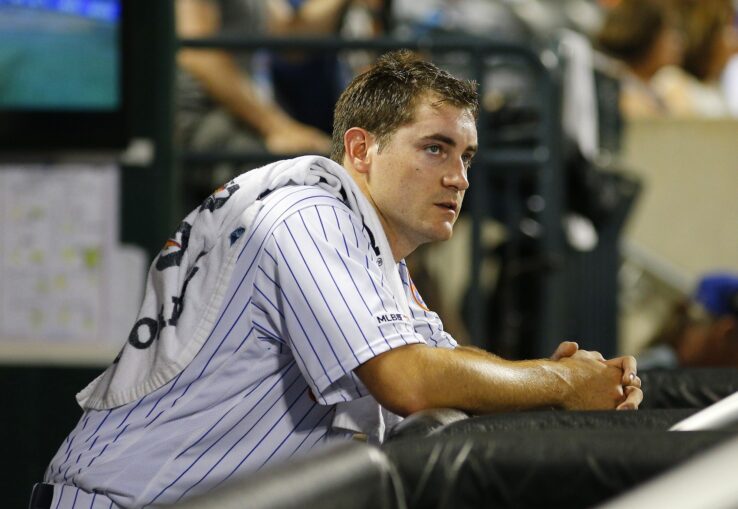
With Friday’s lifeless, second-half-opening loss to the NL-worst Miami Marlins, the New York Mets fell to 40-51, 14.5 games out of first place, blah, blah, blah.
We’ve recounted that line too many times to count over the last week — one of the pitfalls of being out of contention by the All-Star break, I guess.
As we all know, this franchise is no stranger to unrealized hype. With too many instances to count in that regard, we’re going to focus on one of the few times this team has turned things around after a tough start in recent years.
Coming into the 2019 season, expectations were high; and understandably so. With a strong rotation centered around Jacob deGrom, Noah Syndergaard, and 2018 breakout star, Zack Wheeler, the foundation was set in place.
A [air quotes] reinforced lineup with high-profile additions Robinson Cano, Wilson Ramos, and Jed Lowrie in the mix was supposed to complement the strong core already here in Michael Conforto, Jeff McNeil, Brandon Nimmo, et al.
The bullpen had (and still does, for that matter) the pieces in place — on paper, at least — to keep this team’s leads safe in most occasions. Edwin Diaz, Seth Lugo, and Robert Gsellman, to name a few, have been effective in this league and will be again. Onward and upward.
Whatever went wrong over the first half of the season has been talked about, written about, analyzed, and re-analyzed over the last few weeks.
With a reasonable schedule ahead of them — the Mets’ remaining opponents have a combined winning percentage of .490, as of Saturday’s games — the opportunity to finish this season on a high note has not escaped them yet.
Postseason play, for all intents and purposes, is likely out of the question at this point. Crazier things have happened, as well are all well aware of, but the odds are strong that this will be yet another Mets-less October.
Let’s take a look to the past to help put this present situation in perspective, and hope the future will provide a sunnier outlook for this organization.
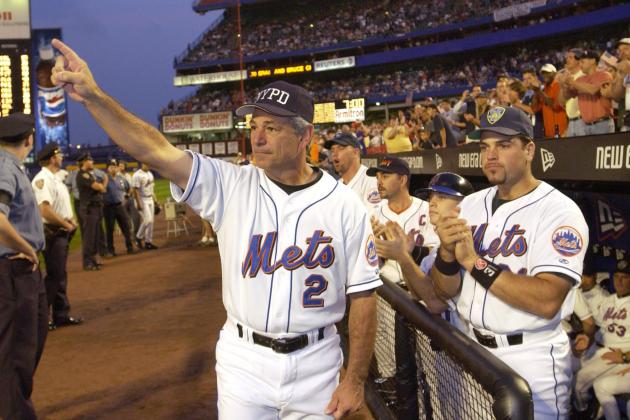
Coming off an inspirational-yet-fruitless World Series run in 2000, Bobby Valentine and his New York Mets were in complete turmoil coming out of the All-Star break the following season.
On July 13, 2001, after a 3-1 loss to the Boston Red Sox (their first game back), the Mets had a 39-52 record, good for fourth in the NL East, 13 games behind both the Phillies and the Braves.
Going from a National League pennant the previous autumn to being double-digits out in July was a shock to everyone — fans, team officials, everyone. The sky was falling all around them, but there was life in this group, yet.
The Mets’ first-half wRC+ was good for 27th in baseball in 2001. The rotation’s 4.57 ERA (15th in MLB) and bullpen’s 4.41 ERA (21st), combined with below-average offensive performance as a group left this team in a tough spot.
Behind Valentine, a manager known for getting the most out of his players, the Mets staged quite the second-half turnaround.
From July 14 through the end of the month — including a five-game winning streak (July 14 through July 18) capped off by a 4-3 walk-off over the Florida Marlins (Tsuyoshi Shinjo, one-out double to score Joe McEwing), and two straight walk-offs versus the Phillies on July 28 and 29 — the Mets went 10-6, entering August 11.5 games out of first (Braves).
A seven-game losing streak (August 10 through August 17), followed by a four-game winning streak (August 18 through August 22) had the Mets back in the same place — 11.5 games out — but finished out August winning six-of-nine (10-of-13, including the four-game streak) to cut Atlanta’s lead to 8.5 games.
The Mets began September on a high note, beating the Marlins, 3-2, on Payton’s walk-off, 11th-inning double off Juan Acevedo, lost the following day, then rattled off six consecutive wins before falling 4-2 to the Marlins on September 9.
Eight games back, two games under .500 (71-73). Almost there, boys. Following an off-day on Monday, the events of that Tuesday, September 11, changed the landscape of, well, everything.
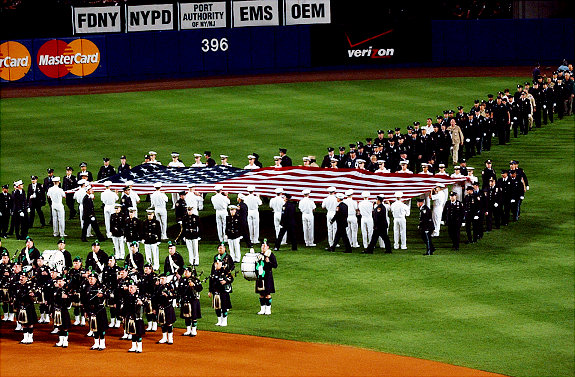
The Mets — and the rest of baseball — got back to work on September 17. New York swept the Pirates in Pittsburgh — now five games back — before heading to Flushing for a highly-anticipated series with the Braves.
Not only was the NL East very much up for grabs, but these were the first games played in New York since the terrorist attacks on the World Trade Center in lower Manhattan.
Mike Piazza was being paid to lead the Mets and did so in an undisputed manner over the second half of the 2001 season.
After slashing a respectable .276/.350/.541 with 21 homers, 48 RBIs, and a 124 wRC+ over the first half, Piazza turned it on over the second half, hitting .330/.424/.612 with 15 homers, 46 RBIs, and a 165 wRC+ down the stretch.
But not one of those home runs was bigger than his eighth-inning blast on September 21 at Big Shea off Atlanta reliever, Steve Karsay.
Not only did his mammoth shot soar clear through the TV camera towers in left-center and stake the Mets to an eventual game-winning 3-2 lead it brought this city back to life — regardless of fan allegiance.
For those who remember these surreal days, this was the fulcrum point where our consciousnesses slipped from shocked to something resembling normal. But back to the pennant race.
A win the following night (Steve Trachsel contributed seven, one-run innings) cut the Braves’ lead to 3.5 games. Holy moly, they were gonna do it. Well, not quite.
A heartbreaking 5-4 loss to Atlanta on Sunday, September 23 courtesy of Armando Benitez‘ ninth-inning meltdown (three runs over 0.2 innings) and Brian Jordan‘s second homer of the game in the 11th off Jerrod Riggan (2.36 ERA over 26.2 IP in the second half) all but halted the Mets’ momentum.
The Mets finished out September on a 4-2 run, keeping similar pace (four games out), but lost four-of-six over the final week of the season, finishing six games out in the East, but making enough of an effort (44-29 after the All-Star break) to close out the year with an 82-80 record.
Steve Trachsel (2.74 ERA over 14 second-half starts), Al Leiter (3.09 ERA), and Kevin Appier (3.23 ERA) helped the Mets starters put up the sixth-best rotational ERA in baseball over the second half (3.51).
Riggan and Rick White (3.42 ERA, 36.2 IP) led the Mets’ relief corps to a 3.51 ERA, good for fourth in baseball, over the same stretch.
Progress was made. Turmoil turned to excitement. It was magical despite the awful, sobering incident dropped smack-dab in the middle of it all.
Guys like Desi Relaford (.312/.369/.520 over 141 second-half PA) and Benny Agbayani (.301/.405/.452 over 111 second-half PA) were the role guys — cogs if you will — that kept the Mets afloat as the core of Edgardo Alfonzo, Robin Ventura, Todd Zeile, Jay Payton, etc found their way.
A quick nod to Rey Ordonez, who hit .280/.335/.401 over the second half that year (229 PA). We were all hoping this was the sign of the arrival of the long-awaited offensive side to his game. Wasn’t in the cards, but that’s neither here nor there.
Here and now, the New York Mets find themselves in similar turmoil. No, they aren’t coming off a World Series appearance, but general manager Brodie Van Wagenen set the bar high and things haven’t worked out.
As bad as things are now, and even if the Mets’ year ends with the other 20 teams at the end of the season, there’s still time to finish out this year with a life-signaling push.
A rebuild — partial or otherwise — is still very much a possibility, despite what we’ve been told (we know better). A strong finish could give this core — and organization — another year to get things on track or, a la Bobby V, get the most out of this group.