
3 UP
1. Callaway and Eiland Fixed the Starting Pitching
While it was not a stated reasons for the hiring, many believed Mickey Callaway was hired to help salvage a once promising Mets rotation which was falling apart at the seams. Hope was bolstered when Dave Eiland was brought onboard to be the pitching coach.
Looking over the rotation in the first half, it seems like the trust placed in Callaway and Eiland was well placed.
Somehow that duo has been able to take Jacob deGrom‘s game to a level some may not have thought possible. This year, we have seen deGrom go from an ace to someone who should win the National League Cy Young award this season.
Both Steven Matz and Zack Wheeler were maddeningly inconsistent injury prone starters. Not only have they remained healthy this season, they are getting stronger as the season progresses.
We are also starting to see Corey Oswalt in the nascent stages of becoming a reliable fourth or fifth starter at the Major League level.
When adding Noah Syndergaard to this mix, you have the makings of what is the best pitching rotation in the National League. Really, if you combine these five starters, they have a 3.20 ERA (as starters). That 3.20 ERA would rank as the best in the National League and the second best in all of baseball.
Considering the progress the Mets starters continue to make, they may be even better than that 3.20 ERA. If so, this is a starting pitching rotation a smart baseball team builds around in what should be the best free agent class we have ever seen.
2. Nimmo Is All That Is Good about Baseball
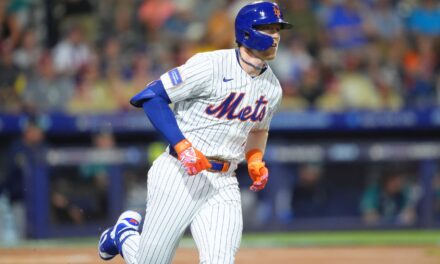
When the Mets signed Jay Bruce to a three-year deal in the offseason, it appeared Brandon Nimmo was never going to get his chance to prove himself as a Major Leaguer, at least not with the Mets. Instead of complaining about it, he maximized each opportunity which came his way. More than that, when he was unfairly sent down to the minors, Nimmo accepted the decision like a man, and he left his manager impressed with how well the conversation went.
No matter what the situation, Nimmo gives his all each and every time he steps on the field. He is constantly hustling, and yes, he’s always smiling. This is a player who genuinely enjoys playing baseball, and he is not afraid to show his enthusiasm for the sport on or off the field.
Behind all of that, Nimmo has shown himself to be an All-Star caliber player. In fact, Nimmo leads National League outfielders in wRC+ (139).
Nimmo has made significant strides as a player, and he has quickly become a fan favorite.
3. Prospect Development
While the Major League team has largely disappointed, we have seen some key Mets prospects make impressions during the first half of the minor league season.
Widely considered to be the Mets best prospect entering the season, Andres Gimenez has only further cemented that status by playing well in the Florida State League. As a result, he has catapulted up from the lower tier of Top 100 prospect lists into the Top 50.
With each and every homer, including his StatCast record breaker in the Future’s Game, Peter Alonso is becoming a legitmate power prospect, which has led to Mets fans to call upon the organization to bring him up to the majors.
After a down year in his first year as a starter, Justin Dunn has made significant strides. He’s learning how to go deeper into games, cutting down on his walks, and he is striking out 10 batters per nine.
Sixth overall pick Jarred Kelenic was hitting so well, he was promoted to Kingsport after just 12 games. What is incredible to ponder is his GCL teammate, Ronny Mauricio, the Mets prize of the 2017 international free agent signing class, had some better stats than Kelenic.
There are a number of other notable performances from players like Tyler Bashlor, Nabil Crismatt, and Anthony Kay.
Overall, the first half of the Mets minor league season was quite promising, and even with the Mets season falling apart, you can see how the future can still be bright for this franchise.

3 DOWN
1. A Team in Disarray
With Sandy Alderson having to step aside due to the recurrence of cancer, the Mets are now an organization in complete disarray at the worst possible time.
This was never more evident than when deGrom’s agent made his statements urging the Mets to trade his client in the event the team is not going to give him a contract extension. That is a crucial decision for the future of the franchise, and it is a decision that is being made on the fly with a team that is utilizing a trio of front office executives as the acting general manager with Jeff Wilpon taking the place of Sandy Alderson.
What is troubling is the Mets seem perfectly content to leave the GM search until the offseason. In the interim, they are going to let people they do not feel even being given the interim make franchise altering decisions like whether or not to trade any of these starters.
Competent franchises don’t work this way.
2. Money Pit
According to Spotrac, the Mets have $94.3 million dollars on the disabled list. This list includes players like David Wright, who is on the disabled list until further notice, and Yoenis Cespedes, who has been injury prone since he signed his first contract with the Mets.
The money problems get worse when you consider how the Mets decided to spend their money this past offseason:
- Jerry Blevins – $7 million (0.1 WAR)
- Jay Bruce – $39 million (-1.0 WAR)
- Todd Frazier – $17 million (1.1 WAR)
- Anthony Swarzak – $14 million (-0.5 WAR)
- Jason Vargas – $16 million (-0.9 WAR)
That’s a combined -1.2 WAR f0r $93 million handed out in options being exercised and free agents being signed. And that is before you account for the mistakes the team made in arbitration like giving AJ Ramos $9.23 million to pitch to a -0.4 WAR before going down with season ending shoulder surgery.
Overall, given how this Mets team spends, it makes this a team with little margin for error. That margin for error gets smaller and smaller when you consider how much money they waste on injury prone players and how they used their money to acquire second or third tier free agents. Ultimately, this is how things fall completely apart.
3. Roster Decisions
Over the course of the season, we have seen Jose Reyes get more chances to get going than the team has given both Luis Guillorme and Dominic Smith to show what they are capable of doing at the Major League. Additionally, the team created the narrative Jeff McNeil is only a second baseman only to have him play third base and left field within a week of that statement being uttered.
The organization decided it was worth giving Vargas the fifth starter’s spot over giving a finally healthy Matt Harvey more than four chances in the rotation. The organization believed Marcos Molina and Chris Beck were worth a roster spot over Hansel Robles, who like Harvey, has performed well in his new home.
By the time the Mets realized Molina and Beck were no longer worthy of a roster spot, they cleared those players away to add players like Drew Gagnon and Matt den Dekker to the 40-man roster.
After two straight seasons where the team had a number of injuries to their pitching rotation, the team opted to save money by moving Robert Gsellman and Seth Lugo to the bullpen over acquiring an additional arm or two in free agency.
Of course, no Mets season is complete without them keeping injured players on the active roster for too long and playing injured players to the point where their injuries become more significant. After all, it was not that long ago the Mets kept playing an injured Bruce at the sake of Nimmo which probably led to Nimmo’s All-Star snub and Bruce’s inability to play in rehab games.