
The Trade
It has been 922 days since former New York Mets general manager Brodie Van Wagenen made the ever highly-debated trade with the Seattle Mariners. As everyone is familiar with, New York acquired Robinson Cano and Edwin Diaz for a package that included top prospects Jarred Kelenic and Justin Dunn.
In his first two years with the Mets, Cano has put a slash line of .275/.312/.463 while accruing a 162-game suspension for this season due to the use of performance-enhancing drugs. Luckily, as for the other piece of the trade? To be blunt it has been borderline elite.
It Was Not All Sunshine And Roses
Diaz’s career as a New York Met started underwhelming, which caused panic and overreactions by several. During the 2019-20 season, Diaz posted a career-high 5.59 ERA, blew seven saves (tied for third most in MLB), and ended up being relegated out of a closer role and into lower-leverage situations.
Further analysis into that season shows it may not have been as bad as it seemed. According to Baseball Savant, Diaz had an xERA of 3.06 (top 9% of the league) compared to his actual 5.59. His xBAA of .188 ranked 39th of 631 qualified pitchers (min. 50 innings pitched). This number also was tied with Cy Young-winning pitcher Jacob deGrom. So, what went wrong?
Diaz gave up extremely hard and high-barreled contact, struggled with his slider, and overall experienced a bit of bad luck. When there is a two-plus point difference in expected and actual ERA and a 100-plus point discrepancy in expected and actual batting average against, play behind the pitcher or “luck” can shoulder some of the blame.
Diaz Has Finally Settled In
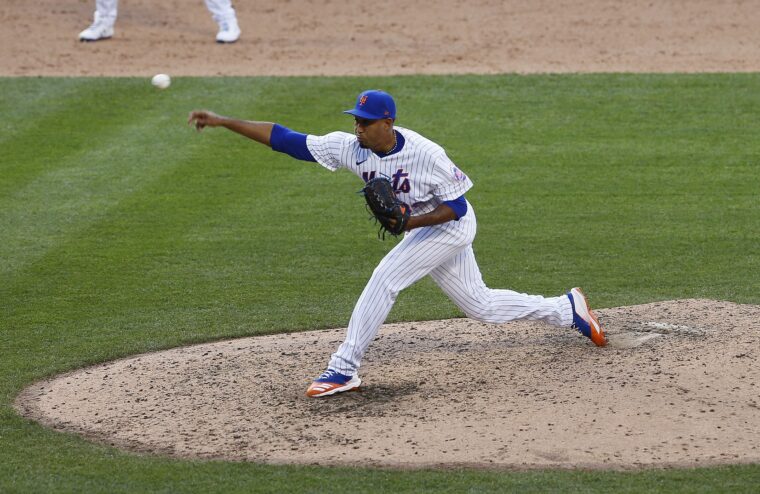
Fortunately, over the past season and a third, the Mets are seeing the type of pitcher they expected when making the trade for the former AL Reliever of the Year. During the shortened 2020-21 campaign, Diaz bounced back and compiled an ERA of 1.75. In doing so, he all but won back his closer role. He adjusted and rectified his contact issues (see table below), fine-tuned his slider back to the terrific pitch it once was (see table below), and overall saw a positive regression back to more deserving numbers.
| 2019 | 2020 | |
| Avg. Exit Velocity | 8th percentile | 81st percentile |
| Max Exit Velocity | 2nd percentile | 76th percentile |
| Barrel % | 8th percentile | 53rd percentile |
| Slider BAA | .297 | .143 |
| Slider Hard Hit % | 47.7 | 26.3 |
The success experienced during his bounce-back season has thankfully carried over to this year as well. Diaz has converted 11 of his 12 save opportunities while posting marvelous analytics that are not so far off from his historic 2018 campaign. Examples of these being his 90th percentile K%, 93rd percentile xERA, and 89th percentile whiff rate, just to mention a few.
Additionally, he has once again limited hard contact against and displayed a slider that is one of the best in the MLB with a BAA of .162 and a K% of 42.1. Each of the above-mentioned areas plagued him back in 2019.
Diaz has cemented himself as an elite closer for the New York Mets and one of the better ones in the league. Just last night was an example of the above being cemented as he tallied a four-out save while overpowering several heart-or-the-order San Diego Padres hitters.
Let’s Not Compare, Rather Marvel
Of course, whenever Diaz is discussed the trade that brought him to New York will be brought up. It is time to let bygones be bygones and focus on the elite play Diaz is now consistently bringing rather than how Kelenic is doing in Seattle. Encouragingly so, it seems this is slowly starting to be the case as fans have rallied around Diaz and his legendary Timmy Trumpet entrance music.
Overall, since the one-off and exaggerated 2019-20 season, Diaz has appeared in 39 games posting elite numbers. Numbers that are reflective of the yearly success he has experienced before coming to the New York Mets. Numbers that cemented him as one of the best relievers in baseball. Folks, the pitcher the New York Mets thought they were trading for back on December 3rd of 2018 is officially here, and here to stay.