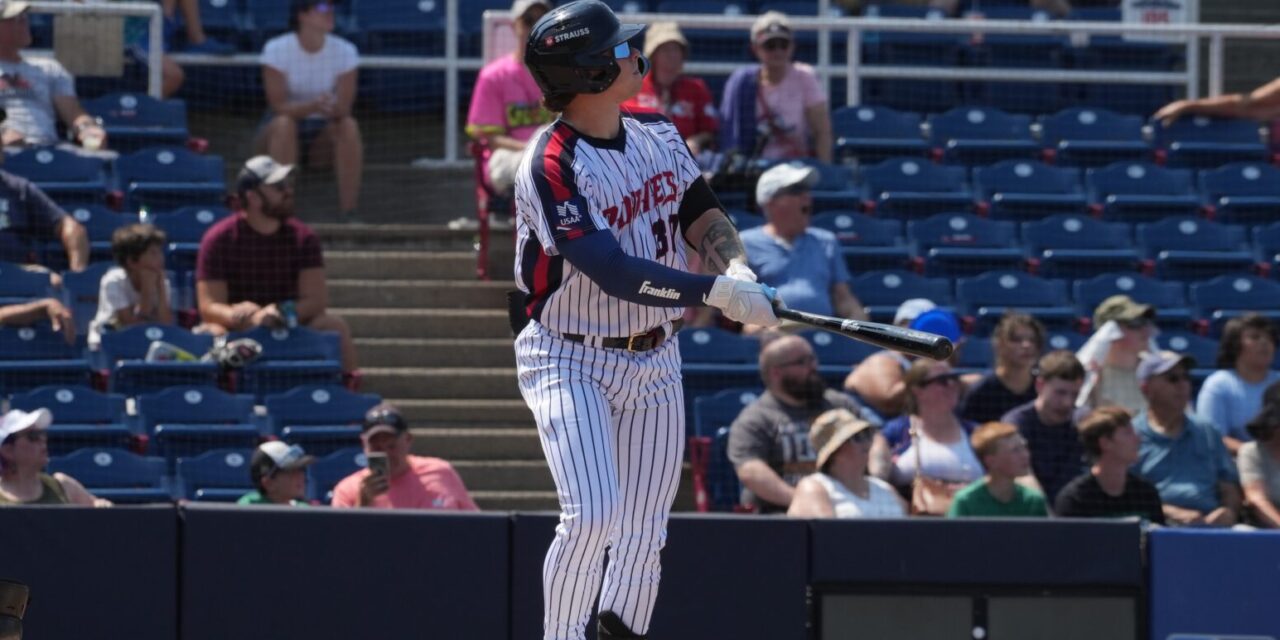
Billy Amick hits bombs. You’ve surely seen them all over social media. Every single time he hits one, it’s there.
Acquired at the trade deadline for A.J. Minter, Amick’s had a loud start to his Mets career. He hit seven homers in 12 games for Double-A Binghamton before his promotion, and has hit five homers in 12 games for Triple-A Syracuse since.
But Amick also strikes out a lot. Yes, a lot of power hitters do, but he strikes out at a rate that even eclipses most of them. Let’s dive into the numbers to find out how concerning the contact issues are, and whether the hype is warranted or if the brakes should be pumped a little bit.
(All stats are of Sept. 8)
Strikeout Rate
Let’s start with basic strikeout rate. At Double-A this season, Amick struck out 127 times in 433 plate appearances, a 29.33% clip.
Since 2021, there have been 105 players to strike out at least 29% of the time in at least 400 plate appearances at Double-A. Only seven have gone on to have any moment of sustained offensive success at the big-league level: Christopher Morel, Michael Toglia, Brenton Doyle, Dillon Dingler, Griffin Conine, Owen Caissie and Spencer Jones.
There are some good players here. Dingler rode a red-hot first half into his first career All-Star selection, but it’s worth noting he has an OPS in the mid-.600s in about 200 plate appearances since the break. Caissie also had a hot start, but has been well below average ever since the third week of the season. Toglia hit 25 home runs in 2024 with the Colorado Rockies, but has since all but fallen out of the league because of his struggles to make contact. Doyle too hit 23 home runs that same year for Colorado, but has seen his offensive production fall off a cliff the last two years. He sticks around because he is an excellent center field defender. Morel is a New York Met right now and showed some promise early in his career with the Chicago Cubs, but has struggled to make rosters over the last three seasons.
The best two of the bunch have been Conine and Jones. Conine showed flashes in his first two abbreviated looks in 2024 and 2025, and has taken his game to the next level in 2026. It’s the largest run of big-league playing time he’s received, and he’s producing. Jones made his MLB debut this year, and while he’s not wowing anyone, he’s staying afloat, producing at a slightly above-average rate through his first 70-plus games.
I am very hesitant to truly declare that either of them will keep this up, though, and it’s for a very simple reason. Look at the other players on the list with them. We’ve seen this before. Conine is a little under 450 plate appearances into his big-league career, and Jones a little under 250 into his. Through his first two years, Morel had a 113 OPS+ through his first two seasons and 854 plate appearances. He also struck out 28.1% of the time, and things eventually unraveled. I think Conine has the best chance to sustain, as his strikeout rate is sitting a hair under 30%, but Jones is over 35%. He’s due for some serious regression.
There have been a handful of others who have big-league service time but never came close to even league-average offensive production: Kahlil Watson, Denzel Clarke, Robert Hassell III, Kyren Paris, Gage Workman, Kameron Misner, Shay Whitcomb and Bryce Teodosio.
There are players at the MLB level who do strike out a lot and produce, though. Kyle Schwarber is the most famous example of this, who is striking out 32.4% of the time and produces more than almost anyone in the league. Oneil Cruz, Nick Kurtz and James Wood all strike out a lot and produce among the best hitters in the league.
But these guys, for the most part, did not strike out that much in the minor leagues. In Schwarber’s 243 plate appearances in Double-A, he struck out 20.2% of the time. Cruz struck out 24.2% of the time. Kurtz flew through the minors but struck out 25.7% of the time in his 101 career MiLB plate appearances in 2025. Wood, who struck out 33.7% of the time at Double-A, is the exception. What he did, though, is cut that number significantly at the next level. His strikeout rate dropped down to 18.2% at Triple-A, and he subsequently gained 49 points in wRC+.
It’s natural to expect a player’s strikeout rate to jump when facing MLB pitching. MLB pitchers are better than Double-A pitchers. If the jump is from the low-to-mid 20s to the high 20s or low 30s—while it will be difficult—some elite power hitters can do it and still produce. But if the starting point is in the high 20s or low 30s and then it jumps even higher, it’s proven to be almost impossible to be productive over an extended stretch.
Amick, right now, is in the latter group.
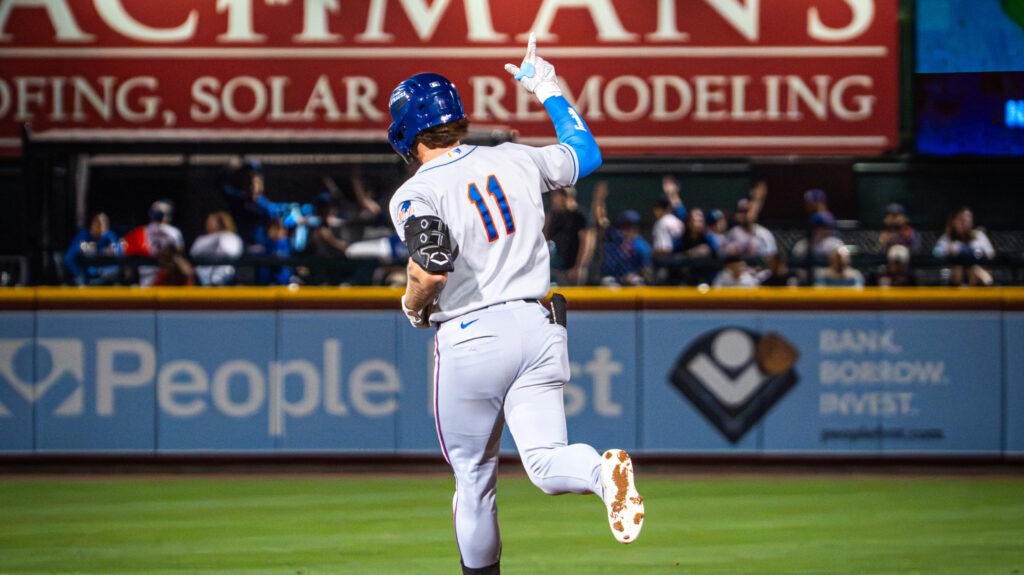
Billy Amick. Photo Credit: Syracuse Mets
In-Zone Contact Rate
Alright, now for in-zone contact rate, which measures exactly what you think it would: how often a player makes contact on pitches in the zone that they swing at. This arguably paints a better picture than strikeout rate. A poor in-zone contact rate is generally under 80%. For reference, among Mets players with at least 200 plate appearances, Francisco Alvarez (77.1%) and Mark Vientos (79.8%) sit at the bottom, with Bo Bichette (90.3%) and Tyrone Taylor (88.2%) at the top. Juan Soto, Francisco Lindor, Carson Benge and A.J. Ewing all sit right about in the 84-86% range.
At Triple-A, Amick’s in-zone contact rate is 70.8%. It’s a very small sample size, but it’s the only level Amick has played at this season that has Statcast data available. His overall contact rate is available at both levels, and it’s pretty consistent across both, so it’s reasonable to figure that his in-zone contact rate is also likely consistent.
There are some familiar names near him on the list. Current Los Angeles Angels outfielder Josh Lowe is there at 68.6%, and he’s been slightly better but still bad in the bigs at 73.6%. Spencer Jones is also here at 69.1%, and he has also improved slightly, up to 74% with the big club. Other recognizable names include Jose Siri, Ryan Noda, Nolan Gorman, Chris Taylor, Blake Perkins, Jacob Melton, Paul DeJong and Tomás Nido. Generally, it’s either young players who haven’t been able to stick due to contact issues or guys trying to hang on at the end of their careers. There are a ton of guys who never made it, too.
One of the more notable names on this list for Mets fans is Ryan Clifford, who has a 73.1% in-zone contact rate. Clifford’s struggles this year have been well documented, and they stem from the amount of swing-and-miss in his game. Amick swings and misses almost exactly as much as Clifford.
Perhaps the best comp, though, is former Mets minor leaguer Luke Ritter. The former Syracuse Mets slugger played 22 games at Triple-A this year for the Phillies before he was released. In those games, his in-zone contact rate was 68.7%. That’s down from where he was with the Mets, but not by a ton. In parts of three Triple-A seasons in the Mets organization, Ritter generally ran an in-zone contact rate between 74-78%. He hit a lot of home runs, and his 26 jacks in 2024 paired with a .849 OPS started some to call for him to be promoted. He never got the call, though, and saw his OPS drop under .700 in 2025 before the Mets moved on.
Ritter was a utility player who saw most of his time at the two corner infield spots but also played some second base and corner outfield. Amick offers less defensive versatility, only playing first and third base, while also making less contact.
When we go back over the last few years to see who else ran similar in-zone contact rates, we see a lot of players who got MLB looks because of their power but could never hang around. Eric Haase. Stone Garrett. Parker Meadows. Bobby Dalbec. These are the players who make contact similar to Amick. They produce in the minors. Dalbec had an .874 OPS with 24 homers in 105 Triple-A games last season. He also had a 73.1% in-zone contact rate. He is playing in Japan this season.
Every once in a while, a name like Zack Gelof pops up, but even then, he actually only reinforces this point. Gelof is having a positive 2026 season, posting an OPS in the high .700s with close to 20 homers. He’s been an above-average hitter this year, no doubt. He’s also raised his in-zone contact rate almost a full 10%, from 68.1% last season to 77.9% this season. It’s still not good, but it’s much better. It’s been good enough for him to produce, even if his home ballpark in Sacramento has helped (he has an OPS close to .900 at home and under .700 on the road). He was unplayable last season with a .502 OPS in 101 plate appearances. Now, his contact improves, and it’s a completely different story.
A player doesn’t need elite contact to produce. Schwarber, Kurtz and those like them are proof of that. But it also can’t be as low as Amick’s currently is. Kurtz’s in-zone contact is at 73% and Schwarber’s is at 76.4% this year versus big-league pitching. In his 97 Triple-A plate appearances last season, Kurtz’s in-zone contact 2as 79.5%. Data doesn’t extend far enough back for Schwarber.
Amick’s 70.8% in-zone contact rate versus Triple-A pitching is unsustainable. His power is real, and he’s only 23 years old. There’s plenty of time for him to make some contact gains. But there’s a reason he was not ranked inside the Minnesota Twins’ top 30 prospects on MLB Pipeline or Baseball America when he was acquired, nor is he ranked for the Mets now. Until those contact gains come, he should not be viewed as a legitimate option for the big-league roster.