
The New York Mets won their fourth straight and 10th of their last 13 Monday night, continuing their surprising surge since becoming the biggest sellers at the trade deadline. Run prevention was the name of the game Monday night against the San Diego Padres who currently hold the third NL Wild Card spot. The Mets took the series opener, 2-1, behind rookie Nolan McLean, who battled in and out of trouble all night. A lockdown bullpen performance and an exhilarating defensive showing from the Psychos finished the job.
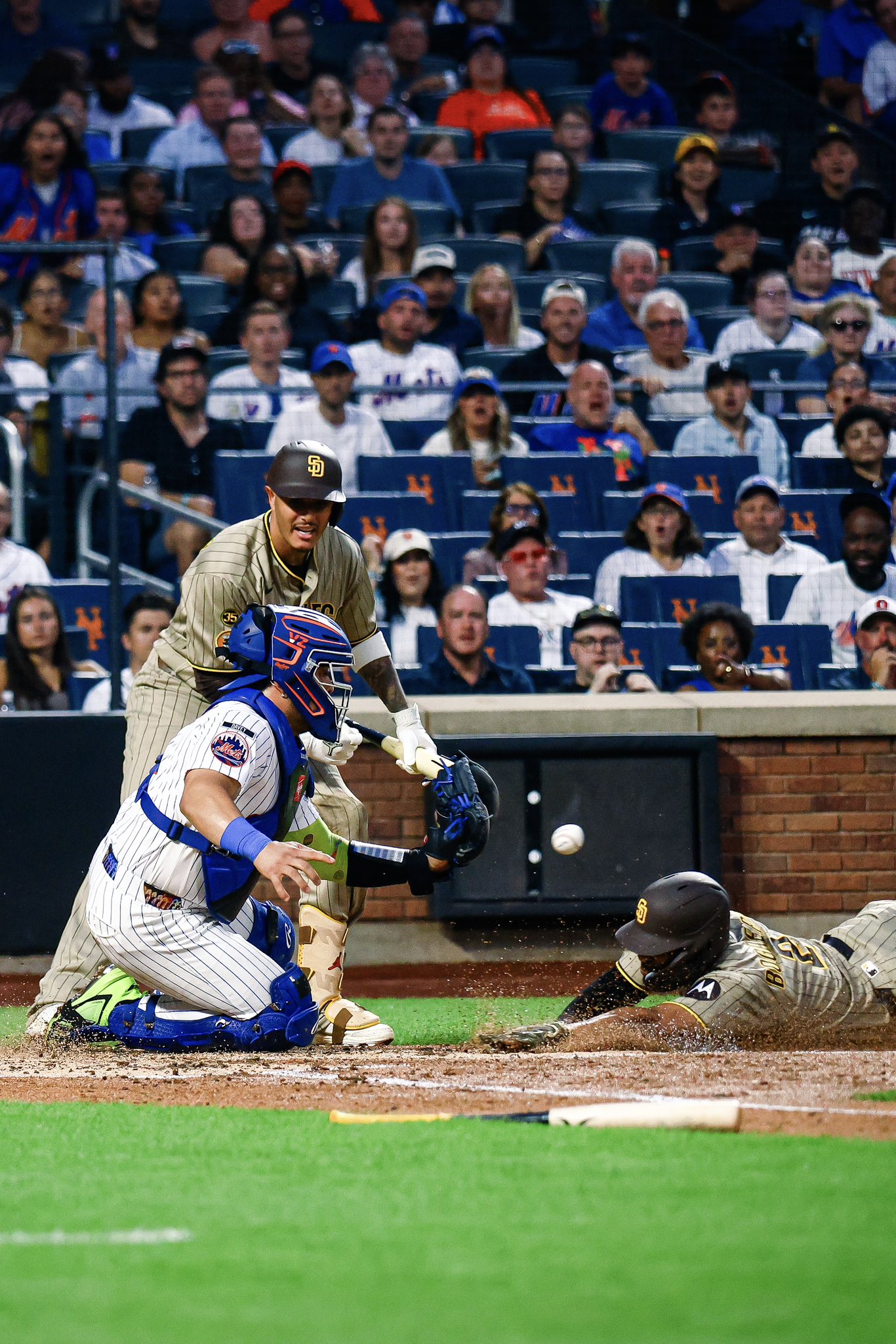
Francisco Alvarez tags out Xander Bogaerts on A.J. Ewing’s outfield assist.
Photo By Berto Carlo
AJ Ewing added his own thrilling run saving assist in the top of the second inning, but it was the cannon attached to Carson Benge’s torso that took center stage. After McLean quickly allowed two singles, it was the third single in a row that threatened to give the Mets an early deficit. Following a questionable call to send Jake Cronenworth home, Benge unleashed a 99.9 mph rocket that arrived at home plate with plenty of time. The next batter? Benge hit replay, except he outdid himself with a 103.9 mph missile (2026’s fastest throw) to nab Manny Machado at home and get the Mets out of the inning.
The two assists in the first inning was Benge’s eighth and ninth on the year. Benge is quickly making the case for having the best arm in baseball. He’s made history as the first player to have two outfield assists of over 99 mph in one inning in the Statcast era. If he has one more assist of over 98 mph before the year ends, he’ll tie Brenton Doyle‘s record from 2023 for the most such assists in a single season.
But an incredible arm isn’t the only case Benge should be carrying around. He also should be making waves in the Rookie of The Year race. Benge ranked a distant third (tied with teammate McLean) in ESPN’s latest odds update on the ROTY race. The two players ahead of him are Cardinals’ second baseman JJ Wetherholt, and Reds corner infielder, Sal Stewart. Let’s break it down.
| 2026 | fWAR | ABs | Hits | HR | RBI | SB | OPS | xwOBA | wRC+ |
| Wetherholt | 4.3 | 464 | 113 | 16 | 46 | 13 | .724 | .347 | 107 |
| Stewart | 2.0 | 476 | 123 | 26 | 91 | 12 | .806 | .346 | 114 |
| Benge | 2.6 | 451 | 123 | 14 | 49 | 18 | .750 | .343 | 112 |
At first glance, Wetherholt’s elite defense gives him a clear advantage in WAR over both Stewart and Benge. While Stewart is having the best offensive production, Benge is comfortably in the middle of the two on each side of the ball. He’s bringing more value on the offensive side than Wetherholt but not Stewart, and he’s bringing more value defensively than Stewart but not Wetherholt. When you look at their advanced metrics, the offense is closer than the raw counting stats make it seem.
Wetherholt may have the defensive edge due to his incredible 22 OAA, but Benge has a weapon Wetherholt can’t match: an absolute cannon in right field.
But there’s one clear caveat that can’t be overlooked. Baseball is a long season and the race will take into account each player’s full body of work, every game, week, and month played. But one month sticks out above the rest: April. For Wetherholt and Stewart, it sticks out because they came out of the gate on fire. Each posted their best months of the season before folks could reliably pack away their winter coats. Stewart posted a .943 OPS in April with nine home runs and Wetherholt posted an .856 OPS in April with seven home runs. Benge on the other hand, had by far his worst month of the year in April with a .525 OPS and two home runs. Let’s take a look how they’ve performed since the calendar flipped to May:
| Since 5/1/26 | fWAR | ABs | Hits | HR | RBI | SB | OPS | xwOBA | wRC+ |
| Wetherholt | 2.6 | 347 | 83 | 9 | 30 | 9 | .678 | .341 | 95 |
| Stewart | 0.8 | 362 | 91 | 17 | 62 | 5 | .762 | .327 | 102 |
| Benge | 2.7 | 361 | 106 | 12 | 43 | 12 | .806 | .357 | 127 |
The differences start to lean significantly more in favor of Benge since May 1. While a lot of rookies understandably struggle as the year progresses due to the grind and opposing pitchers having a more complete scouting report on them, Benge has done the opposite. After a brief adjustment period, he’s only gotten better as the season has progressed. More importantly, Benge’s 2.7 fWAR is the highest of the three and his .357 xwOBA since May 1 is comfortably better. That’s a pretty compelling indication that his production isn’t simply the product of good fortune.
Wetherholt may have built his lead in April, but Benge has spent the last three months erasing it. He has steadily closed the distance while becoming one of the most impactful rookies in the National League. If his second-half surge continues, the Mets outfielder may have a legitimate shot at turning this into a two-man race.