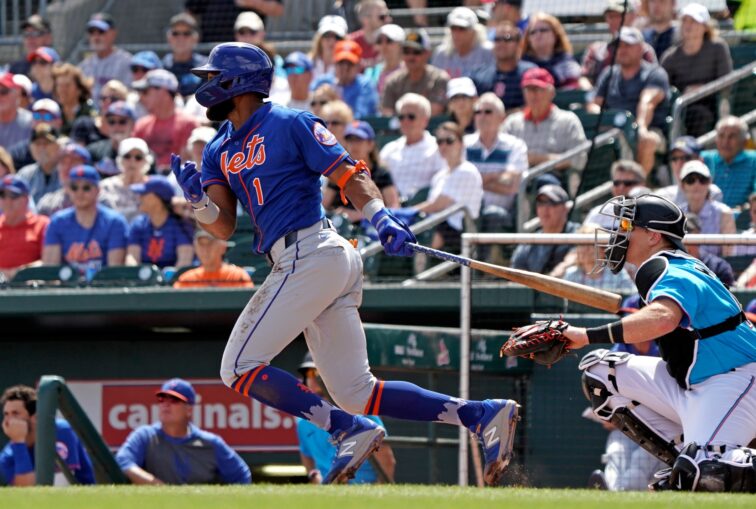
The 2020 regular season has included some good moments for the New York Mets. But mostly, it’s been frustrating for a squad that owns a 9-14 record and seems to always take two steps backward after taking one forward.
In those frustrating moments and performances, shortstop Amed Rosario can unfortunately be found toward the top of the list.
The 24-year-old appeared to be coming into his own thanks to a 2.7-fWAR performance in 2019. It had been a years-long buildup, but with each campaign since debuting in August 2017, Rosario had found a way to improve on offense. Even if it was just a slight improvement, there was reason to be encouraged because he was moving in the right direction.
It feels like most of that optimism has gone straight out the window these days. Through 66 plate appearances thanks to a pinch-hitting appearance Sunday afternoon, the former top prospect is struggling to a .197/.197/.288 line with just three extra-base hits (one double, one triple, and one home run), four RBI, eight runs scored, and no stolen bases. Among hitters with at least 60 plate appearances so far this year, Rosario’s 32 wRC+ is the fifth-worst mark in baseball.
While this start in particular is pretty bad, watching Rosario start slow out of the gate isn’t overly surprising, mostly because it’s something he’s done rather consistently in 2018 and 2019. It was so pronounced in the past that I mentioned how a strong start was key for the young shortstop back in February, which feels like 20 years ago because we were still anticipating a 162-game season at that point.
As the days passed and the size of MLB’s regular season kept shrinking, Rosario was one of the few Mets players on my mind because of this fact. Slow starts are never fun, but it’s easier to eventually get it erased during a six-month regular season schedule. Any kind of prolonged slump at the beginning of a two-month season obviously has much greater ramifications for a player’s overall performance.
Was it possible to see what’s happening to Rosario coming, though? If we look back at his 2019 campaign and split up his performance into two halves (pre- and post-All-Star break), it’s clear that some of his peripherals didn’t exactly match up to the success he experienced. The same could be said about his less-than-stellar first half, so it was easy to chalk this up to the Baseball Gods evening things out a bit.
But some of those potentially concerning peripherals have gotten more concerning over the past three-plus weeks. Prior to Sunday’s game, Rosario’s batted-ball profile looked not so great in just about every way imaginable:

None of these numbers should be surprising after seeing how much he’s regressed in the plate-discipline department. He’s the only hitter with 60-plus plate appearances to not draw a walk yet in 2020, and he’s taken a significant step back with regard to his chase rate (38.1% to 44.6%) and swing rate on strikes (71.8% to 63.7%). There also hasn’t been a significant change in his overall contact rate (77.6% to 77.8%), which makes it awfully hard to have any kind of success.
Rosario’s .235 BABIP is much lower than what he’s done previously in his career (has never finished below .310 in a single season). After viewing some of these numbers, though, it’s hard to see how it’ll ever improve unless his approach starts shifting back to what it was.
This may be difficult to do moving forward based on the Mets’ current situation. Sure, they’re only four games behind first place, but it’s not as if the club is firing on all cylinders at the moment. With that in mind, it only makes sense for manager Luis Rojas to go with what actually is working. Robinson Cano will eventually be manning second base again on a regular basis now that he’s back from the Injured List and still looking good at the plate, and both Luis Guillorme and Andres Gimenez haven’t given Rojas any reason to bench them consistently to play Rosario.
Rojas did recently say Rosario is the team’s starting shortstop, and it’ll be impossible for the 24-year-old to start hitting again without getting the necessary on-field reps. However, Rosario’s inferior defensive performance (when compared to both Guillorme and Gimenez) will also make it difficult for him to run out and play shortstop every single day. This is a great example of how quickly things can change in baseball. One minute, Rosario looks rather entrenched as New York’s every-day shortstop for at least the 2020 season, but now, who knows how long that’ll last if his struggles continue.
Baseball has always been and will always be a results-oriented, “what have you done for me lately” business. That’s more apparent now than ever before with a 60-game regular season, and we’ll soon find out how much a pitiful start at the plate from Rosario will impact his playing time over the next six weeks.