
Player Data: Age: 38 (6/29/1988) B/T: L/L
2026 Traditional Stats: 61 G, 52 2/3 IP, 3.25 ERA, 1.272 WHIP, 5-7, 51 K
2026 Advanced Stats: 129 ERA+, 22.8% K%, 8.9% BB%, 3.96 xERA, 3.95 FIP, 4.16 xFIP, 0.5 fWAR, 1.1 bWAR

Breakdown
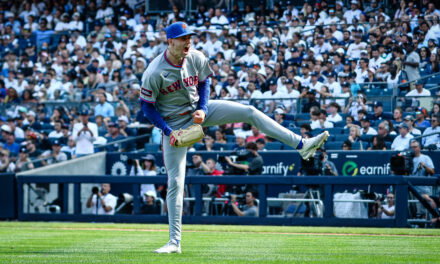
As reported by SNY’s Chelsea Janes, the New York Mets have checked in with left-handed reliever Brooks Raley, which makes sense considering his previous success with the club. Raley was a key member of the Mets’ bullpen before being traded to the Philadelphia Phillies at last season’s trade deadline. However, his time in Philadelphia was nothing short of a dud, making a return to the Mets an intriguing possibility as he enters free agency.
Before the trade, Raley appeared in 45 games for the Mets, marking himself as an important piece in their bullpen. Despite a disappointing overall season for the Mets in 2026, their bullpen was one of the team’s more consistent strengths. New York’s relievers collectively posted a 3.82 ERA and a 3.79 xERA, along with a strikeout-minus-walk rate of 15.1%, ranking fourth in baseball before the trade deadline.
Raley largely contributed to that success. Across 41 1/3 innings with the Mets, the crafty lefty recorded a 1.96 ERA, making him one of the more dependable options in Carlos Mendoza‘s and Andy Green‘s bullpen. He excelled in seventh-inning and set-up situations, providing the Mets with an experienced left-handed arm capable of handling hitters from both sides of the plate.
Over four seasons with the Mets, Raley recorded a 2.33 ERA in 148 appearances, which highlighted his comfort in pitching at Citi Field and in a Mets uniform. When New York traded him in early August, he was considered one of the better left-handed relievers available, particularly since he had pitched well after successfully returning from Tommy John surgery.
His performance against both left-handed and right-handed hitters highlighted his versatility. Before the trade, left-handers batted .186 with a .542 OPS against him, while right-handers managed a .216 average and a .636 OPS. Although he was more effective against lefties, the differences suggested he could handle varied matchups.
However, concerns about Raley’s performance began to pop up after the trade. Despite solid results with the Mets, underlying metrics indicated signs of regression. After joining the Phillies at the trade deadline, he struggled mightily, blowing a save in his first appearance. In 16 total games for Philadelphia, Raley went 0-2 with a 7.94 ERA, allowing 11 runs over 11 1/3 innings and finishing with a -0.3 bWAR. His lack of success with Philly led to him being left off the Wild Card roster.
Over his career, Raley has focused on forcing contact rather than overpowering hitters. According to Baseball Savant for the 2026 season, he ranked in the 91st percentile for hard-hit percentage, 77th for average exit velocity, and 65th for barrel percentage, showing his effectiveness in preventing hard contact. However, his expected stats were more modest, with a 55th-percentile xERA and 57th-percentile xBA. His strikeout and chase rates were in the mid-50s, while his whiff (36th percentile) and walk rates (43rd percentile) note potential areas for improvement.
His velocity is also a limitation, averaging just 90.3 mph on his sinker (4th percentile) with an extension in the 8th percentile. He relies on movement and location, using a four-pitch arsenal: a sweeper (36% usage), cutter (30%), sinker (22%), and changeup (13%). The sweeper is his main pitch, and the cutter helps induce weak contact.
Contract
Raley will be entering his age-39 season, and his struggles in the second half of the season raise questions about his consistency over a full year. His 7.94 ERA with Philadelphia shouldn’t define his entire career, but it’s hard to overlook when evaluating his next contract.
A reunion on a short-term, relatively inexpensive deal would allow the Mets to bring back a familiar face without taking on significant financial risk. Raley wouldn’t necessarily need to return as a primary set-up man; instead, a more limited role focusing on left-handed hitters could help him showcase his remaining strengths.
When the Mets signed Raley in 2025, his salary was $2.3 million, with a team option for 2026 valued at approximately $1.4 million. If a potential reunion occurs, the contract would likely resemble the $1.4 million he earned in 2026, possibly including an option based on how the team views Raley’s fit in their plans for the future.
Recommendation: Worth Checking In
Despite his lackluster performance in Philadelphia, there is a strong case for the Mets to consider bringing Raley back. The Mets have a history of getting productive innings out of him, and his performance in 2026 before the trade deadline showed that he still has something to offer. His ability to suppress hard contact remains a huge plus, especially for a left-handed reliever who does not rely on velocity to get outs.
Raley has proven that he can be an effective reliever in Queens. His time in Philadelphia revealed some limitations related to his age and declining skills, but his underlying ability to limit hard contact suggests he may still have value in the right situation.
For the Mets, a reunion with Raley would represent a relatively low-risk opportunity to add an experienced left-handed reliever who is already acquainted with the organization. Bringing Raley back to Queens could be a smart move for a team looking to stabilize their bullpen.