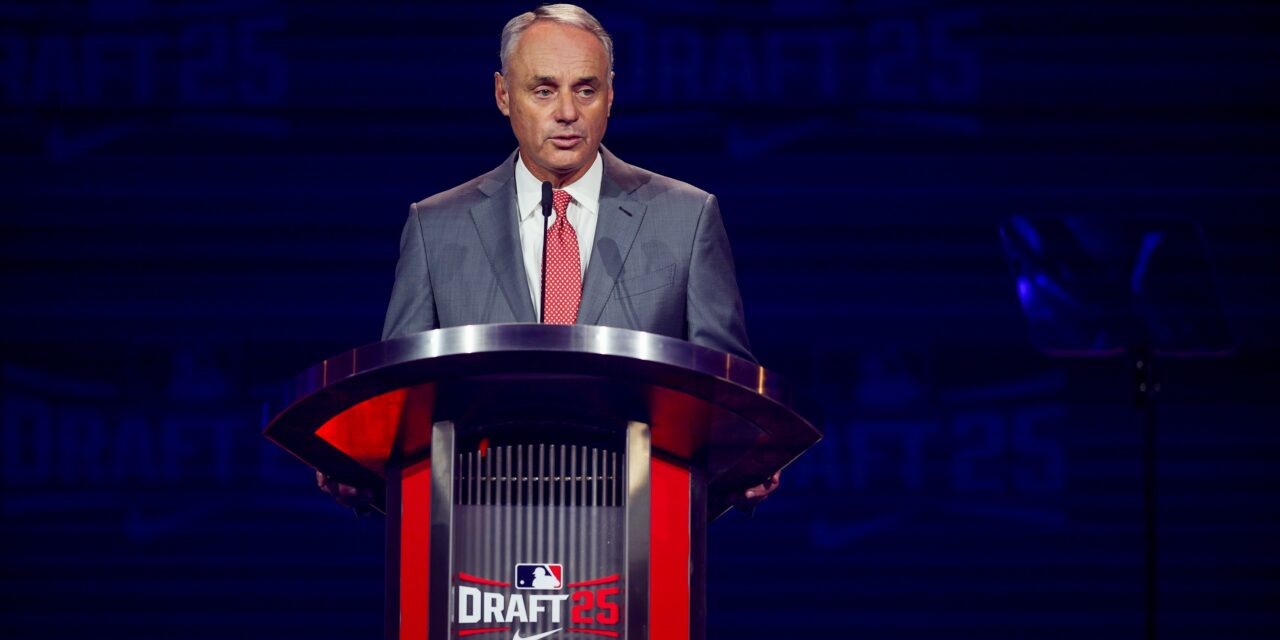
Major League Baseball had proposed completely overhauling the draft in its most recent proposal. Below is a breakdown of the biggest changes.
High School Eligibility
In MLB’s proposal, high school players will no longer be eligible to be drafted. Recent Met high school draftees include A.J. Ewing, Jonah Tong, Brett Baty, and Mark Vientos.
Currently, a player must be in their junior year and turning 21 years old by August 1 of their draft year to be eligible out of college. In this new system, the college players would be eligible a year earlier in their sophomore year, and age 20 by September 1.
MLB Draft combine medical evaluations would become mandatory. This would prevent surprises like the Mets had with Kumar Rocker in 2021.
Draft Length
MLB looks to cut the draft from 20 rounds to 12 rounds, slash draft bonuses by 50%, and allow for more expansive draft pick trading. Teams can only trade within a draft cycle – you cannot trade a 2029 pick before the 2028 draft has concluded. Teams will not be able to trade first-round picks in back-to-back drafts. Teams will not be able to trade draft picks once the first round has concluded. The draft previously shrank from 40 rounds to 20 rounds in 2021.
The most notable Mets players over the last 20 years taken between rounds 13-20 are Daniel Murphy, taken in round 13 of the 2006 draft, and Lucas Duda, taken in round 20 of the 2007 draft.
MLB also wants to institute hard slot values, which means draftees will no longer be able to negotiate signing bonuses. The Mets taking Brett Baty under slot so they could sign Matt Allan over slot in the third round would not be possible with this system.
Ten players selected by MLB would also have to attend the draft and would be paid $50,000 for their appearance.
International Draft and Undrafted Free Agents
MLB proposes a separate international draft with a similar structure to the major league one, but with significantly smaller bonus pools than the domestic draft. Eligibility for international signings would increase from age 17 to age 18.
Un-drafted free agent signings would drop from $125,000 to $10,000. Teams can sign as many of these players as they want, but the goal is to push these players to college baseball, where they can develop at no cost to major league teams. These players would be rule five eligible after only two years, but teams can give them a $30,000 bonus to push that eligibility back a year.
Why Does MLB Want This?
The most obvious answer is that this puts more money in the owners’ pockets. Fewer rounds with set, smaller bonuses are a savings of their own – expected to go from $13.379 million on average to $6.67 million – but eliminating the high school eligibility greatly decreases scouting costs. MLB has been shrinking the size of the minor leagues, and eliminating high schoolers from being drafted likely plays into that as well. Having fewer young players in systems makes it easier to consolidate the minor leagues. The owners also save $115,000 per undrafted free agent as well.
This could also increase interest in the MLB draft as college players typically reach the majors much more quickly than high school players.
Will the Union Support This?
Across the board, the answer is likely no. That should be expected from early proposals, which tend to skew heavily one side to the other. You need to start far apart if you want to negotiate to the middle. This proposal also gives the owners things that can drop in negotiations to go after bigger fish.
The players’ union is unlikely to accept a proposal that cuts the draft by so much, especially in terms of money. They have long fought against an international draft, and this proposal is unlikely to change their minds. They have not supported shrinking the minor leagues and eliminating domestic high school players will likely be a non-starter.
There is still almost half a year until the collective bargaining agreement ends, and there will be many changes to these proposals in the meantime.