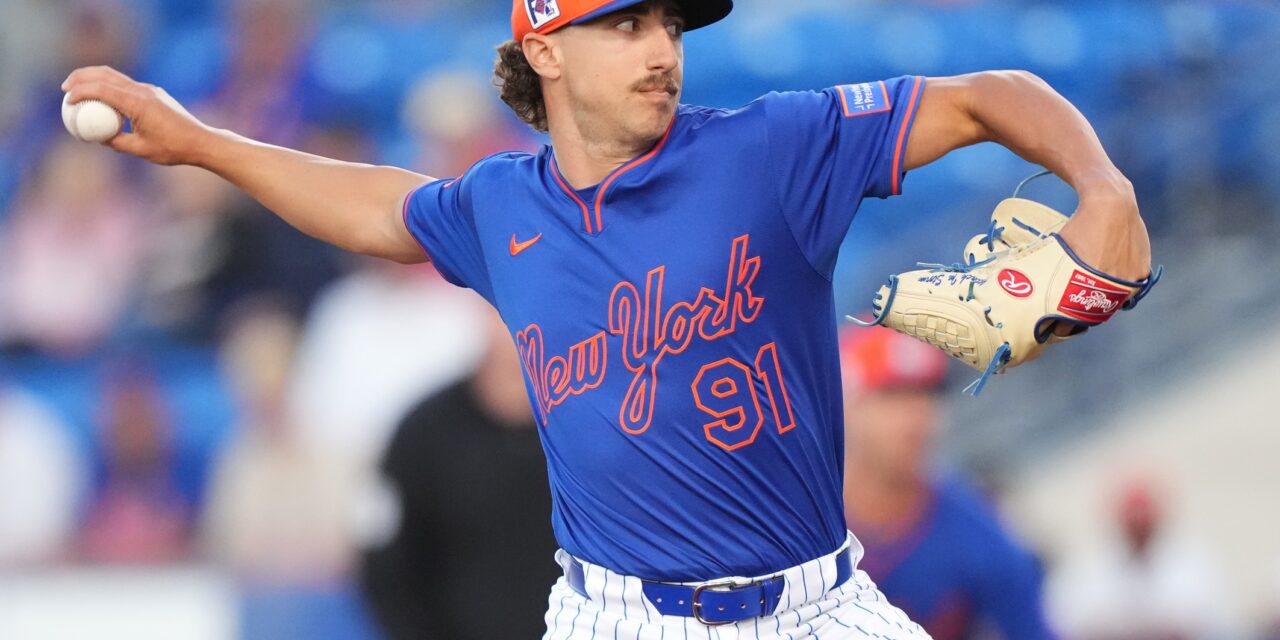
Brandon Sproat entered 2025 as the Mets’ top pitching prospect and a Top 100 prospect in baseball, but for the first three months of the season, he largely struggled.
He struggled in Triple-A in 2024 as well after blowing through High-A and Double-A, but it was largely written off as fatigue from reaching his third level of the minor leagues in his first season of professional baseball. When those struggles continued well into 2025, it sounded the alarms. Sproat tumbled off the top 100 prospect lists and was passed by Nolan McLean and Jonah Tong in his the ranks of own organization.
Then, in his final start of June, things clicked. In six starts from June 28 to July 31, Sproat gave up just two earned runs in 33 innings—a 0.55 ERA. He struck out 39 while giving up just 16 hits and 11 walks. How did this happen? Thanks to pitch data (via Thomas Nestico, @TJStats), we can try to find the answers.
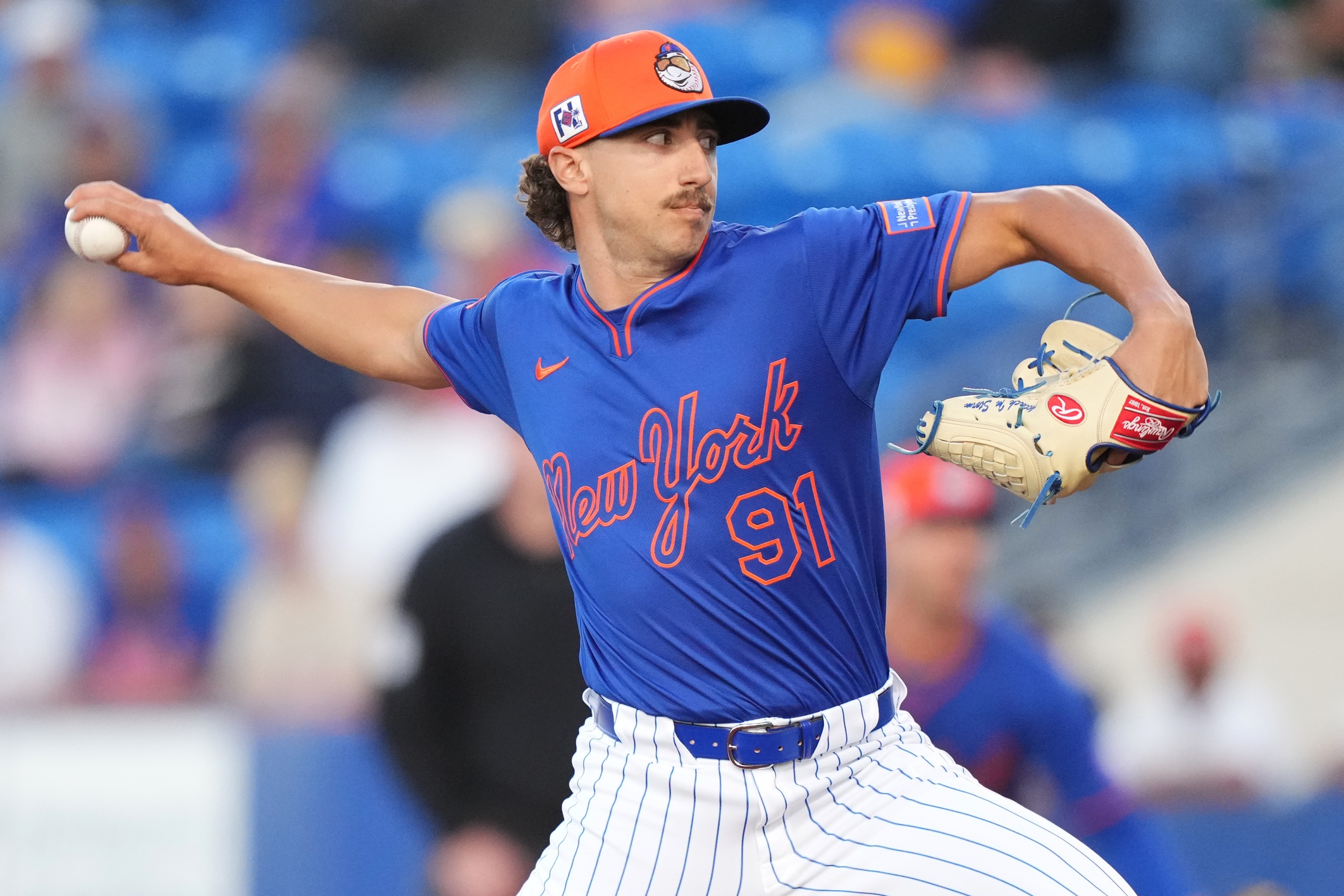
Brandon Sproat. Photo Credit: Jim Rassol-Imagn Images
Why did Sproat struggle in Triple-A in 2024?
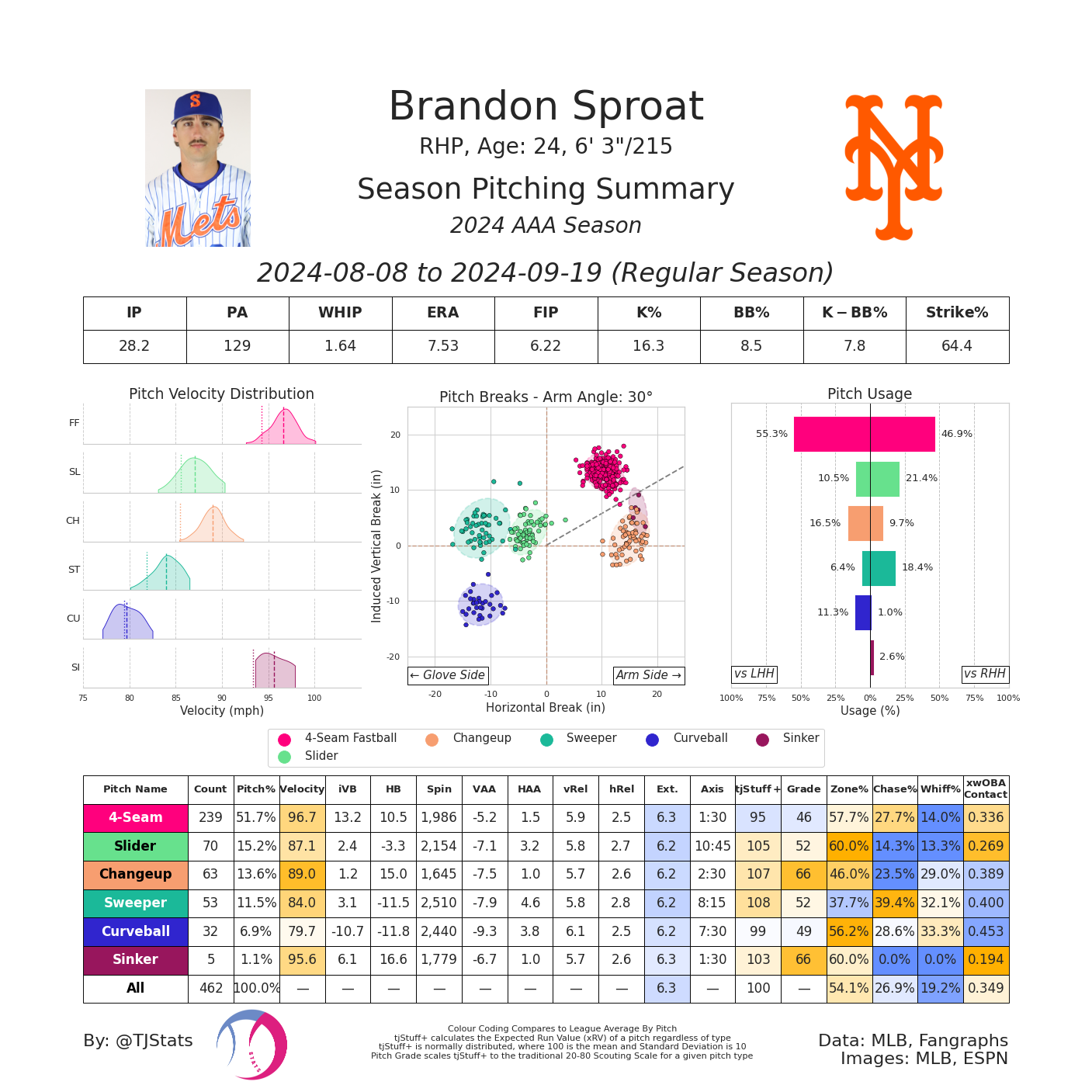
Sproat’s primary offering is his fastball. It’s a hard one—regularly hitting 97 mph and above—but it’s unspectacular. He gets poor induced vertical break (IVB) on his four-seam, resulting in it often playing worse than fastballs thrown much slower. To end last season, it did not perform great. It wasn’t bad, with hitters recording a fine .336 xwOBA against it, but he didn’t miss bats. Just 17 of the 121 fastballs that opposing hitters swung at resulted in a whiff, a mark of 14%.
He struggled to induce swing and miss with his other pitches as well. His slider was his most-used secondary and recorded the best quality of contact against of any of his pitches (besides his sinker, which he threw five times), but also recorded just a 13.3% whiff rate. He threw 70 sliders last year, had people offer at it 30 times, and got just four swings and misses.
The changeup, sweeper and curveball all ran better whiff rates, but were all just around league average. None of them stood out as a big swing and miss pitch, and batters hit them hard when they did connect.
As a result of all of this, his strikeout rate plummeted once he reached Triple-A. Striking out 32.4% of hitters in High-A and 33.2% of hitters in Double-A, he struck out just 16.3% of hitters in Triple-A. His batting average against and WHIP soared, leading to a 7.53 ERA over his seven starts at the level.
Courtesy of Thomas Nestico @TJStats on X.
Why did those struggles continue into 2025?
In Sproat’s first start of 2025, he allowed three hits, three walks, and four earned runs in two innings with three strikeouts. His ERA at the end of April stood at 5.48 and rose to 6.02 by the end of May. He then treaded water for most of June, sitting at 5.95 through his first four starts.
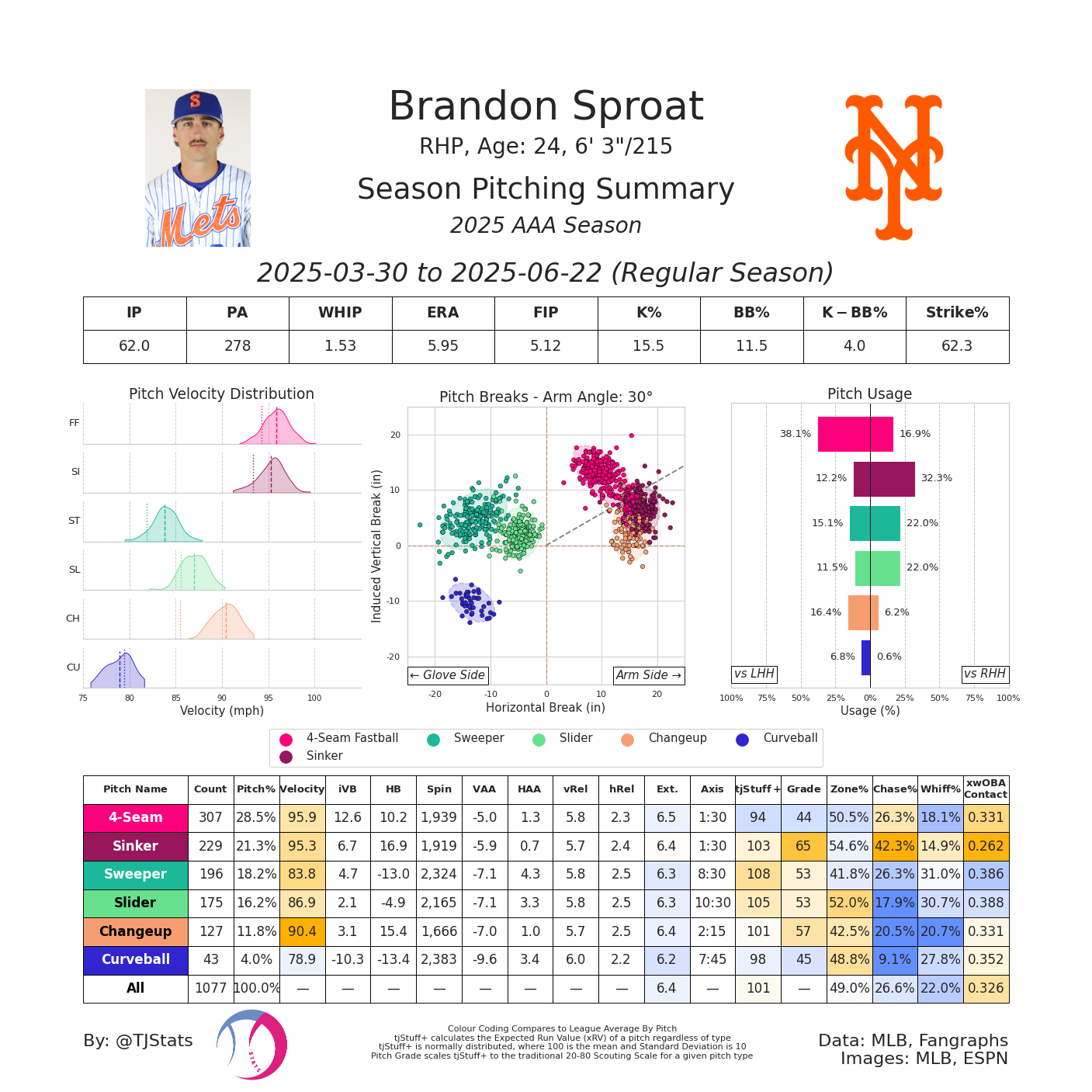
The first thing that jumps out about his arsenal is the usage rate on his pitches. The sinker, which basically didn’t exist in 2024, flew up to his second-most-used pitch. It was good too, getting a 42.3% chase rate. The whiff rate wasn’t outstanding at 14.9%, but that’s often not the intent behind throwing a sinker. The purpose is to generate weak contact and ground balls, and the 0.262 xwOBA against supports that.
The rest of the arsenal lagged behind. His four-seam velocity was down almost a full mph from where it was in 2024, and he got similar chase rates, whiff rates and quality of contact. He threw his four-seam much less than he did in 2024 because of the sinker. In 2024, Sproat threw 52.8% fastballs, with 51.7% of them being four-seamers. From the start of 2025 to June 22, he threw 28.5% four-seamers and 21.3% sinkers, so 49.8% fastballs. His fastball usage mostly stayed the same; he just threw two different variations instead of primarily one.
The secondaries all performed poorly. None of the sweeper, slider, changeup or curveball produced good chase or whiff rates, and for the most part, all allowed mediocre-to-below-average quality of contact metrics. Sproat struck out just 15.5% of batters over his first 15 starts and 62 innings, which was the ninth-worst of 86 Triple-A pitchers to record at least 200 plate appearances from the start of 2025 to June 22.
Courtesy of Thomas Nestico @TJStats on X.
What changed to help him turn it around?
In Sproat’s final start of June, he threw six scoreless innings while allowing two hits and three walks while striking out six. It wasn’t perfect, but it was easily his best start of the season to that point. He had just two scoreless outings in his previous 15 games and struck out six just once. The dominance continued into July. He followed up his final June start with four of five outings without giving up an earned run, surrendering his only two runs of the six-game stretch in a five-inning, two-run showing on July 25.
Here, his velocity is what jumps off the page. After averaging 96.7 mph on his four-seam to end 2024 and 95.9 mph through his first 15 starts of 2025, Sproat averaged 97.3 mph on his four-seam from June 28 to July 31. In his first 15 starts, Sproat threw 91 of his 536 (17%) four-seamers and sinkers at 97 mph or faster. In his next six starts, he threw 123 of his 151 (81%) four-seamers and sinkers at 97 mph or faster. Again, the four-seam is unspectacular—but it can still work when thrown that hard.
It wasn’t just his four-seam. Four of his five other pitches made velocity gains.
- Sinker: 95.3 mph to 96.1 mph
- Sweeper: 83.8 mph to 85.0 mph
- Slider: 86.9 mph to 89.3 mph
- Curveball: 78.9 mph to 81.0 mph
The only one of his pitches that didn’t gain velocity was his changeup, which averaged 90.3 mph opposed to the previous 90.4 mph. The changeup, which jumped to his second-most-used pitch, is maybe the other most notable thing on this chart. It was a weapon for Sproat, recording the highest whiff percentage of any of his pitches. Hitters chased it, missed it, and made weak contact when they did hit it.
The sinker usage dropped a bit, going from 21.3% to 13%, which is interesting because it was his most effective pitch when he was struggling in the first half of the season. In this stretch, though, it oddly wasn’t as effective at producing weak contact. It wasn’t bad, but the xwOBA against is more in line with league averages, so that could explain why he threw it less.
The sweeper was great, and while hitters didn’t chase it a ton, they still swung and missed enough to be effective. What stands out here is the quality of contact against this pitch when hitters did connect, which was a paltry 0.069. The curveball, which he used just 4% of the time before this stretch, recorded the second-best chase and whiff rate of all his offerings, and saw its usage rate jump to 12.2%. His slider was his least-used pitch and recorded the worst xwOBA against. He threw it for strikes more than any other pitch, but hitters didn’t chase it or whiff at it much and made solid contact against it.
Overall, it was a triumphant stretch for Sproat. His velocity returned to what people are accustomed to seeing from him, and as a result, all of his pitchers performed better. Not only were the secondaries stronger on their own, but a higher-quality heater also helps the secondary offerings play better off of it.
His strikeout rate jumped from 16.3% in 2024 and 15.5% in his first 15 starts of 2025 to 31.2% in this six-start stretch—back in the range of when he dominated High-A and Double-A. He’s also getting a ton of ground balls. On the season, his ground ball rate is 54.4%, a big jump from his already good 46.8% rate at Triple-A last season.

Courtesy of Thomas Nestico @TJStats on X.
Why has he struggled again in his first two starts in August?
Sproat dominated July, but got hit a bit in his first start of August. It wasn’t anything major, but he gave up three earned runs in six innings. He also allowed his first home run since June 22. It was his next start that blew up on him, when he surrendered five earned runs in 3 and 1/3 innings.
What changed? Based on the data, not much.
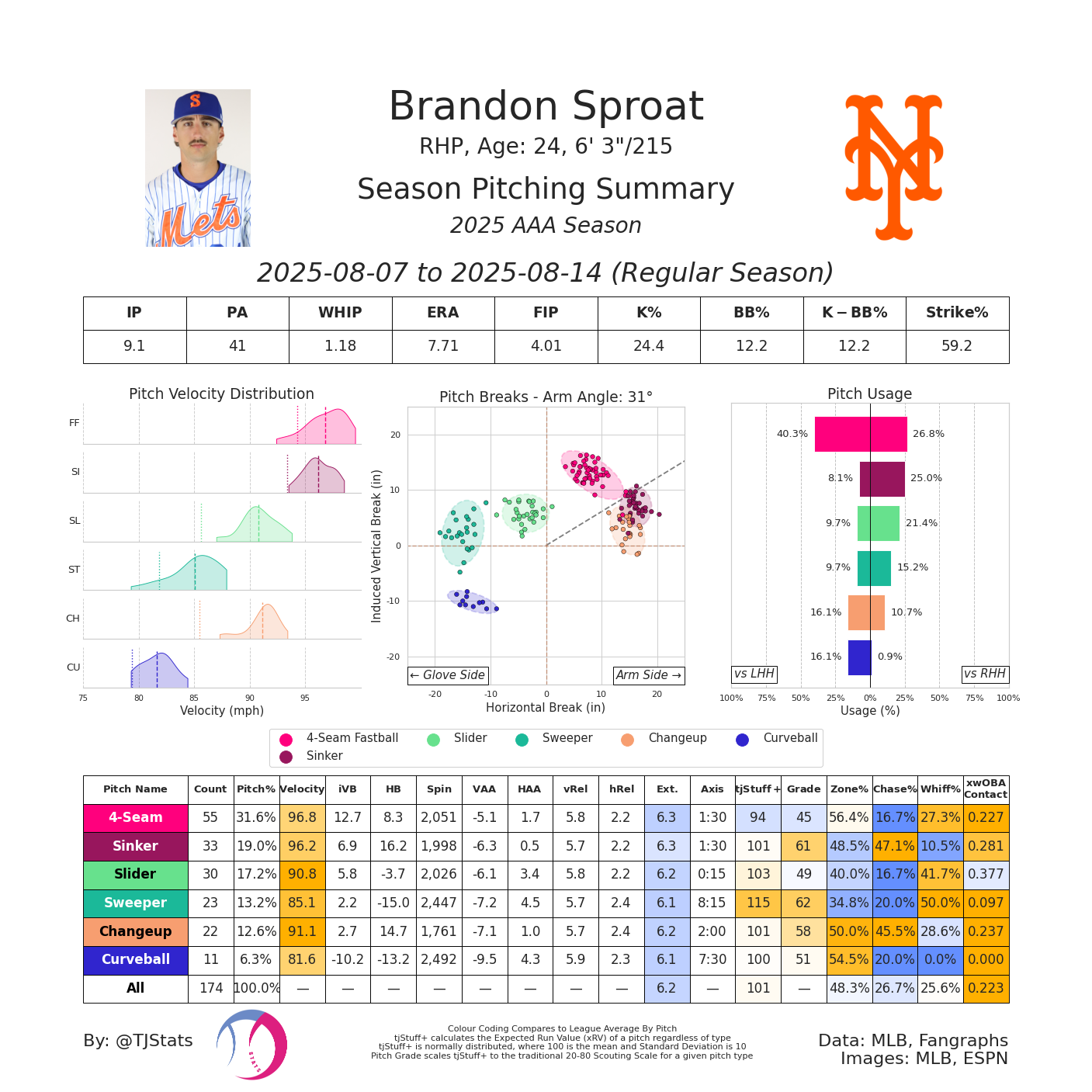
His velocity is slightly lower but is mostly still there, averaging 96.8 mph on his four-seam and 96.2 mph on his sinker. In those two starts, 39 of his 88 (44%) four-seamers and sinkers were at 97 mph or faster. It’s definitely down, but it’s not down drastically, and context is needed here. Just 15 of his 88 (17%) fastballs over his last two games were 95 mph or slower, and 3 of 88 (3%) were 93 mph or slower. In the 15-start stretch where he struggled, 171 of 536 (32%) fastballs were 95 mph or slower, and 25 of 536 (5%) were 93 mph or slower. So yes, he’s not hitting 97 mph as consistently, but he’s also not dropping much lower than 97 most of the time.
It probably plays at least a small role in the recent struggles, but overall, his pitches look much more similar to how they did when he was going well. He hasn’t gotten as much chase, but he’s still gotten solid whiff and has actually induced a weaker quality of contact than his run from June 28 to July 31.
The most notable thing is he’s just walking more batters. He’s throwing about the same percentage of his pitches in the zone, so it’s likely a result of the lower chase rate he’s getting. It could be a result of the pitch mix, which is more in line with what he threw in his first 15 starts of the season.
The changeup was an extremely effective pitch for him in July and its usage rate skyrocketed, but it’s back down to his fifth pitch in his last two starts. The slider usage is up, too, and it’s the only pitch that has consistently been hit well all year. But who knows, in a two-game sample size, that could be for any number of reasons. Maybe the scouting report one game said the lineup he was facing hammers changeups, so he intentionally didn’t throw it. That’s just one example, but there could be any number of reasons.
Or, and this could be the most likely answer, sometimes you just get hit. A 0.55 ERA is unsustainable, and sometimes hitters have a good read on you even if you have your best stuff. A few extra ground balls find holes, a pop-up finds grass and a batter puts a “tip your cap” swing on a well-executed pitch, and all of a sudden, your numbers look much worse despite not doing anything different.
There are a few things to keep an eye on, like his small velocity regression, but it’s a two-game sample size. Sproat has a handful of more starts lined up for 2025, and it will be interesting to see how he fares and if his velocity can get back over 97 mph more consistently.
That’s the biggest thing for Sproat: consistency. The version of Sproat we’ve seen since June 28 is a top 100 caliber prospect, but he’s only been that pitcher for about a quarter of his starts this year. If he can finish 2025 strong and start 2026 the same way, it’ll be huge for his prospect outlook. If his velocity dips and he struggles again, sound the alarms.
Courtesy of Thomas Nestico @TJStats on X.