

The Mets have seen this before from Tylor Megill.
The big question entering the second month of his season was whether he was just off to another strong start that would inevitably disintegrate into inconsistency — or if he’d finally turned an actual corner.
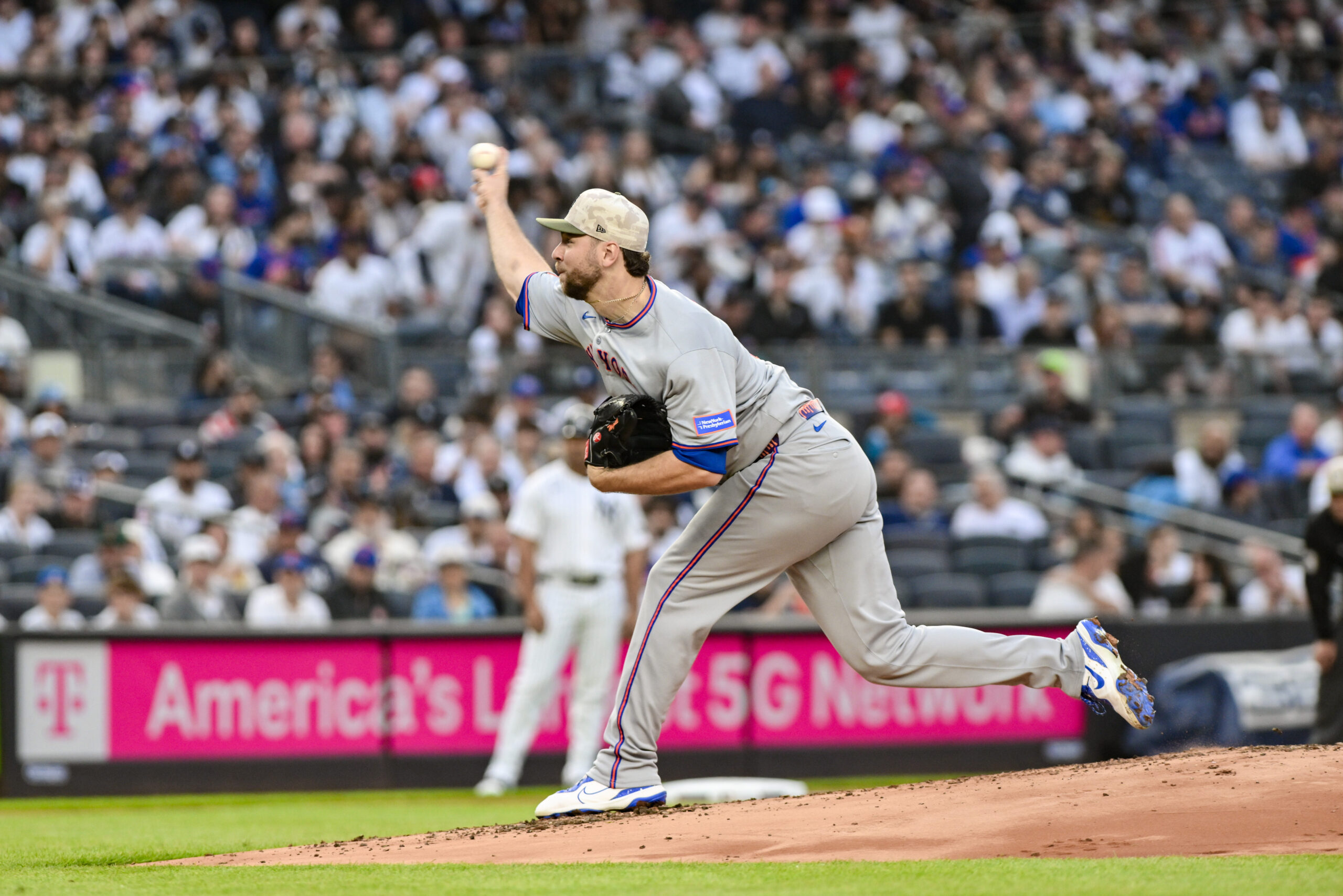
And, lately, Megill’s performance has faltered. He had a fantastic March and April, with a 1.74 ERA in six starts. But he gave up four runs in back-to-back starts to start the month of May, and matters only got worse on Friday at Yankee Stadium as Megill failed to get through the third inning.
It was his worst start of the season. Things were going so well for Megill as recently as a couple of weeks ago, which begs the question: What happened?
John Jones-Imagn Images
For the first two innings, Megill looked okay. His fastball command still wasn’t perfect, as he walked Trent Grisham and gave up a hit to Cody Bellinger, but he struck out Aaron Judge and Jasson Domínguez in a scoreless first inning. He dropped in a curveball to catch Domínguez looking. The curveball has been Megill’s most seldom-used offering this season, but it’s been effective in the roughly 5% of the time he’s thrown it. Last year, in a larger sample, it had a .130 xBA.
Megill got two more strikeouts in a perfect second inning. He used his sinker to punch out Austin Wells looking, then got Oswald Peraza to chase a couple of sliders below the zone.
Quality of stuff hasn’t been the issue in Megill’s struggles; it’s been location and endurance through an outing. And things crumbled quickly in the third inning.
Megill surrendered a leadoff single to Jorbit Vivas. His style of pitching gradually became more passive as the inning wore on, and he wasn’t going after hitters the way he did in the first two innings. He’d previously struck out Judge on a fastball; the next time up, he threw Judge five straight sliders and walked him.
In Megill’s defense, two of the hits he gave up in the third inning were fluky. Bellinger and Paul Goldschmidt each scratched out a soft single that found a spot. Goldschmidt was credited with an RBI, but a second run scored on a throwing error by Francisco Lindor.
Still, regardless of where the blame lies in the mess Megill found himself in, he did himself no favors in trying to navigate out of it. He walked three of the next four hitters, at which point Carlos Mendoza ran out of patience and pulled Megill from the game. A positive look at it could be that Megill wasn’t exactly getting hit around — but the concern is that he didn’t show the command that’s necessary to go deep into a major league ballgame.
“Four walks in an inning, that ain’t gonna cut it,” Megill told reporters after the game. “I mean, that’s basically what happened tonight. I got into a tough situation, tried to make some pitches for chase, keep the score close. Ended up walking quite a few that inning. I feel like I made some good quality offspeed pitches, trying to implement some chase. But the fastball was kind of all over today.”
Megill was missing all over the place. He threw fastballs high and away, along with sliders in the dirt. He ended up throwing just 37 strikes and 35 balls overall.
Only 52% of his fastballs went in the strike zone. His sinker wasn’t much better at 54%. Ten percent of his sliders were in the zone, with hitters only chasing it 21% of the time. The pitch he actually threw in the zone most often was his curveball, with five of the eight landing within the parameters. Overall, just 39% of his pitches were actually in the strike zone — which wouldn’t necessarily be an awful number if the chase rate against his pitches wasn’t a measly 23%.
Megill threw 39 pitches in that third inning while failing to get through the frame. He allowed four runs on four hits and five walks in 2 2/3 innings, though he collected four strikeouts.
“He lost the strike zone. He didn’t throw enough strikes,” Mendoza told reporters. “When you’re doing that against an offense like these guys, they’re going to make you pay. It just comes down to executing. He kept going to that slider in that inning and couldn’t throw it for a strike. It’s as easy as filling the zone with quality pitches, and we didn’t do that today… He’ll get through it. The stuff is there.”
Megill’s season ERA now sits at 3.74. It’s risen by two runs in his last three starts, in which he’s allowed 12 earned runs in 12 1/3 innings.
Megill’s past seasons have followed similar trends. Last year, he had a 1.69 ERA through three starts between March and May, then a 7.43 ERA in five June starts. In 2023, he had a 3.96 ERA in five April starts before putting up a 5.28 ERA in six May starts. In 2022, he posted a 1.93 ERA in five April starts before giving up 11 runs in 6 2/3 innings in May. So many glimpses of promise before his season collapses out from under him.
There are still reasons for optimism surrounding Megill; he has a career-high 11.63 K/9, and opposing hitters are only batting .229.
But his command is letting him down. He’s walked 10 in his last 12 1/3 innings after 12 in his first 31 innings of the season. And even when he was doing well, he only completed six innings once. He just is yet to prove that he has the durability over the season to be a reliable MLB starter — and he’s losing fans’ faith at this point, with this being his fifth major league season, and the same bug still biting him.
Megill will get at least a few more chances while the Mets await the returns of Sean Manaea and Frankie Montas. But when those pitchers do get back, likely sometime in June, the Mets will have some decisions to make. Megill can still be optioned to Triple-A Syracuse — a choice that Megill could make less difficult if his trends continue in the way they’re going. But, with his overall numbers still that of a quality MLB pitcher (3.74 ERA, previously-mentioned strikeout rate, etc.), he could make his case to stay in the bigs if he can get back to his April form over the next couple weeks.