The Washington Nationals may or may not have the best farm system in the division, but they definitely have the best individual prospect. We’ve made our way through the farms of the Braves, Marlins, and Phillies, so now it’s time for the final stop on our tour around the division.
League Rankings
Baseball America: 14
MLB Pipeline: 10
FanGraphs: 14
The Athletic: 11
Baseball has updated its farm system rankings since the last article on the Phillies, bumping the Phillies from 14 to 20 and moving the Nationals into the No. 14 spot. The Nationals have a clear top-half farm system, but also clearly not one of the premier systems in the game. Part of that is due to the graduation of James Wood, a blue-chip prospect who played enough last year to no longer be considered one. Wood will be the primary left fielder for Washington this year, and in the other corner will be the organization’s current top prospect.
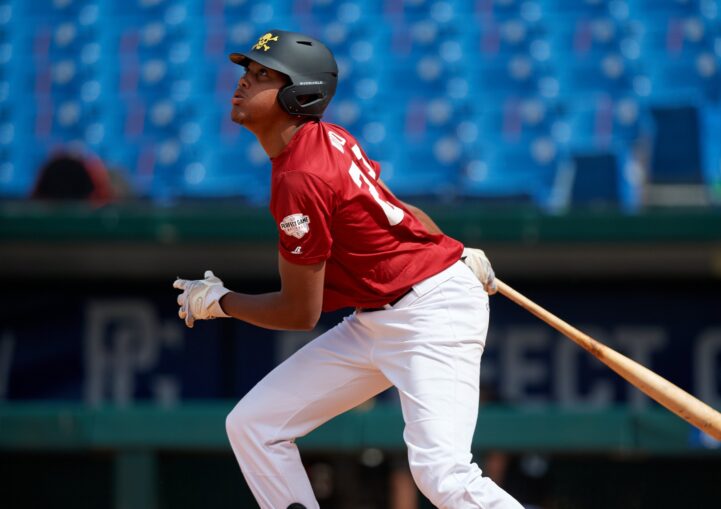
James Wood. (Mike Janes/Four Seam Images)
Crews and Wood
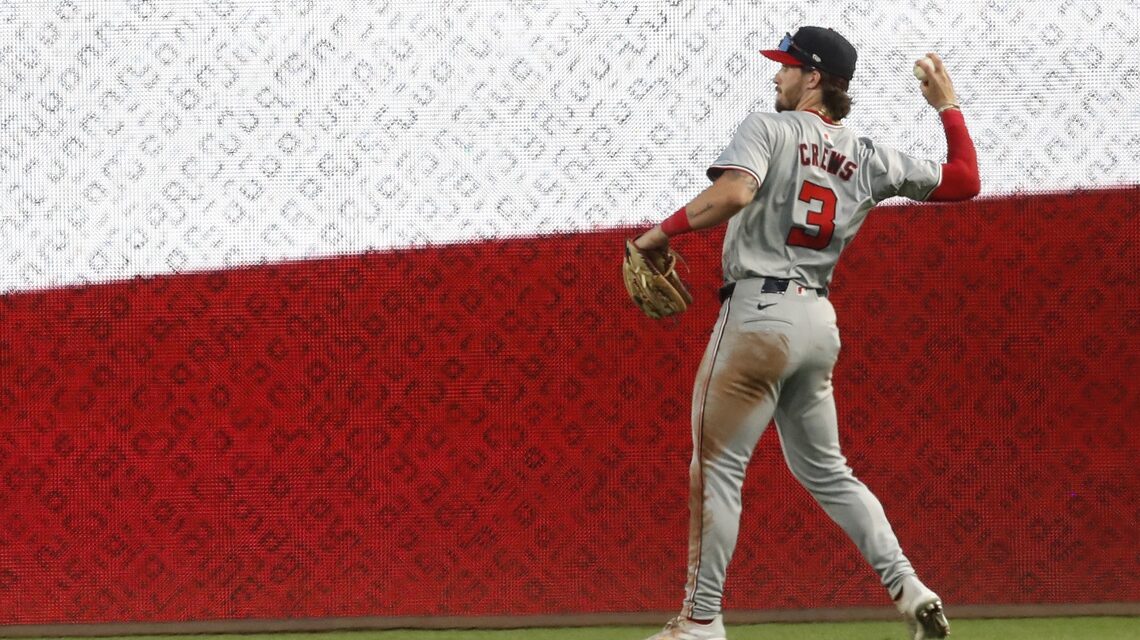
Dylan Crews is the No. 4 prospect on MLB Pipeline, the No. 6 prospect on Baseball America, and the No. 7 prospect on The Athletic. He’s one of the best prospects in baseball, and he’ll be the Opening Day right fielder opposite Wood in left. Together, the Nationals could have a pair of young corner outfielders hitting back-to-back in the heart of their order for the next six years at a minimum.
Crews is the higher draft pick than Wood, taken No. 2 overall in the 2023 MLB Draft directly after Paul Skenes went to the Pittsburgh Pirates, and he is the only one of the two actually drafted by the Nationals. Wood, the No. 62 overall pick in the 2021 MLB Draft by the San Diego Padres, was acquired by the Nationals in the trade that sent future Met Juan Soto out west. He’s also about seven months younger than Crews despite being drafted two years earlier because he was drafted out of high school, while Crews spent three years at LSU.
Wood, who torched the minors and impressed in his first taste of MLB action in 2024, is probably the better hitter. Aside from a five-game stint in rookie ball in 2022, Wood never posted an OPS that started with anything lower than an eight at any step along the way. It was often even better than that, culminating in a 1.053 OPS in 53 games in Triple-A before his big league promotion in 2024. He played 79 games for the Nationals last season, hitting .264/.354/.427 (.781 OPS), good for a 120 wRC+. As a 21-year-old rookie, that’s impressive. Wood has his faults, he strikes out at a clip higher than the league average and he is not a good fielder, but his bat is very, very real. The Nationals can hide him in left field and get away with it while likely hitting him third, right behind Crews.
Crews is still a great prospect in his own right, even if his bat wasn’t quite as good in the minors as Woods. There’s a reason he’s a consensus top-10 prospect across the league. He was pushed aggressively through the minors, making it all the way to Double-A just months after being drafted. He played 20 games there in 2023, and while he tore up rookie ball and Single-A (he skipped High-A), he finally struggled once he got to Double-A.
He returned to Double-A to begin 2024 and was much better, but not outstanding. In 51 games, he hit .274/.343/.446 (.789 OPS) with five home runs and 15 stolen bases. He was promoted to Triple-A and turned in a very similar line, slashing .265/.340/.455 (.795 OPS) with eight home runs and 10 stolen bases in 49 games. There were 30 22-year-olds to have at least 200 plate appearances at Triple-A last season. Crews’ OPS ranked 16th and his wRC+ of 106 ranked 15th. Wood, who also fit that criteria, ranked first in both statistics.
Nevertheless, the Nationals promoted Crews to the big leagues in late August. He played in 31 games for the Nationals to close out the year and narrowly preserved his rookie status for 2025. He didn’t do great, hitting .218/.288/.353 (.641 OPS) with three home runs and 12 stolen bases in 132 plate appearances. However, it’s a small sample size, his peripherals for the most part looked at least league average, and his track record provides enough confidence that he’ll be better in 2025.
Both Baseball America and Pipeline have Crews with a 60-grade hit and power tool and have him as a 70-grade runner. Unlike Wood, he’s a plus-glove and can play center field, although he’ll likely end up in right. Crews won a lot of awards for his bat in college and has still hit the ball hard in pro ball. Baseball America touted his well-roundedness as a hitter and Keith Law of The Athletic wrote that Crews, “still shows the underlying characteristics of an above-average hitter in the big leagues.” Ultimately, results are the most important thing, but he has plenty of time to turn his pedigree and batted-ball data into tangible results.
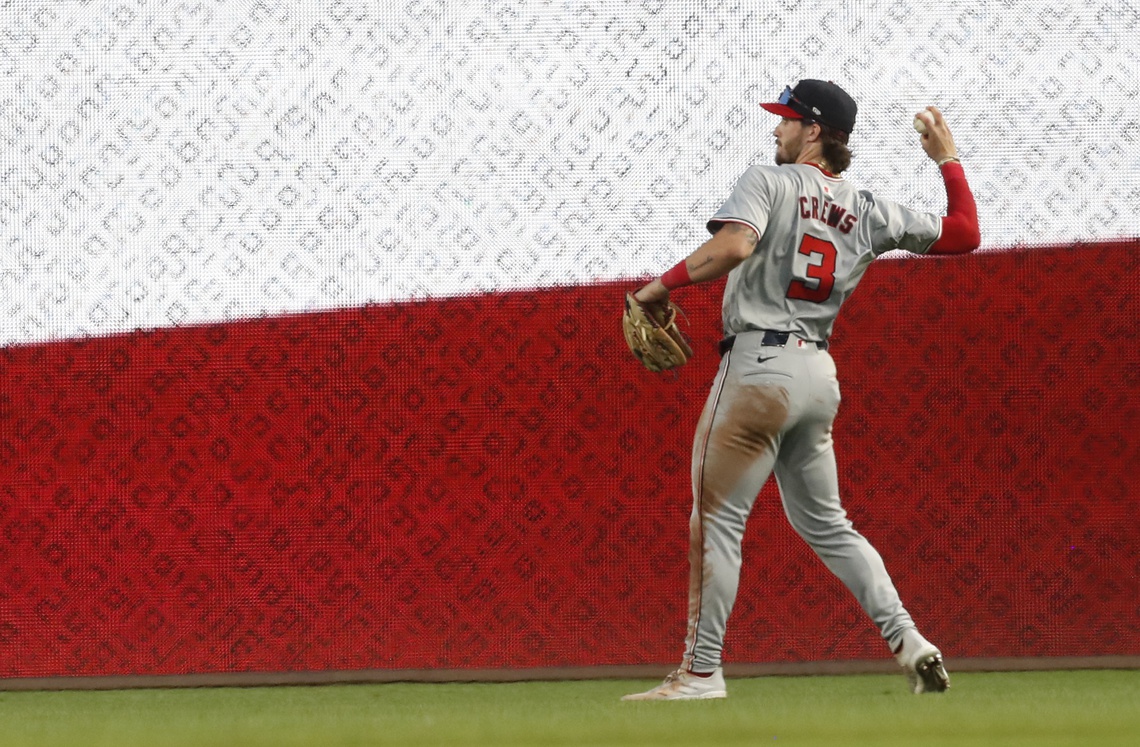
Dylan Crews. Mandatory Credit: Charles LeClaire-Imagn Images
Other Top Players To Know
Behind Crews in Washington’s farm system are a couple of first-round pick bats and then a trio of arms with really exciting tools.
Brady House, the No. 11 overall pick in 2021, was a much hotter prospect name a year ago and was even ranking in the middle-third of the various top 100 prospect lists, but he has since fallen off them. A third baseman, House took off in 2023, going from Single-A to High-A to Double-A all in one season and having success at each stop. In 88 games between the three levels, House hit .312/.365/.497 (.862 OPS) with 12 home runs and 36 extra-base hits. He did this while striking out at a 23.8% clip and not walking much, which ended up rearing its ugly head in 2024.
House’s flaws were only worsened in 2024. His strikeout rate went up to 26.4% which was the 10th-highest of the 48 players aged 21 or younger to have at least 500 minor-league plate appearances in 2024; only a little better than Mets prospect Ryan Clifford. What Clifford did though that House didn’t was take the free pass, with House only walking at a 5.7% clip. That was the third-worst of the same 48 players, and House ultimately ended up with the worst BB/K ratio of the entire group. If House is going to be a major-league player, he needs to fix that. He was a high school draftee and will turn just 22 years old in June, so he has time.
Seaver King, the No. 10 overall pick in 2024, is worth keeping an eye on as he begins his professional career. An athletic player who can play the infield or outfield, King has a high-swing, high-contact profile with probably below-average power. He played well in a small taste of pro ball last season, hitting .295/.367/.385 (.754 OPS) in 20 games at Single-A. A college bat who started his NCAA career in Division II before transferring to Wake Forest and playing himself into a top-10 pick, King is an interesting prospect with a nice story.
Now, onto the arms. Travis Sykora was one of the breakout pitching prospects from the 2024 season. A third-round pick in 2023 who signed for well, well over-slot value, he spent his entire 2024 season in Single-A and excelled. In 20 starts, Sykora had a 2.33 ERA and 0.91 WHIP with 129 strikeouts to just 27 walks in 85 innings. He led all Single-A pitchers in strikeouts despite throwing dozens of fewer innings than anyone near him.
His fastball sits in the mid-90s with a 60-grade from MLB Pipeline and 65-grade from Baseball America. He pairs that with a slider and splitter that both received plus grades from both outlets. His control is the biggest question mark, but both outlets have it at average and he clearly didn’t struggle with it in 2024. With a strong 2025, Sykora will skyrocket up boards and become one of the highest-ranked pitching prospects in baseball.
On Thursday, Nationals general manager Mike Rizzo informed reporters that Sykora underwent surgery on his hip over the winter, which will likely keep him out until May. It shouldn’t be a major setback and it’s not an arm injury, so as long as he comes back fully healthy the injury shouldn’t impact his prospect status too much.
Jarlin Susana, who accompanied Wood from San Diego in the Soto deal, is one of the most exciting pitching prospects in baseball. He might not be one of the best, still top 100, but definitely one of the most exciting. Susana’s calling card is his velocity. He regularly throws in the triple digits and has hit 103. He struggled in 2023, posting an ERA above five while displaying the control issues that plague many hard throwers, but took a big step in the right direction in 2024. His results still weren’t amazing, as his ERAs at both Single-A and High-A were in the low fours, but it was an improvement.
The most encouraging thing? Susana walked just 48 in 103 and 2/3 innings after walking 40 in 63 innings the year before. He also struck out 157 batters and had a top 10 K% among minor-league pitchers who threw at least 80 innings. Sykora was No. 1. Susana’s fastball has a 70-grade on Baseball America and a 75-grade on Pipeline, along with a plus slider and about average changeup. There’s a ton of relief risk here, but there’s no doubt Susana has one of the most electric arms in the minor leagues.
Staying on the trend of great fastballs is Alex Clemmey, a second-round pick in 2023 by the Cleveland Guardians who was sent to Washington for Lane Thomas at the 2024 trade deadline. His fastball sits in the mid-90s and can reach the high-90s, and he has a couple of solid breaking balls and offspeed pitches. His results weren’t outstanding in 2024 but they weren’t awful putting up a 4.58 ERA in 92.1 Single-A innings with a lot of strikeouts and a lot of walks. He’s still just 19 years old so he is far, far out from the big leagues, but Clemmey is definitely a name to monitor.

Tyler Stuart. Photo by Nathan Ray Seebeck-USA TODAY Sports
2025 Impacts?
The Nationals farm system is full of players who could play in the big leagues in 2024, which is perfect for where they are as a team. Obviously, Crews will be the Opening Day right fielder, but there are plenty of others who could make impacts during the long season. One is House, who is already at Triple-A. If he can right the ship he could end up as the team’s third baseman, where the current starter is projected to be José Tena.
Outfielder Robert Hassell III, another piece of the Soto deal, is also up to Triple-A. Once a very high-rated prospect and a the No. 8 overall pick in 2020, Hassell has really struggled since arriving to the Nationals. He appeared at Double-A in three-straight seasons following the trade and finally turned in a good showing in 2024, and even then his OPS was still just .728. He then got to finish out the year in Triple-A and slumped hard, hitting .125 with a .344 OPS in 17 games. Hassell has the draft pedigree where he’ll keep getting chances, and if he turns it around in 2025 he could be a big-league option.
Yohandy Morales is another bat who could enter the mix for 2025. The No. 40 overall pick in 2023, Morales was great in the months immediately following the draft and a little less great but still solid in 2024. He spent the majority of his season in Double-A, posting an OPS in the mid-70s. If he can at least keep that up and ideally improve in Triple-A in 2025, he could be very in the mix for one of the corner infield spots at some point.
The Nationals also have a ton of pitching options, headlined by 2020 No. 22 overall pick Cade Cavalli. The flamethrower got roughed up in his one and only MLB appearance back in 2022, and then missed all of 2023 and most of 2024 while recovering from Tommy John surgery. He’s only had success in his minor league career, so as long as he’s healthy, he should at least have a chance to crack the Opening Day rotation that is rather thin after MacKenzie Gore and Jake Irvin. If not, he’ll certainly get a chance at some point.
Other players who fit that bill are Andry Lara and Brad Lord. Lara had a lot of success at Double-A last season and should make the move to Triple-A to begin 2024, and Lord made that move himself last year and pitched well. Former Mets prospect Tyler Stuart is also an option. Stuart, sent to the Nationals in the Jesse Winker trade, was one of the best pitchers in the Mets’ system in 2023 and pitched well again in 2024 before the trade. He had a stellar four starts in Double-A for Washington before struggling in four Triple-A starts, but he is definitely an option to at least make a spot start for the Nationals at some point in the season.