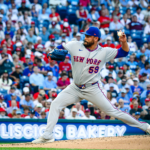

No. 5 — Miami Marlins
The Miami Marlins field a rotation full of uncertainty, even with potential ace Sandy Alcantara. They have made no significant additions this offseason. The Fish head into 2025 with a rotation that includes an ace in Alcantara coming off Tommy John surgery, another injury-prone pitcher in Ryan Weathers, and yet another in Edward Cabrera. You get the idea.
With Miami’s rotational situation, one would expect a team with a $67 million payroll (per FanGraphs’ Roster Resource) to add proven big-league talent to its rotation of inexperienced prospects. However, there has been no movement in that direction, and it seems this is what the Marlins will have to work with in 2025.
Clearly, Alcantara is one of the best pitchers in baseball when healthy. The key here is “when healthy.” When he’s on the mound, he deals—but we haven’t seen him deal at that level since 2023, or since 2022 if you consider his 2023 season more pedestrian. Still, he’s one of the game’s premier aces, and he’ll lead the staff—but beyond Alcantara?
Weathers logged a solid 3.63 ERA last year, though in just 86 2/3 innings. He, for one, is at least somewhat projectable and has had some success in the majors. Cabrera and Max Meyer are still young, but both are at an age where questions about their futures are starting to be voiced. Neither has shown prolonged success in the big leagues, though Meyer underwent Tommy John surgery in 2023. The problem is, that both possess career ERAs that don’t suggest they’ll be effective in 2025, even though they were once top 100 prospects. These are the pitchers perhaps guaranteed to get rotation spots, which shows where Miami’s rotation stands at the moment.
Fighting for that last rotation spot—previously Eury Pérez‘s to lose before his injury—are Adam Mazur, Valente Bellozo, Robby Snelling, and Dax Fulton. All are top prospects in the Marlins’ system, but aside from Bellozo, none have more than 50 innings at the major league level.
No. 4 — Washington Nationals
The Nationals enter 2025 with five of six of their 2024 rotation members returning. Jake Irvin, MacKenzie Gore, Mitchell Parker, and Trevor Williams are all coming back. To replace their lone exit in Patrick Corbin, the Nationals inked Shinnosuke Ogasawara and Michael Soroka to major league contracts.
Aside from Ogasawara and Soroka, all of the Nationals’ 2025 rotation members have established themselves as legitimate big league pitchers. They are all solid, yet none are necessarily ace-level. Irvin, 27, was outstanding in the first half of 2024, although he struggled in the second half of the season. Parker had a respectable but unspectacular season, posting a 4.29 ERA in 151 innings. Williams led last year’s staff in bWAR despite pitching only half the season. For the most part of his career, he has been a back-of-the-rotation guy. The two-year, $13 million deal he received from the Nationals this offseason reflects that expectation.
The two lefties in Gore and Herz are the ones who appear to have a slightly higher upside. Apart from being left-handed, which is always an advantage, both pitchers excel in strikeout rates (Gore 65th percentile, Herz 81st) and limiting hard contact (Gore 74th percentile avg exit velocity, Herz 81st percentile hard-hit rate). Additionally, the two offer excellent fastballs. While Gore’s fastball, which averages 96 miles per hour, surpasses Herz’s 93.5-mile-per-hour four-seamer in velocity, Herz’s four-seam fastball generated a run value of 9 last season, ranking 23rd in MLB, per Baseball Savant, for the pitch. If any pitcher leads the Nationals’ rotation to greatness, it can be one of these lefties (from my perspective). However, both have yet to reach their full potential or post a sub-3.50 ERA, with no guarantee of doing so in 2025.
The Nationals will also be playing with some wild cards, having signed former Brave Michael Soroka and NPB All-Star Shinnosuke Ogasawara. For Soroka, the story has largely been his health, with shoulder, ACL, and Achilles tendon injuries being the primary setbacks. With the White Sox last year, he had something of a comeback season, posting a 2.35 ERA out of the bullpen and a 4.74 mark overall. This came in a sample size of 79 2/3 innings, his most since 2019. Ogasawara’s main issue is his weak strikeout rate of 13.6% last year in the NPB. It remains uncertain whether he will be able to translate his success into the majors given his struggles in that regard.
Andrew Golden of the Washington Post has Irvin, Gore, and Soroka as locks to be in the Opening Day rotation. That would leave Parker, Williams, Herz, and Ogasawara to fight for the remaining two spots. Whichever five make the rotation, they’re probably major-league-caliber, but unless they reach their full potential, the Nats’ staff won’t be better than any NL East team besides the Marlins.
No. 3 — New York Mets

Photo by Brad Penner-Imagn Images
The Mets made a deep postseason run with their 2024 rotation, which ranked fourth in the National League in ERA (3.91). Over the offseason, they made several signings to replace their innings leader, Luis Severino, and the reliable Jose Quintana. With the addition of former Yankees closer Clay Holmes and the return of Japanese right-hander Kodai Senga, the Mets have made it clear that they are committed to a six-man rotation. They’ve also signed Frankie Montas and inked a new deal with southpaw Sean Manaea to round out the starting staff.
This rotation features several new faces, and finding consistent innings in some areas could be a challenge. Holmes lacks experience as a starting pitcher in the majors, and Senga is two years removed from his last healthy season. All three of David Peterson, Tylor Megill, and Paul Blackburn are not guaranteed to throw 100 innings, let alone 150. Additionally, José Buttó appears set for a bullpen role.
There are some things going for the Mets. Though Senga is two years removed from his last healthy season, he posted a 2.98 ERA in his last one and nearly won Rookie of the Year. Montas boasts an excellent pitch mix, with two fastballs that held batters to a .294 and .327 wOBA in 2024. Holmes already has one of the best sweepers in baseball and may be developing a fastball and changeup. Perhaps Peterson and Megill will not provide the innings the Mets need, but their promise is not in question.
The Mets have some prospects in the minors, including Brandon Sproat, though they need development and should not be rushed to the majors. Sproat had his best professional season last year, climbing prospect rankings lists, but he hit a rough patch in Triple-A—something that has happened to many Mets prospects. Along with Sproat, Dom Hamel and Blade Tidwell saw their progress stall in Syracuse while Mike Vasil, now a Tampa Bay Ray, also slowed down.
There’s undeniable upside in New York’s six-man staff, but plenty of uncertainties remain. While we trust David Stearns, Montas and Holmes are far from guarantees, and the rest of the rotation carries its own question marks. The Mets have talent, but whether it will be enough is debatable.
No. 2 — Atlanta Braves
The Braves are led by 2024 Cy Young Award winner Chris Sale. Reynaldo López and Spencer Schwellenbach are also both legitimate second and third starters. Beyond those three, the Braves are likely to deploy a number of prospects, unless the Braves make a surprise move for a starter.
Sale was obviously elite in 2024, but before that, his last healthy and strong season was in 2018, much like former Met Jacob deGrom. It might be difficult to imagine more Cy Young-level performances from a 36-year-old Sale. Maintaining his 5.6% walk rate (87th percentile) will be challenging, and some regression toward a more typical 6.8% rate seems plausible. He also allowed just nine total homers last year, which is an exceptional figure. While Sale’s 2024 performance was outstanding, there are questions about whether he can replicate it or remain healthy for an entire season.
Reynaldo López had an outstanding 2024 season, posting a 1.99 ERA and earning an All-Star nod en route to unlocking his potential and delivering the best season of his career. That said, repeating that success is far from certain. All indicators suggest that his 2024 success may be unsustainable. Theoretically, if he can maintain his virtually untouchable slider, which held opponents to a .168 batting average, he has a chance to come close to his 2024 form—but that’s a big if.
Spencer Schwellenbach has been a tough opponent for the Mets, with a perplexing 0.86 ERA against them. However, his success against New York may not be a fluke. He could very well emerge as a top-10 pitcher in baseball next year if his actual performance can agree with his advanced stats. If that occurs, Mets fans will certainly have an “I told you so” moment. Last year, Schwellenbach posted an impressive 34.1% whiff rate and ranked in the 95th percentile for walk percentage. He also does a great job missing barrels (90th percentile), et cetera, et cetera.
In addition to Atlanta’s top three pitchers, the team is likely to open 2025 with Ian Anderson and Grant Holmes. Both are out of options and have something to prove. Holmes, who was used as a reliever last year, will look to secure a permanent starting role, while Anderson, who recently recovered from Tommy John surgery, was quickly sent down to Triple-A Gwinnett upon his return.
Flamethrower Spencer Strider will also be a key part of the discussion in Atlanta. He’ll likely take the mound 15-20 times and return mid-season. Widely considered one of the better pitchers in baseball, Strider’s elite fastball and strikeout ability make him one of the most dominant arms in the league. When he returns, he’ll be a crucial asset in Atlanta’s rotation.
No. 1 – Philadelphia Phillies
The Phillies have a significantly better rotation than the rest of the division. They have the best pitcher in baseball in Zack Wheeler and a workhorse in Aaron Nola, who consistently logs 200 innings. Ranger Suárez and Cristopher Sánchez are strong top-of-the-rotation arms, and their addition of Jesús Luzardo is an underrated move that only further strengthens their staff.
Wheeler, like Jacob deGrom, keeps learning and sharpening his game as he ages. There has been no decline from him, and he feels unstoppable, a pitcher who should be at the very top of preseason NL Cy Young power rankings. With a 35.2 career bWAR, his Hall of Fame trajectory may be doubtful, but his quality is undeniable, and his prime undoubtedly is one of a Hall of Fame caliber pitcher. All that’s left for him is to keep doing what he does—deal.
There’s a clear drop-off from Wheeler to Nola, and it’s actually becoming a bit concerning now. Wheeler is three years older, yet Nola is the one showing real decline. Wheeler remains elite, while Nola is just… solid. His age is starting to show. His fastball has never been overpowering; however; his sinker is now getting hit harder than ever. Whether that becomes a serious issue remains to be seen, yet something seems off. He’ll still give the Phillies 180-200 innings, and they’ll be solid innings—but he’s not the pitcher he once was.
Both Suárez and Sánchez broke out last year, albeit in different ways. Suárez had one of the better first halves in the league but saw a significant drop-off in the second half, with his ERA jumping from 2.76 before the All-Star break to 5.65 after. Watch out for his slow curveball, which finds the zone about 37% of the time. Sánchez was solid too, keeping the ball on the ground at a crisp 58.3% rate while ranking in the 98th percentile for chases. He’s a much better pitcher at the Bank, with a 2.21 ERA in Philly compared to a 5.02 mark away from home.
The Phillies clearly see something in Luzardo, 27, despite his 5.00 ERA last season. A key factor in his drop-off from a career year in 2023 was his fastball velocity, which dipped from 96.7 miles per hour to 95.1 mph. Still, he generated whiffs at a solid 29.6% rate in his limited 66 2/3 innings. However, he needs to improve in the strikeout department—after punching out 208 batters in 178 2/3 innings in 2023, he managed just 58 in 66 2/3 innings last year. Having missed much of 2024 with a lumbar stress reaction, a healthy 2025 should give him a good chance to rebound.
Top prospect Andrew Painter and veteran Taijuan Walker should be the Phillies’ go-to depth options if any of their top five starters go down. The two are almost complete opposites—Painter, just 21, has been a standout in the minors, while the 32-year-old Walker left much to be desired last year in the majors.
We know what to expect from the two veteran Phillies—Wheeler, the ace, and Nola, the stalwart. But something special is brewing in Philadelphia with this trio of southpaws. This rotation has the ability to produce one, two, three, or even four All-Stars next year.
As the season unfolds, the Phillies’ rotation depth gives them a clear edge, but baseball is unpredictable. If the Braves or Mets’ gambles pay off, the race for the best NL East rotation could get a lot more interesting.