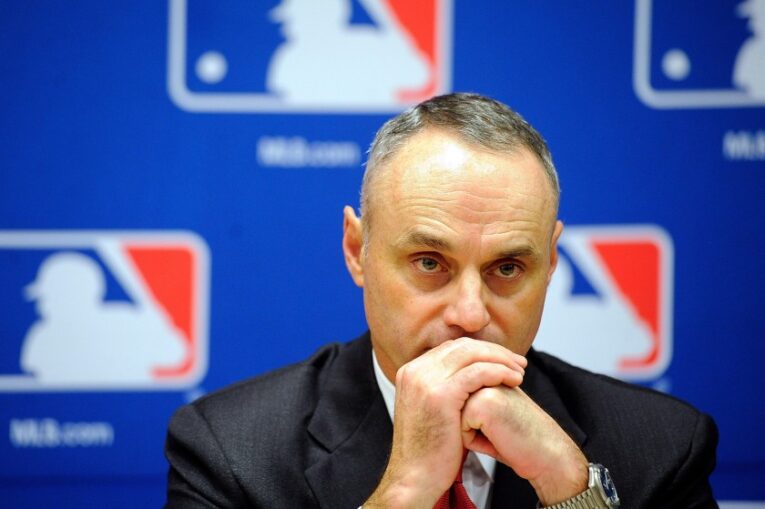
Major League Baseball and the Major League Baseball Players’ Association met Sunday for the seventh consecutive day. Reports are that the talks were productive, however, no economic proposals were exchanged. With one day to go before regular season games are canceled, today’s modest progress may not be enough to allow the season to start on time.
According to Evan Drellich of The Athletic, the owners and players will meet again Monday, and earlier in the day, on the official “deadline day.”
There was some sense of productivity today, but the gap on key issues remains large. Tomorrow on deadline day, they’re meeting earlier in the day than they had yet. Notable: no one suggested Sunday brought significant momentum, or a breakthrough. So, temper the urge to be excited
— Evan Drellich (@EvanDrellich) February 28, 2022
Here’s the breakdown of what happened Sunday:
- MLB offered to slightly raise the Competitive Balance Tax threshold.
- MLB offered to eliminate draft pick compensation for free agents that sign elsewhere, but tied this to a 14-team playoff format, to which the union objects.
- The MLBPA proposed a 12-team playoff format, where the division winner with the best record gets a first-round bye, while the other two division winners play a best-of-three round, hosting all games against their non-division winner opponents. Also, the division winners would start with one “ghost win” and need only to win one game.
- The two sides exchanges philosophical ideas, but no concrete economic offers.
Probably the best news coming from Jupiter, Florida today is that the tone of the negotiations seemed positive, and both sides committed to stay as long as necessary on Monday to try to get to an agreement. After Saturday’s session, the players were said to be furious at the way the owners reacted to the MLBPA’s comprehensive revised offer.
Here we are. There is one day left to save March 31 as Opening Day, and there is a lot of work to do. If games end up being canceled (and I do not believe they will), there’s plenty of blame to go around. I have been writing about the lockout for three months, and expressed that the players seem disingenuous by saying the want increased competition throughout the league (which they should), but advocating for higher CBT thresholds, which allow the large market clubs to have a competitive advantage. That’s not fair competition, and it makes their position on competitive balance ring somewhat hollow.
However, this stalemate rests largely on the owners’ shoulders. Take Saturday’s session. The players made the first big move, significantly lowering their request for the percentage of players to be eligible for the bonus pool, which would replace arbitration for players with more than two but fewer than three years of service time. That’s classic negotiation in action. In a negotiation such as a labor dispute, the sides typically develop three lists. One is the things they’re willing to sacrifice, the next is things they’d really like to have but may trade for a “must have”, and then the “must haves.”
Saturday, the players showed their cards. On one of the three core economic issues (pre-arbitration compensation), the union dropped its eligibility request from 75% to 35%. This is a big move, and the union had reason to expect the owners to move on that issue, or one of the other two, those being revenue sharing and the CBT.
The owners essentially did not move on any core economic issue, making a $1 million concession on one year of the CBT threshold. MLB has said it will not move on eligibility for the bonus pool (MLB wants to keep it at 22%) or revenue sharing, and has made extremely small movements on the CBT. MLB is not negotiating in good faith, and the players have a right to be angry.
Business owners are the “captains of industry” and in any business, owners are the risk takers. As such, they have a right, in non-union settings, to determine how wages will work, and workers have a right to accept or decline those terms. However, baseball is different. Everything is collectively bargained, and baseball enjoys and anti-trust exemption. So terms of employment are collectively bargained, and when Collective Bargaining Agreements are up, both sides have to negotiate in good faith. It’s hard to find examples of how the owners have done this during the lockout.
Monday is February 28, and there needs to be a new CBA by the end of the day to allow the season to start on time (unless both sides agree to an extension if they’re close). The players have moved, now the owners have to respond. The clubs know that in a $10 billion dollar industry, alienating the paying customers is not good business. Two-thirds of the players earn less than $1 million dollars per year, so while that’s a lot of money, the majority of the union members probably are not too excited to miss paychecks.
I hold out hope for a deal on Monday, or something close that either keeps the process movement or lifts the lockout. Maybe this is overly optimistic, but both sides stand to lose if there is no agreement. The players lose in the short-term, and the owners would be inflicting damage on their own product, that will manifest in several ways, not the least of which being franchise valuation if the sport’s popularity decline is accelerated by lost games.
This is where baseball finds itself. Let’s hope it can find its way out of a mess of its own making.