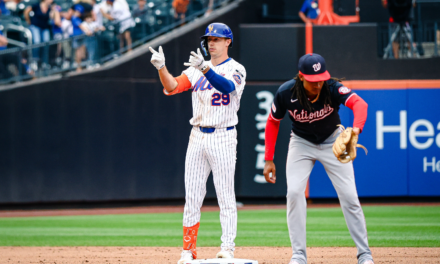


Credit: Jayne Kamin-Oncea-USA TODAY Sports
With just over one month remaining in the regular season, the New York Mets currently find themselves looking up in the standings, and if they’re going to have any chance at making a late push for a playoff spot, they’ll need the majority of their roster to perform effectively down the stretch.
For the most part, the bullpen has excelled throughout this season and has kept this team in each game even when they’ve struggled scoring runs, but with reliever Miguel Castro in particular, the 26-year-old has proven to be a major disappointment and is someone who might start witnessing fewer opportunities if his struggles on the mound continue.
Castro, who was acquired from the Baltimore Orioles at last season’s trade deadline, displayed some encouraging signs over the final month of the 2020 campaign as he struck out 14 batters over his 9.0 innings of work. Entering his first full season with the Mets, the coaching staff was hopeful the right-hander could build off that success and serve as a medium to high-leverage arm in 2021, which he accomplished out of the gate.
Enjoying a solid start to the season, the 6-foot-7-inch hurler compiled 9.0 innings in April, producing an impressive 2.00 ERA, 0.84 FIP, 1.62 xFIP, 1.22 WHIP, .235 OPP AVG, 63.2% GB rate, 15 strikeouts, and only a trio of walks. In addition, he also recorded his second career hold in a Mets uniform during this same span.
Thanks to these outstanding results, manager Luis Rojas and his staff were encouraged about Castro’s ability to play a key role at the backend of the club’s bullpen, unfortunately, it’s been downhill for him ever since then. Unable to locate the strike zone, the former Oriole has struggled mightily with his command over the last four months and, despite his best efforts, has become a major liability almost every time he’s taken the mound.
Showcasing this exact issue during his most recent appearance, which came against the Los Angeles Dodgers, the young righty entered the game in the sixth inning with his team trailing 2-1, and allowed a weakly-hit single prior to walking the next three batters. As a result, he ultimately walked in the game-winning run and couldn’t record a single out before being pulled after facing just four hitters.

Credit: Jason Getz-USA TODAY Sports
While the Mets have provided Castro numerous chances to correct his command woes, he just hasn’t found a way to turn things around this season, causing him to endure one of the worst statistical performances of his career – not something most experts believed was possible based on the success he enjoyed back in April.
Nevertheless, the Dominican native hasn’t performed up to his expectations since May, resulting in a 3.80 ERA, a 5.68 FIP, a 5.04 xFIP, a 1.41 WHIP, a 51.3% GB rate, a 22.5% strikeout rate, and an alarming 15.2% walk rate over his last 42 2/3 innings pitched.
Given that Castro’s performance has dropped off significantly over these past four months, his overall results on the year have understandably taken a major hit and have transformed him into one of the most unreliable relievers in the majors. In turn, he currently ranks near the bottom of the leaderboard in multiple different categories, which is obviously less than ideal for a pitcher who continues to be utilized in important situations.
Largely impacted by his inconsistent accuracy, the former top prospect has produced the 11th-worst FIP (4.92) and the 14th-worst walk rate (14.1%) among all qualified relievers, according to FanGraphs.com. Additionally, he’s also tied for the fifth-lowest fWAR rating (-0.3) and the eighth-worst FIP- (119).
Making matters worse, Castro has struggled to command his primary pitch – a high-90s sinker – an issue he’s experienced at times in previous seasons, but his inability to control it has reached an all-time high in 2021. While he was able to locate his sinking fastball effectively last season, that hasn’t been the case this time around, as it’s been the main source of his increased walk totals.

Source: BaseballSavant.com
After posting a 12.5% walk rate in 2020 – his lowest clip since 2017 – the hard-throwing righty’s sinker has witnessed a dramatic increase in that department this season, causing it to climb 12.8% (25.3% in ’21). Having said that, this situation has improved in recent months, as its walk rate has rebounded from a season-worst 35.7% rate in May down to a 21.4% rate in August, however, that’s still a considerable amount of free passes.
Even with reducing the number of walks allowed, Castro’s primary weapon remains near the top of the majors in this category, as it owns the third-highest walk rate among all pitchers who’ve thrown at least 100 sinkers in 2021, according to BaseballSavant.com.
Examining any potential differences from year to year, one of the biggest aspects that have changed for the young hurler is the release point on his sinker. Unlike in previous seasons, the right-hander hasn’t been nearly as consistent with the location of where he releases each pitch, which has likely played a huge role in his command issues.
While Castro discovered a comfortable release point in 2019, one that allowed him to thrive with his sinking fastball over the last two seasons, he’s seemingly lost the feel for it in 2021 and likely won’t regain his effective command unless he finds that ideal comfort zone once again.
Here’s where Castro has been releasing his sinker from this season:

Source: BaseballSavant.com
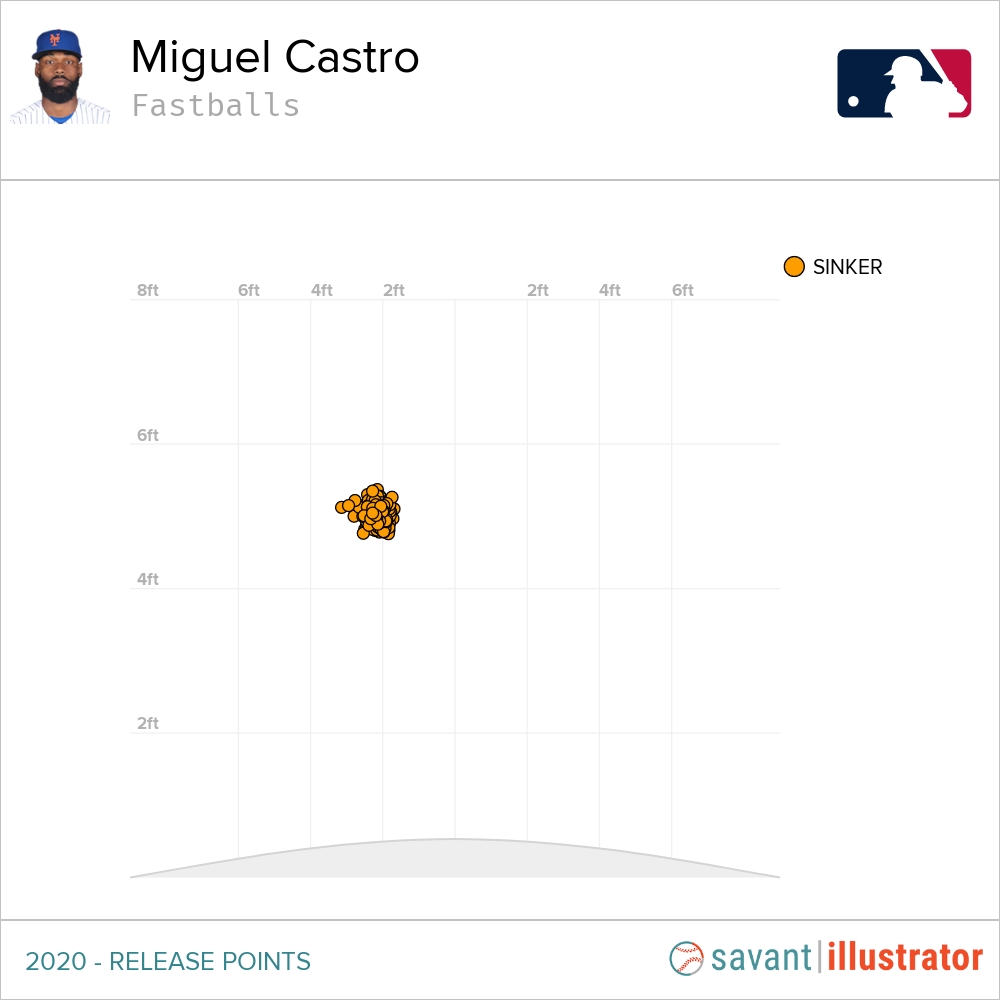
Vertically, Castro featured an average release point of 5.12 feet when he threw his sinker in 2020. But in 2021, that figure has dropped to an average of just 4.9 feet, which may not seem like a massive difference, although it can have an impact on location when each pitch is naturally moving downwards.
Horizontally, the sinking fastball created an average release point of 2.42 feet last season. Similar to its vertical measurements, its average release point has experienced a dramatic increase this season, as it’s risen to 2.56 feet.
And here’s where Castro released his sinker from last season:
Source: BaseballSavant.com
Since Castro’s release point involving his sinker has lowered and shifted arm side, both of these factors appear to have led to its increased out of zone percentage, which has climbed to a career-worst 54.4% in 2021 (42.9% in ’20). Unless the struggling reliever can revert back to his previous release point, opposing hitters will likely continue to lay off his primary offering, preventing him from reducing his walk totals.
Assuming the towering hurler isn’t able to correct these mechanical woes during the final month of the season, the Mets probably can’t afford to continue allowing him to perform in crucial situations down the stretch. Considering this team still has a ton of ground to make up in the standings, winning every game possible is undoubtedly their priority right now, and they likely can’t do that with the power-righty on the hill.
So unfortunately for Castro, it’d be wise for the coaching staff to reduce his playing time moving forward, ideally limiting his duties to low-leverage situations, at least for the remainder of the campaign.
If these struggles continue even after having his role reduced, then perhaps Castro could become a non-tender candidate this off-season, especially since he’ll be arbitration-eligible once again and is slated to hit the open market following the 2022 season.