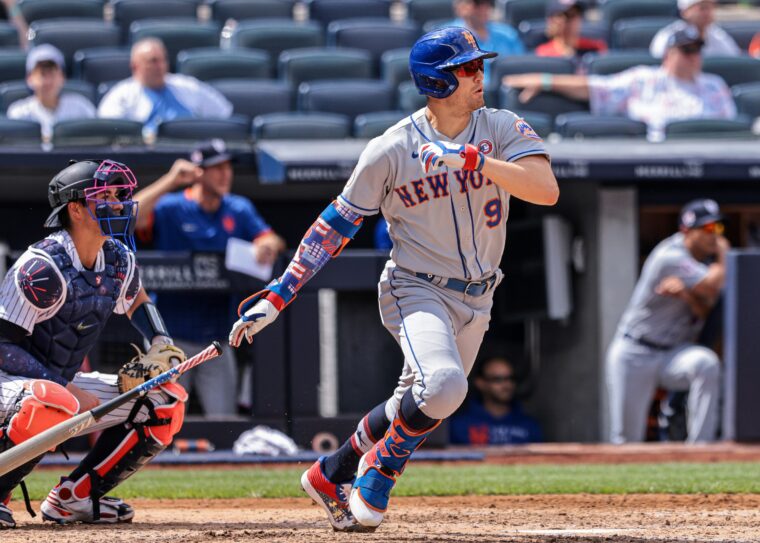

Mandatory Credit: Wendell Cruz-USA TODAY Sports
While the New York Mets haven’t exactly lit the world on fire with their 9-7 record since July 3rd, there’s no way anybody can deny the impact Brandon Nimmo has had on the offense since returning from the injured list.
As New York slogged through June with a 15-15 record, it was mostly because the pitching staff continued to step up for the club. Their combined 3.71 ERA was the eighth-best mark in baseball, with the starting rotation (3.14 ERA) doing more of the heavy lifting than the bullpen (4.50 ERA). The offense, on the other hand, mostly struggled.
As a squad, the Mets slashed .222/.297/.379 with an 88 wRC+, which was the league’s fifth-worst mark in June. They scored just 105 runs, sussing out to an uninspiring 3.5 runs per game. But in just 16 games since Nimmo returned on July 3rd, the Mets have already scored 92 total runs, which is a much more palatable 5.75 runs per game.
Is it just a coincidence that the offense has woken up? It takes more than one player for this kind of lift to happen. However, it helps when there’s someone like Nimmo setting the table and putting immediate pressure on the opposition every day.
Since he’s returned, he’s displayed two very different approaches at the plate, and both have been working quite well. One is an approach we’re very familiar with, but the other? Not so much. Although, I wouldn’t mind seeing it more frequently when the situation calls for it.
The Aggressive Nimmo
By the time he returned from his long stay on the IL, 11 games were left before the All-Star break. Nimmo appeared in 10 of them with nine of those appearances being starts. He accumulated 41 plate appearances during this time, and it looked like he was chomping at the bit to get back on the active roster.
The 28-year-old slashed .316/.366/.421 with four extra-base hits (all doubles), five RBI, and nine runs scored. This performance led to a healthy 121 wRC+, giving Nimmo some good vibes heading into the midsummer respite. While nothing in the above numbers looks bad, his on-base percentage appeared to be a little lower than we’re used to seeing, and it’s because he was hardly drawing any walks. He earned three of them during this span of time, which gave him a very un-Nimmo-like 7.3% walk rate.
So, what was different? If you haven’t guessed by now, it’s that Nimmo was much more aggressive with swinging the bat. Here’s what his plate-discipline numbers looked like heading into 2021, compared to what he did during his first 41 plate appearances off the IL:

We’ve obviously got some very uneven sample sizes going on with this comparison, but it illustrates just how unusual this aggressiveness at the plate was. He only posted a 16.0% fly-ball rate during this short period of time leading up to the All-Star break. It was accompanied by a 44.0% line-drive rate and 40.0% hard-hit rate, though, which is why his BABIP was all the way up at .480.
This wasn’t what we typically see from Nimmo at the dish, but hey, if you’re going to swing more, do it like this.
The Nimmo We’re Used To Seeing
Upon the start of the second half, we’ve started seeing the hitter we’re used to seeing when Nimmo steps into the batter’s box. It was incredibly noticeable during the series in Pittsburgh against the Pirates, as our own Patrick Glynn pointed out earlier this week:
“He went just 1-for-8 — the lone hit a home run on Saturday — but he had eight walks. Eight! Eight beautiful sprints to first base. So that’s a .125 batting average for the series, but also a .563 on-base percentage. That feels like Brandon Nimmo.”
They are beautiful sprints, indeed.
While the frequency of walks getting drawn cooled down a bit during the series in Cincinnati, he’s definitely back, as a 32.3% walk rate would suggest. That’s enabled him to post a 155 wRC+ with a .200/.484/.350 line in 31 plate appearances. Nimmo’s 29.9% swing rate is obviously a dramatic difference from what he did during the first part of July, as is his 17.2% chase rate and 52.9% swing rate on strikes.
But what you love to see here is that when opposing pitchers stopped peppering the strike zone at a higher rate, he simply stopped swinging. Check out how his chase rate and swing rate on strikes changed from before and after the All-Star break, along with how the first-pitch strike rate and zone rate took a dip.

One of the (many) things I love about Nimmo’s game is he rarely strays from his overall plate approach. He did stray from what he typically does when he initially returned from the IL, but it worked. When opposing pitchers adjusted and started staying out of the strike zone more often, he just went right back to what he does best.
Benefits To the Rest of the Lineup
As mentioned previously, the Mets’ offense has seemingly woken up this month. Among the 11 hitters who have accumulated at least 20 plate appearances in July, eight of them have a wRC+ of 115 of better (Francisco Lindor, Dominic Smith, Nimmo, Luis Guillorme, Jeff McNeil, James McCann, Pete Alonso, Tomas Nido, Michael Conforto). It’s taken way longer for this to happen than any of us were anticipating, but it’s finally here. Having someone like Nimmo at the top of the lineup and getting on base as consistently as he is will be huge.
New York’s ability to score runs again will come in handy quite a bit as the front office figures out exactly how to supplement a roster that desperately needs some depth on the pitching staff. It’s so good to have Nimmo back and immediately making an impact, and it’s great to see him do damage in two very different ways thus far.