Mandatory Credit: Vincent Carchietta- USA TODAY Sports
After a torturous three-game stay the Trop in Tampa Bay, let’s think about something positive for a second, shall we?
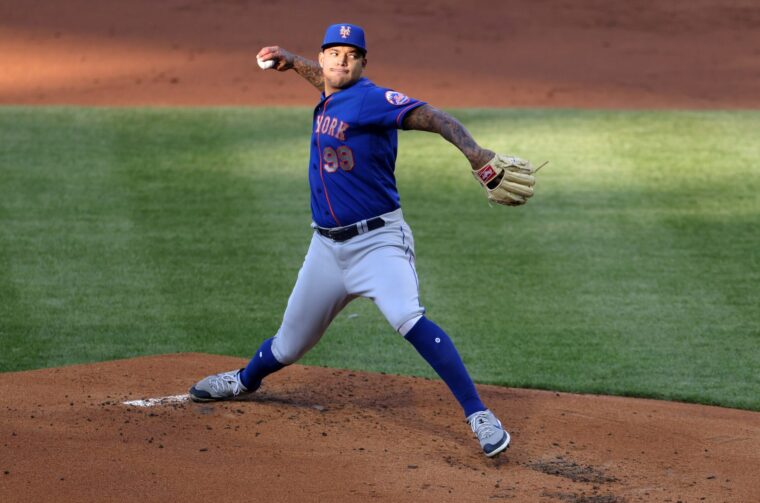
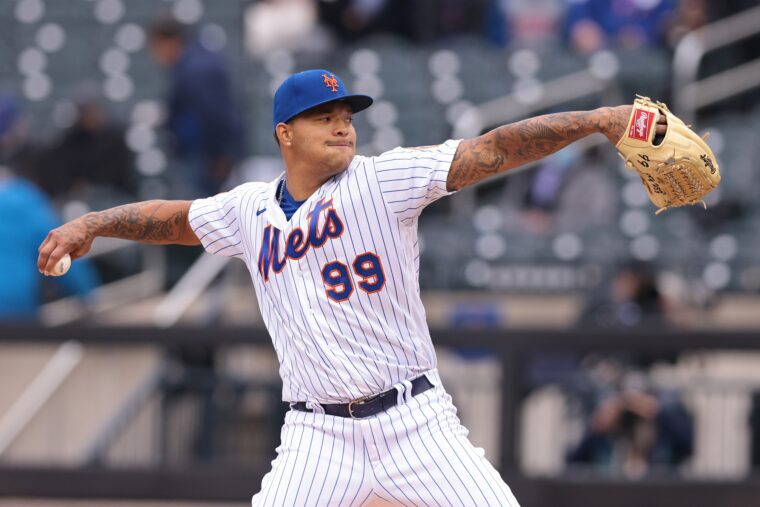
The season is still young, but it’s hard to ignore the production the New York Mets have already gotten from starting pitcher Taijuan Walker. And when you think about him getting signed for three years and $23 million, it feels like an even shrewder deal for the Amazins.
After his most recent gem against the Baltimore Orioles last Thursday, where he allowed just one run on four hits, three walks, and four strikeouts in seven innings, Walker’s current season-long stats are a wonderful sight. The veteran right-hander has pitched to a 2.20 ERA and 1.02 WHIP, along with a 23.9% strikeout rate and an 11.0% walk rate in 41 innings.
What’s most notable to me, though, is how much more valuable he’s been compared to last year if fWAR is the benchmark. His performance in 2020 was worth 0.6 fWAR in 53.1 innings pitched, and he’s already up to 1.1 this season. This is especially interesting because advanced ERA estimators are typically not painting as rosy of a picture. While Walker’s FIP is 2.91, his xERA is 4.07, his xFIP is 4.11, and his SIERA is 4.40.
These numbers actually aren’t much different from where they settled at the end of last year, so there could be a trend forming. There are three areas where Walker has excelled through the first portion of his Mets tenure that needs to be recognized.
Corralling His Control
Even though Walker’s overall results have been mostly good, there’s a clear divide in his performance when looking at his first seven starts. His first 14 innings of the year (three starts) yielded a respectable 3.21 ERA and a 31.1% strikeout rate, but it was also accompanied by a 1.43 WHIP thanks to an 18.0% walk rate. Walker completed six innings in his team debut against the Miami Marlins and then failed to complete five frames in the two starts that followed.
Over his most recent four starts, though, he’s completed at least six innings each time, exiting after completing seven on three of those occasions. This stretch has also included three quality starts, and although a 19.6% strikeout rate during this span is likely a contributor to his 4.32 xFIP, he’s the proud owner of a shiny 1.67 ERA and 0.81 WHIP, thanks to a much more palatable 6.9% walk rate (nice).
The key here? Getting ahead and continuing to pound the strike zone. Through his first three starts, Walker was throwing first-pitch strikes at a 54.1% clip, with 44.2% of his total pitches landing inside the zone. Over his last four starts, those rates have improved to 62.7% and 47.6%, respectively.
Successfully Manipulating Contact
Walker has never been a huge strikeout guy, and despite that early surge in strikeouts through three starts, the same is holding true in 2021. As it currently stands, the right-hander owns a 23.9% strikeout rate on the year, which is just slightly above his 21.6% career rate. With that in mind, it’s obviously imperative for him to have pinpoint control so he can manipulate the contact of batted balls opposing hitters put in play.
It’s not necessarily ideal to see him posting a 27.9% line-drive rate and a 37.5% ground-ball rate allowed (20.8% and 40.3% career rates, respectively), but progress in his quality-of-contact numbers can negate that somewhat. While Walker is allowing hard contact at a 32.4% clip, which is slightly above his career average, he’s paired that with a 23.8% soft-hit rate, which would be a new career-high mark if the season ended today.
Although the sample sizes are obviously small, his soft-hit rate allowed has continually improved when looking at both of his stops in 2020. In 27 innings with the Seattle Mariners, it was at 14.5%, and in 26.1 innings with the Toronto Blue Jays, it increased 19.7% before his current rate.
Part of that can be attributed to a continual rise in infield-fly rate, which has been trending upward since the beginning of last year — it was 6.5% in Seattle, 10.0% in Toronto, and now 16.7% in New York.
Two Pitches That Have Been Elite
There have been some interesting wrinkles in Walker’s pitch selection. Last year, he tossed his slider at a career-high clip of 21.6%, and he’s in that same neighborhood as a Met (20.1%). As for his fastball, he’s typically used it close to 60.0% of the time throughout his career…until 2020, when he used it just 50.3% of the time (46.4% in Seattle, 54.3% in Toronto). To this point in 2021, his usage mirrors what he did with the Blue Jays last season, as it’s currently sitting at 54.1%.
Using FanGraphs’ pitch values, these two offerings are on track to be the best they’ve ever been in a single season (1.56 value for fastball, 2.50 value for slider, both on a per-100-pitch basis). These numbers check out when compared to other qualified starters in baseball, too, with each pitch ranking within the top 15 (14th for his fastball, 11th for his slider).
Walker’s four-seamer produced a 22.5% strikeout rate, a 16.3% walk rate, and a 92 wRC+ last year. Those numbers are 41.4%, 8.6%, and 16, respectively, so far this season. The story isn’t exactly the same for his slider — his walk rate has gone from 1.8% to 5.6% and his strikeout rate has gone from 29.1% to 16.7% — but opponent wRC+ has dipped from 48 all the way down to 2 through his first seven starts in New York.
When the dust settled during the offseason, the Mets didn’t get their first choice for the rotation. But so far, the early returns have been excellent for both New York and Walker.