
Credit: Robert Hanashiro-USA TODAY Sports
With the New York Mets looking to add an impact arm to their starting rotation this offseason, they’ll need to explore every single option available to them, which should include searching through the international market.
While the Mets haven’t shied away from signing Japanese-born pitchers in the past, they haven’t enjoyed much success in that department in recent years, as pitchers like Ryota Igarashi, Hisanori Takahashi and Ken Takahashi were acquired during the later stages of their careers and only stayed in Queens for a short time. Despite those struggles, the front office might be able to make a significant splash in the near future, as the top hurler from Nippon Professional Baseball is expected to be posted at some point next month.
Tomoyuki Sugano is expected to be posted within the next two weeks, now that the Japan Series has ended, source says. @MLB clubs have been scouting him for years in preparation for this move. @MLBNetwork
— Jon Morosi (@jonmorosi) November 25, 2020
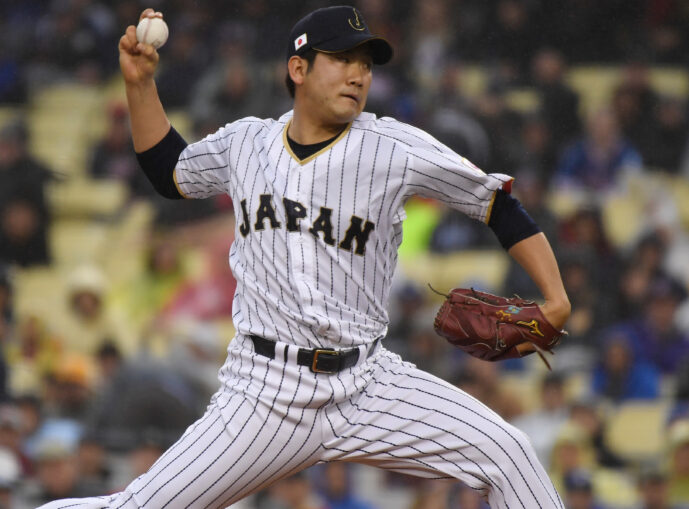
Though the team is hopeful they’ll be able to land Trevor Bauer this winter, acquiring Tomoyuki Sugano, 31, from the Yomiuri Giants — considered the New York Yankees of Japan – could be a solid backup plan if they fail to land the 2020 NL Cy Young award winner in free agency. Since he’s dominated overseas throughout the majority of his career, it’d be wise for management to at least consider making an offer on him once the right-hander becomes available next month.
Considered a middle of the rotation hurler in North America, Sugano could compete for the No. 2 spot and potentially fill in behind Jacob deGrom until Noah Syndergaard returns from his Tommy John surgery next season. Adding to his attractiveness, the 6-foot-1 hurler definitely wouldn’t cost anywhere close to Bauer’s price point, as Japanese pitchers who’ve already crossed over the age-3o threshold haven’t historically received lucrative contracts.
While the Mets would be forced to pay the Giants a release fee to acquire his services, that figure probably wouldn’t be overly expensive and there’s a very strong chance it’d end up being much cheaper than paying infielder Jed Lowrie $20 million in exchange for just eight plate appearances over the last two seasons. That being said, they certainly wouldn’t be the only team who’d have an interest in him, as most organizations across the majors are currently searching for starting pitching and it’s possible each of them could make a serious run at him.
For those unfamiliar with MLB’s posting system, it’s fairly easy to understand, as any player that’s posted has 30 days to negotiate with as many clubs as possible and they’re permitted to sign a contract of any length for any amount they choose. As for the release fee, the organization that signs a foreign player must pay the team that posted him 20 percent of the first $25 million of his contract, 17.5 percent of the next $25 million, and 15 percent of any amount that remains.
For example, if New York signs Sugano to a four-year, $40 million deal this offseason, they’d be forced to pay Yomiuri a release fee of approximately $7.6 million. So in total, the front office would be spending $47.6 million to acquire his services — not too bad for some who’s been considered Japan’s top pitcher over the last six seasons.

Credit: Kelvin Kuo-USA TODAY Sports
Even though a nagging back injury significantly impacted his 2019 campaign, the 2014 Central League MVP was able to bounce back strong this past season, as he produced one of the best statistical performances of his entire career and helped lead his team to the Japan Series — NPB’s version of the World Series.
Over his 137 1/3 innings in 2020, Sugano performed to a 14-2 record, posting a 1.97 ERA (lowest since 2017), 2.76 FIP, 0.89 WHIP, 6.4 H/9, 0.5 HR/9 (tied for career-best), 24.6% strikeout rate, along with a 4.7% walk rate.
In comparison, the back-to-back Sawamura Award winner (Japan’s Cy Young award) was limited to 136 1/3 innings of work in 2019, recording a career-worst 3.89 ERA, 4.13 FIP, 1.25 WHIP, 9.1 H/9, 1.3 HR/9, 20.8% strikeout rate, and a 5.6% walk rate.
Based on these results, it’s clear Sugano is still able to maintain his elite ability to limit walks and generate a ton of swings and misses even when he’s struggling on the mound. Since his precise accuracy is a trait that can be applied at any level of competition, it’s one aspect of his game that the veteran hurler should be able to easily transfer over to the major leagues, meaning he shouldn’t have any major issues limiting free passes moving forward.
Similar to his fellow countryman Masahiro Tanaka, Sugano also features a deep repertoire of pitches and he’s capable of locating each of them consistently throughout an entire game. Relying on two different fastballs (four-seamer and a two-seamer), both of his heaters average in the low-90s but he’s been able to max out at 95 mph with his four-seamer.
Adding to his toolbox, the highly-touted pitcher also relies on his 12-6 low-80s curveball, a mid-80s slider, and occasionally mixes in his mid-80s cutter and splitter. In particular, the righty has shown a preference for leaning on his two-seam fastball along with both of his breaking balls during two-strike counts.
For a better understanding of how Sugano works, here’s a clip of him facing off against former MLB slugger Adam Jones during the 2020 campaign:
Since Sugano is slated to become eligible for unrestricted free agency next winter, he could decide to return to Japan for one final season and then potentially earn a larger contract after the 2021 campaign concludes. But considering he’d be 32 years old at that point, making the jump over to North America this offseason will likely be his best opportunity to cash in on himself and earn the largest contract of his career.
With that in mind, it appears the emerging star will hit the open market very shortly and could potentially agree to his first MLB contract before the calendar happily turns to 2021. While it’s still uncertain as to where he’ll eventually end up, there’s no question one of the most accomplished pitchers from Japan would be a welcome addition to the Mets’ pitching staff, as he could help them correct their woes from this past season.
Even if management isn’t sold on Sugano, which would be understandable since MLB scouts weren’t allowed to travel overseas in 2020, they’ll still need to locate an impact arm before this offseason concludes or they may endure some similar run prevention issues next season.