
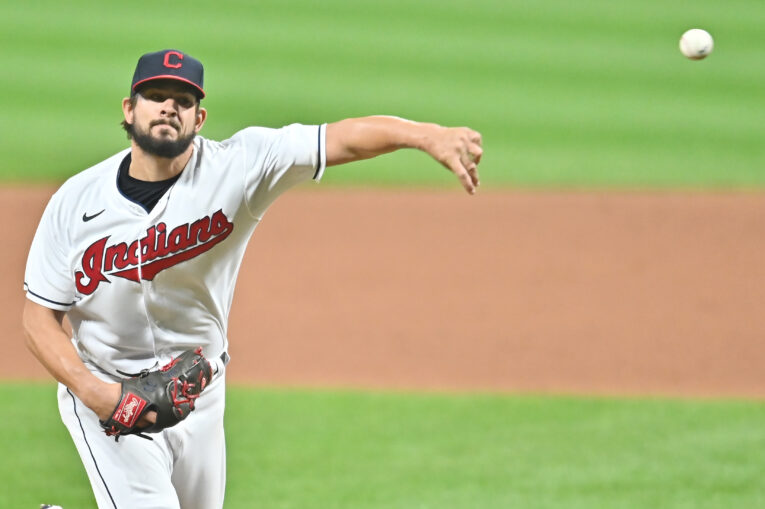
Sep 27, 2020; Cleveland, Ohio, USA; Cleveland Indians relief pitcher Brad Hand (33) throws a pitch during the ninth inning against the Pittsburgh Pirates at Progressive Field. Mandatory Credit: David Dermer-USA TODAY Sports
Following a disappointing 2020 campaign that saw the New York Mets finish short of the postseason, it’s clear changes are coming to their roster this offseason and there’s a very strong chance the front office, whoever is running the show, will be looking to add a few quality relievers over the next few months.
While the Mets’ bullpen definitely performed better this past season compared to the 2019 campaign, there’s no question their entire unit performed far from perfect, as they finished tied with the sixth-lowest fWAR rating (0.5) among all 30 teams in the major leagues. With that in mind, along with relievers Justin Wilson and potentially Dellin Betances – who owns a $6 million player option – becoming free agents, some adjustments will need to be made before spring training opens in 2021.
Considering the team shouldn’t have any financial restrictions this winter with billionaire Steve Cohen expected to take over ownership, it’d make plenty of sense for them to target some of the top relievers available on the open market. Since someone like Brad Hand just recently became available after being placed on waivers by the Cleveland Indians, there’s a strong possibility he could be pitching in Queens next season, which would be a massive addition to the club’s bullpen.
Though his $10 million club option made him a necessary casualty due to the upcoming financial crunch, his impending release certainly doesn’t take away from his impressive performance, as he enjoyed another quality showing while serving as the Indians’ closer for the third straight season. Despite being limited to just 23 outings, which was his lightest workload since 2013, the 6-foot-3 hurler was still able to finish near the top of the leaderboard in several different categories.
Over his 22.0 innings of work, Hand finished with the most saves (16) among all qualified relievers in the majors, producing a 2.05 ERA, 2.48 xERA, 1.37 FIP (third-lowest), 30 FIP- (third-lowest), 0.77 WHIP (sixth-lowest), 4.7% walk rate (11th-lowest), 33.7% strikeout rate (20th-highest), zero percent HR/FB rate (tied for league-best), and a 1.1 fWAR rating (tied for second-highest), according to FanGraphs.com.
Adding to these stellar metrics, the left-hander was also able to lower his ERA- by 25 points (44), his OPP AVG by .078 (.163), his xAVG by .053 (.175), his BABIP by .107 (.255), his wOBA by .079 (.213), his xwOBA by .053 (.253), his xwOBACON by .099 (.317), his LD rate by 14.8% (16.3%), and his hard-hit rate by 5.5% (32.7%).
Credit: Ken Blaze-USA TODAY Sports
Based on his outstanding 2020 performance, Hand will instantly become one of the top names available on the free-agent market this offseason, especially since most teams across the league will be searching for a high-leverage arm. That being said, there’s definitely an argument to be made about how the Mets shouldn’t outbid everyone to land his services on a multi-year contract and would be better suited to offer him a one-year deal instead.
Starting with his age, the veteran hurler will be entering his age-31 season in 2021 and recent trends suggest his effectiveness could start to drop off very shortly as he inches closer to his mid-30s. Adding to this, the former second-round pick also witnessed the velocity on his fastball and slider, his two primary weapons, drop considerably and wasn’t able to generate nearly as many swings and misses with either of those pitches as well.
While his slider remained his favorite pitch, utilizing it 50.7% of the time, its average velocity decreased by 1.6 mph (79.6 mph) and also saw its average spin rate decrease by 89 RPMs (2385). As a result, the devastating breaking ball couldn’t create nearly as much vertical movement, which led to a decrease of 1.3 inches of drop (44.3) from the 2019 campaign.
Taking into account these declines, opposing hitters were able to lay off Hand’s breaking ball more effectively, creating a 38.6% whiff rate (4.0% decrease since 2019), 30.0% chase rate (4.5% decrease), 46.7% chase whiff rate (16.8% decrease), 31.3% whiff rate with two strikes (9.6% decrease), 34.9% chase rate with two strikes (12.1% decrease), along with a 33.3% chase whiff rate during two-strike counts (26.7% decrease).
Even though Hand increased his slider’s strikeout rate by 2.6% (45.9%) in 2020, it’s clear that rate wouldn’t have been sustainable during a normal season and probably would’ve declined during the second half of a 162-game campaign. Taking this a step further, if this past season wasn’t shortened, the three-time All-Star could’ve allowed his first home run of the season against his breaking ball, as it recorded a 31.6% FB rate (7.0% increase from 2019).
As for his fastball, the Chaska HS standout utilized it 35.5% of the time and watched its average velocity decline for the second consecutive season, dropping it down from 92.7 mph in 2019 to 91.4 mph during the 2020 campaign. To make matters worse, this slight decrease in speed caused his heater to sit lower in the strike zone, which resulted in a 0.3-inch increase with its vertical movements.
Similar to his slider, this unfortunate change prevented Hand’s four-seamer from creating a large number of swings and misses and allowed batters to generate a concerning amount of fly balls against it.
Despite producing a 30.0% strikeout rate, his low-90s heater induced a 9.4% whiff rate (10th-lowest among all qualified relievers), 19.3% chase rate (8.1% decrease from 2019), 9.1% chase whiff rate (17.0% decrease), 9.1% whiff rate with two strikes (14.8% decrease), 20.8% chase rate with two strikes (14.4% decrease), 20.0% chase whiff rate with two strikes (12.0% decrease), and a 45.5% FB rate (18.0% increase).
Looking at the number of fly balls Hand allowed against his fastball and slider, no one should be shocked that his overall 57.1% FB rate ranked fifth-highest and his 24.2 degrees average launch angle finished sixth-highest in the majors this past season. That said, his ability to keep his pitches out of the middle of the strike zone allowed him to enjoy so much success on the mound, which deserves at least a little recognition.
While the Mets would probably be better off signing someone like reliever Liam Hendriks, who finished second in the majors in saves (14) this past season, there’s no question acquiring Hand would significantly improve the team’s bullpen next season. But it’d likely be wise to let him sign somewhere else on a multi-year deal, as it seems the soft-throwing lefty is nearing the end of his prime.
Though free agency won’t open for another few days, it appears the Mets will be exploring every single option as they attempt to improve several parts of their roster this offseason in hopes of finally breaking through to the playoffs when baseball returns next season.