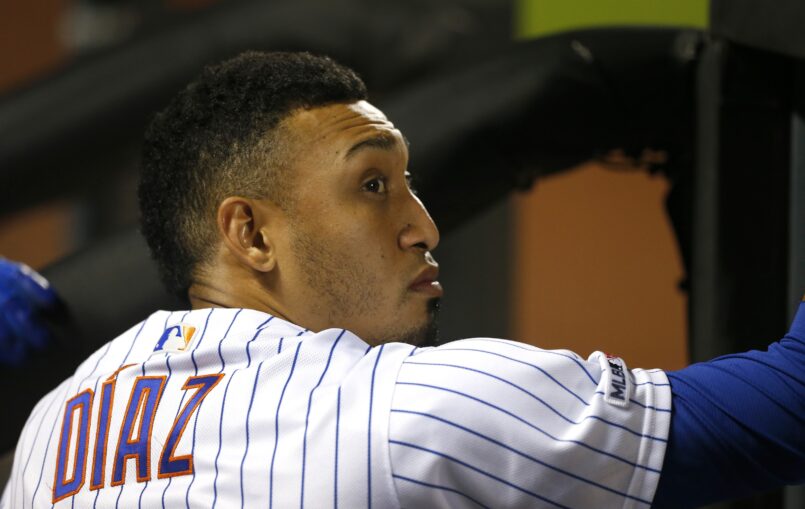
Following a miserable inaugural campaign, the New York Mets were hopeful reliever Edwin Diaz would be able to bounce back during his second season in Queens and actually play up to his high expectations.
While the 26-year old looked shaky on the mound at times and lost his closer role for a brief period, he was still able to turn things around during this shortened 60-game season, as he outperformed his results from the 2019 campaign.
Considering general manager Brodie Van Wagenen paid an extremely high price to land the 6-foot-3 hurler – sending prospects Justin Dunn and Jarred Kelenic along with absorbing the remainder of Robinson Cano‘s 10-year, $240 million contract – it was crucial for the former Mariner to perform effectively this past season.
Over his 26 appearances in 2020, Diaz compiled 25 2/3 innings, saving six contests and producing a 1.75 ERA, 2.46 xERA, 2.18 FIP (13th-lowest among all qualified relievers in the majors), 2.29 xFIP (fourth-lowest), 42 ERA-, 50 FIP- (tied for 13th-lowest), 52 xFIP- (tied for fourth-lowest), 1.25 WHIP, .191 OPP AVG, 45.5% strikeout rate (third-highest), 43.2% GB rate, 34.1% FB rate, 13.3% HR/FB rate, 38.6% hard-hit rate, 6.8% barrel rate, along with a 0.9 fWAR rating (tied for third-highest), according to FanGraphs.com.
In comparison, the right-hander threw 58.0 innings of work and saved 26 games during the 2019 campaign, recording a 5.59 ERA, 3.25 xERA, 4.51 FIP, 3.07 xFIP, 1.38 WHIP, .254 OPP AVG, 39.0% strikeout rate, 36.7% GB rate, 43.8% FB rate, 26.8% HR/FB rate, 45.7% hard-hit rate, 10.1% barrel rate, and a 0.0 fWAR rating through his 66 outings.
Despite this impressive progression, Diaz still struggled during high-leverage situations this summer, which resulted in his trio of blown saves (tied for third-most in the major leagues). In addition, the one-time All-Star also watched his walk rate increase by 4.0% (12.7%), his line drive rate increase by 3.2% (22.7%), and he generated the 10th-highest BABIP (.381) among all qualified relievers.
Considering the former third-round pick is only two years away from free agency, and is expected to earn a raise from his 2020 salary of $5.1 million, the Mets could be tempted to explore potential trade offers for the young arm this offseason.
Since Van Wagenen was willing to move the Puerto Rico native before this season’s trade deadline, it definitely wouldn’t be shocking to see him revisit that idea (for the right price of course) over the next few months.
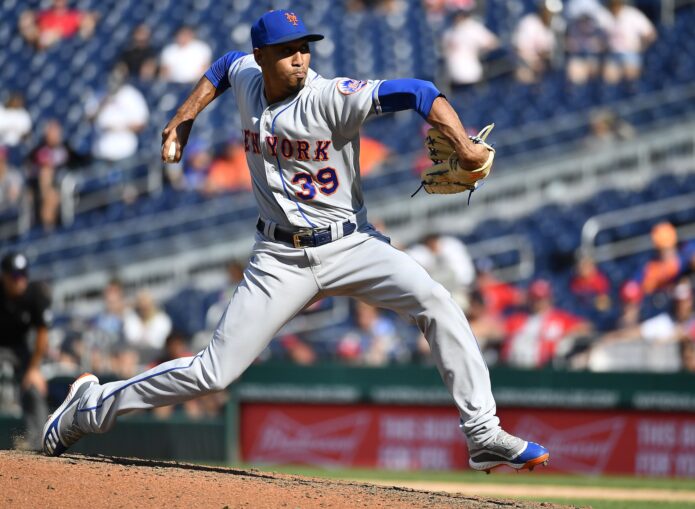
With Diaz set to enter his age-27 season in 2021, this winter would likely be the best opportunity to maximize his value on the trade market, as he’s coming off a respectable second season in Queens and still features two years of arbitration remaining on his current contract.
That said, it’d only make sense to part ways with the 2018 AL Reliever of the Year if the team receives a package in return that addresses at least one of their major needs.
Taking into account the areas where the Mets need to improve, their front office should only entertain offers that include a starting center fielder, a front of the rotation pitcher, or an everyday catcher. But if no one is willing to pay that price, and there’s a solid chance most teams will balk at their demands, then the club will need to take alternative routes to address those concerns.
As a result, Diaz would be slated to earn another opportunity to control the closer’s role next season, which might not be a worst-case scenario for this team. While his overall results weren’t spectacular, the hard-throwing righty started to find his footing in August and ultimately hit his stride once the calendar turned to September, resulting in the best stretch of his entire season.
From Aug. 31 to Sep. 27, the explosive right-hander completed 12 2/3 innings of work, creating a 0.71 ERA, 1.38 FIP, 2.44 xFIP, 0.95 WHIP, .140 OPP AVG, .286 BABIP, 44.0% strikeout rate, 12.0% walk rate, 19.0% LD rate, 47.6% GB rate, 33.3% FB rate, 19.0% hard-hit rate, and he didn’t surrender a single home run during that timeframe.
Taking this a step further, the majority of these impressive results should be credited to Diaz’s ability to steadily improve his high-90s fastball over the second half of the 2020 campaign. Though its usage was essentially cut in half, down to 27.9% in September compared to 51.9% in August, it still proved to be a very effective strikeout weapon through the final month of the regular season.
Over his 11 2/3 innings in September, Diaz threw 57 four-seamers, generating a .167 AVG (.183 decrease from August), .092 xAVG (.089 decrease), .250 SLG (.300 decrease), .173 xSLG (.103 decrease), .214 wOBA (.190 decrease), .146 xwOBA (.087 decrease), 53.8% strikeout rate (8.3% increase), 25.9% chase rate (3.9% increase), 46.4% whiff rate (2.2% increase), along with a 7.7% walk rate (1.4% decrease) against it.
Based on his strong finish to the season, there’s an argument to be made that the over-powering righty may have corrected his issues on the mound and his newfound success could position him for a lights-out performance in 2021. And considering he’s still on a team-friendly contract, it’d be a shame if he enjoyed that type of showing with another organization.
Since teammate Seth Lugo is looking to remain in the starting rotation next season, the closer’s role will likely be Diaz’s to lose if he’s still on the team when training camp opens next spring. But even if he begins the 2021 campaign on the club’s roster, there’s no guarantee he won’t be moved before the trade deadline.
With the 2020 postseason still underway, the Mets have plenty of time to determine their offseason plans and the addition of billionaire Steve Cohen is expected to increase their aggressiveness over the next several months, which could result in one of the most interesting and exciting winters in recent years.