
Entering spring training, the New York Mets featured what GM Brodie Van Wagenen believed was going to be one of the best rotations in baseball.
Fast forward to a few months later, the team’s pitching staff is now riddled with injuries and they’ll be without Marcus Stroman, who opted out on Monday. It’s not even 20 games into the 2020 season and the sky is already falling in Queens. Well, maybe not just yet.
With Jacob deGrom at the front of the rotation, the Mets should be able to continue relying on their ace hurler every fifth day. Beyond the back-to-back Cy Young Award winner, they’ll need someone to step up and help him carry the load through the rest of the season.
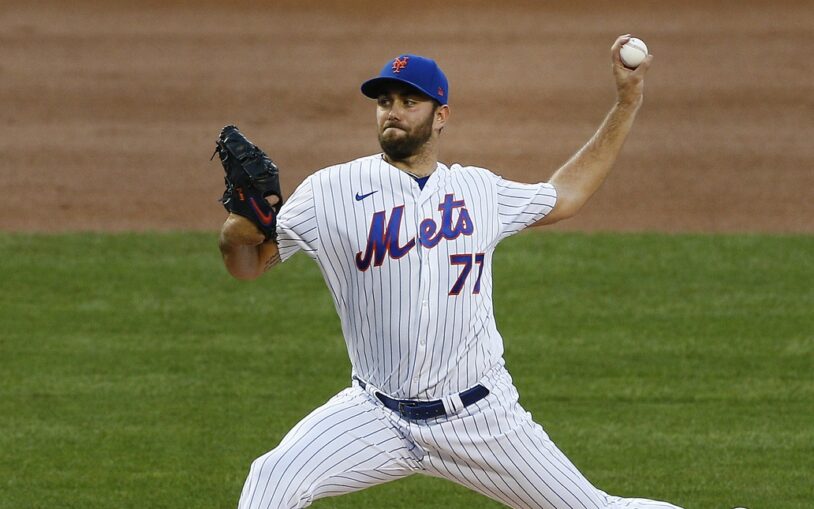
Despite his limited major-league experience, David Peterson has already shown flashes of developing into a reliable starting pitcher through his first three starts this season. While the former first-round selection couldn’t crack the top-10 within the Mets’ minor-league system earlier this spring, sitting at No. 13, the 6-foot-6 arm could earn a ton of attention before the conclusion of the regular season.
Initially assigned to the alternate training site in Brooklyn, Peterson was recalled before the end of July because of Stroman’s calf injury. But with the impending free agent calling it quits on the 2020 campaign, the rookie hurler will now continue receiving opportunities to prove himself as a starter and will be leaned upon to produced quality starts.
Luckily for the Mets, the Oregon standout has already achieved plenty of success during his brief time in the majors. Along with earning wins in two of his three starts, the towering left-hander has also completed at least five innings and hasn’t allowed more than three runs in each of those outings.

In total, Peterson has compiled 16 2/3 innings, producing a 3.78 ERA, 3.99 FIP, 4.09 xFIP, 1.32 WHIP, .258 OPP AVG, 20.6% strikeout rate, 8.8% walk rate, 47.9% GB rate, along with a 0.2 fWAR rating. As a result of these encouraging metrics, the 24-year old sits with the fifth-lowest walk rate, the sixth-lowest FIP, the sixth-highest GB rate, and is tied for the third-highest fWAR rating, among all qualified rookie pitchers in 2020.
While the Colorado native relies on five pitches, his low-90s sinker and low-80s slider are his most important weapons. Without these pitches, the young lefty would struggle to induce high amounts of ground balls along with swings and misses.
Starting with Peterson’s primary breaking ball, he’s been able to consistently keep hitters off-balance with it and has also forced batters to expand the strike zone as well. Over his trio of starts, No. 77 has generated a .179 AVG, .163 xAVG, .357 SLG, .291 xSLG, .235 wOBA, .209 xwOBA, 37.9% strikeout rate, 36.1% whiff rate, and a 53.3% chase rate against his slider.
What’s even more impressive is that these results will likely be sustainable throughout the remainder of the season and probably beyond that point as well. Considering his slider is averaging the 10th-most inches of drop (43) in the major leagues, it should continue baffling hitters through the rest of the season and it could also potentially become one of the most elite breaking balls in the near future.
As for Peterson’s sinker, it hasn’t reached its full potential just yet and still requires a little more refining. With that said, his sinking fastball has already started improving significantly since his opening start of the season, which resulted in plenty more ground balls during his latest outing.
During his MLB debut, the former Boston Red Sox selection allowed a .500 AVG, .510 xAVG, .750 SLG, .968 xSLG, .555 wOBA, .634 xwOBA, 12.5% whiff rate, 25% GB rate, and a 85.8 mph average exit velocity against his sinker.
During his third start of the 2020 campaign, the soft-throwing lefty surrendered a .000 AVG, .075 xAVG, .000 SLG, .097 xSLG, .000 wOBA, .086 xwOBA, 42.9% whiff rate, 100% GB rate, and a measly 72 mph average exit velocity against his sinking fastball.
Based on these results, Peterson has to be very encouraged about the progress he’s already made with his sinker, especially since it’s averaging the 19th-most inches of break (15.4) in the majors. But moving forward, he’ll need to locate his sinking fastball lower in the strike zone, as it’s tied for the 23rd-fewest average inches of drop (21.7).
With teammates Steven Matz and Rick Porcello struggling on the mound, it’ll be critical for Peterson to continue improving and developing his craft through the final two months of the regular season. If successful, the promising young hurler could potentially steal some of the spotlight away from deGrom as the Mets’ top pitcher. But would that be so awful? Probably not.
Since the playoffs are expanding to eight teams in the National League in 2020, the Mets don’t even have to win the NL East division to return to the postseason this fall. In order to accomplish that feat, the team will need a rookie of the year caliber performance from Peterson this season and that doesn’t seem to be beyond his reach.