

While the first stretch of regular season games hasn’t exactly been pleasant for the New York Mets, it hasn’t all been bad. One of the few bright spots has been outfielder Michael Conforto’s overall performance at the plate.
And in the past few days, what Scooter does with his bat has become increasingly more important. You know, first it was because Yoenis Cespedes opted out, and then because Robinson Cano hit the Injured List, while Jeff McNeil and Amed Rosario are both sidelined (hopefully temporarily). His increased importance has been shown by a shift in where Luis Rojas is penciling him into the every-day lineup. Through the season’s first week, he took up residence in one of the top four spots twice. Since August 1st, his name has popped up there in four out of five opportunities.
The 27-year-old has posted a solid .313/.411/.479 line with two home runs, six RBI, and a 156 wRC+ through 56 plate appearances. When looking at what he accomplished in 2019, a handful of areas have improved in the early going that have contributed to this.
(All 2020 statistics shown don’t include Wednesday’s game against the Washington Nationals, unless otherwise noted.)
Improved Plate Discipline
From the moment Conforto made his MLB debut in 2015, he’s shown a knowledge of the strike zone that’s been ahead of most hitters his age. He posted an 8.8% walk rate as a 22-year-old rookie, and that number hasn’t dipped below 10.3% since 2016. He’s also paired that with a mostly declining strikeout rate. After watching it jump up to 25.6% and 25.7% from 2016-17, respectively, it traveled back down to 23.0% last year. Following Wednesday’s game against Washington, his strikeout rate currently stands at 21.4%, while his walk rate stands at 12.5%.
Conforto’s aggressiveness on pitches within the strike zone took a noticeable step forward in 2019, and so far, that change has held in 2020. What’s also changed, though, is how often he’s chasing balls outside of the strike zone.

Despite the significant drop in contact rate on balls outside the zone, the corresponding drop in his swing rate for that situation has actually helped boost Conforto’s overall contact rate compared to last year (75.3% to 76.5%). One may assume this shift in plate approach would have an advantageous impact on Scooter’s batted-ball profile.
If you thought that, you’re right.
Shifts in Batted-Ball Profile
Here’s a look at how Conforto’s batted-ball outcomes have shifted so far this year as he focuses more on attacking strikes.

The slight drop in power numbers through this first stretch of games can be explained by a drop in fly-ball rate. Conforto’s overall production hasn’t suffered because that drop in fly-ball rate has gone straight to his line-drive rate, thankfully. The outfielder’s hard-hit rate is actually down a smidge (36.5% to 34.5%), but what’s important here is the significant change in soft-hit rate thus far, going from 13.6% in 2019 to 6.9% (nice).
So it’s clear to see how the (albeit premature) change in Conforto’s plate approach has directly impacted how he’s been putting the ball in play.
Getting it Done vs. Lefties
The 27-year-old’s offensive performance against left-handed pitchers hasn’t always been sunshine and rainbows, but that’s also partially because he wasn’t given as many chances as he should’ve received against them early in his career. Here’s a look at how his wRC+ against lefties and righties have progressed between 2015 and 2019.
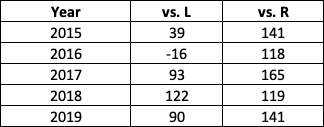
The numbers are stark because of the small sample size, but this year has been a rousing success so far. His plate appearances in each situation are basically even (24 plate appearances against lefties, 27 against righties), and Conforto owns a 210 wRC+ when facing southpaws, along with a 118 mark against righties.
What’s also noticeable here is that not only has both of Conforto’s homers come against lefties, but all of his extra-base hits have come in this scenario (those two homers plus two doubles).
Areas to Improve
A fast start doesn’t necessarily mean a perfect start, and there’s always things to improve upon for any ballplayer. Given the current state of the Mets’ lineup, Conforto needs to be a run producer and come up big in clutch situations.
That’s been an issue. With nobody on base, he owns a .928 OPS. That number drops down to .899 when he steps in with runners on base, and it goes down again to .701 when those runners are in scoring position.
This is not just a Conforto problem, of course — prior to Wednesday’s win, the Mets’ .609 team OPS with runners in scoring position was fifth worst in baseball.
Conforto is also seeing four-seam fastballs less than normal, which has led to increased usage in cutters (5.7% to 12.7%) and curveballs (10.4% to 20.3%) from opposing pitchers. Curveballs are the big issue Scooter needs to figure out, as he entered Wednesday night with a -35 wRC+ and 44.4% strikeout rate against that pitch.
New York has been fortunate to see some of its impact position players start hot. With the present circumstances, the Mets will need Conforto to continue his current pace and join forces with Pete Alonso (once he snaps out of his own slump) to be the lineup’s main run producers.