
Since the dawn of the expansion era, the New York Mets franchise owns the second-worst OPS (.688) after the sixth inning. Excluding the San Diego Padres, no other team seems to have as much trouble hitting relief pitching. I wouldn’t give the moment away for anything, but even their most famous eleventh-hour comeback in game six of the 1986 World Series was aided by a passed ball and an error of biblical proportions.
Incidentally, then, it’s not exactly easy to separate the relievers who merely kept with tradition from those who actually dismantled Met hitters in the late innings. Some hurlers stand out as especially formidable, nonetheless. Here are just a few of the closers and high-leverage pitchers who had the most fun at our expense in the Mets’ 58-year history.
Don McMahon
The concept of a relief pitcher in the 1960s would never fly in baseball today. Take the 1969 World Series, for instance, where the only two non-starters to appear in the Mets’ five-game romp of the Baltimore Orioles were Nolan Ryan and Ron Taylor, whereas the O’s only used three (Dick Hall, Dave Leonhard, and Eddie Watt). About one half to two-thirds of big-league starts would go down as complete games, so the field is pretty narrow.
Even then, during the Mets’ first competitive breaths in the late-60s and early-70s, Don McMahon seemed to show up pretty regularly, and they didn’t seem to have an answer for him most of the time. From 1969 to 1972, only three relievers appeared in more games than the San Francisco Giants righty, and of the 14 such arms to appear in at least 27 during the Mets’ first decade of existence, McMahon ranks second in ERA (0.92), first in WHIP (0.778), first in batting average (.120), first in OBP (.222), and first in slugging (.160).
McMahon also managed eight strikeouts per nine innings across those four years. For perspective, he only averaged 6.9 for his career, only 36 of the qualified 481 relievers in all of baseball during that time averaged more than eight. In an era that idealized the starter who pitched to quick contact, ate innings, and kept his team ahead, McMahon stood out as a reliable fireman with a penchant for swings and misses. It would only make sense that in 1969, he’d finish all three of the games he appeared in and would only allow one of his 17 opposing Met hitters to reach base.
While sifting through the closers that owned the Mets in their early years (among all the other players and teams) would be a bit of a chore, three noteworthy mentions also stand out: chief among them would be Cubs, Braves, and Reds righty Ted Abernathy, who notched 15 saves and a 0.90 ERA in the 43 games he appeared in against us from 1965-1969. A teammate of McMahon’s, Frank Linzy (1.14 ERA and 31 games finished in 45 appearances), also has some figures to show for, as does the well-traveled, former Met pitching coach Phil Regan (3.00 ERA and seven wins in 40 games and 66 innings of work between the Dodgers and Cubs).
Al Hrabosky
Moving into the early-1970s, the now-winning Mets had actual rivalries within the NL East to reconcile, and few teams posed a threat quite like the St. Louis Cardinals. Lou Brock, Joe Torre, and Ted Simmons packed an unforgiving lineup, and Bob Gibson headlined a tough rotation, to boot. Though few old-school Met fans could forget the late-innings obstacle that was Al Hrabosky, “the Mad Hungarian.”
From 1970 through 1977, the fierce lefty closer went undefeated (5-0) in 37 games against the Mets. Hrabosky finished 22 such contests, converting seven saves and posting a 1.84 ERA. Just seven relievers appeared in as many games through the decade, and none could match either his ERA, strikeout rate (9.2 per nine), or opponent OPS (.512). Met batters scratched just .163 against him, nearly 40 points lower than the next-best figure.
Between 1973 and 1976 – their last competitive season of the decade – the Mets went just 25-29 against the Cardinals, with Hrabosky enjoying that final year in particular. As an 86-win Met club failed to put up a winning split against a 90-loss group in the Redbirds, Al pitched 13 innings. He faced 48 batters, walking just six and allowing only three hits. The .289 OPS New York struggled under is the second-lowest single-season mark of the decade. It ranks one place behind 1977 Willie Hernandez and one ahead of 1974… Al Hrabosky. Go figure.
Lee Mazzilli would achieve some form of retribution in July of 1980, when a Hrabosky fastball over the head of Pat Zachry ignited a shouting match from the on-deck circle and ended with a Mazzilli homer a few moments later. The benches would clear as Lee rounded the bases, but between the fact that Hrabosky now pitched for an NL West team in the Atlanta Braves, the score had gone from 7-2 to 9-2, and the Mets would finish the year with 95 losses, it didn’t erase the scars.
Among honorable mentions, the late Tug McGraw enjoyed success at our expense from Philadelphia in the latter half of the decade, saving 17 of the 37 games he appeared in (the most of any reliever) and managing a 0.95 WHIP and striking out 46 (both third-best). Accompanying our old friend on these leaderboards are Mike Marshall (95.1 innings, 48 games, 41 finished, .609 opponent OPS) and Gene Garber (0.929 WHIP, 2.09 ERA, and 3.08 K/BB in eight years between Philly and Atlanta… and then a 0.841 WHIP, 1.32 ERA, and 3.55 K/BB ratio during the ’80s).
John Franco
Believe it or not, there one was a time when the Mets and their fans associated the thought of John Franco pitching with the team losing. Prior to joining the Mets in the 1990 offseason, the Brooklyn native enjoyed his time at Shea Stadium ripping any hitter in the orange and blue to shreds.
He debuted with the Cincinnati Reds in 1984, limiting the sample to 27 appearances, but Franco still leads the pack when it comes to ERA (0.70), WHIP (0.802), and all three of the slash lines (.140/.224/.202). His 11 saves, which rank fifth for the decade, are all the more impressive for this reason. It would only be reasonable that his 1986 numbers against the Mets be his most dominant, as the lefty tossed 11.2 innings of shutout ball, reducing a juggernaut offense to a .432 OPS.
Upon realizing he’d somehow lost three of five decisions versus the Mets, I dug into the archives to figure out how this came about. Franco’s first defeat came in his first appearance of the 1985 season, when, after a scoreless eighth inning, a first-pitch Darryl Strawberry homer in the ninth broke a tie for good. His second loss came at the end of April in 1988, when Mookie Wilson reached on a two-out throwing error from his shortstop, Barry Larkin, that scored the go-ahead run in the top of the ninth. Then a week later, Strawberry hit another walk-off bomb.
So for those keeping track, the best closer in Mets history used to wipe the floor with them as a youngling with Cincinnati. We got lucky once, and unless Straw was batting, they had virtually no chance against him.
For what it’s worth, Franco’s in pretty good company among ’80s relievers. From his prime in Chicago all the way in his last reps with the Cardinals and Braves, Bruce Sutter cleaned up pretty well against the Mets through this time, as his 38 saves (tied first all-time), 3.21 K/BB ratio (third on the decade), and 1.052 WHIP (sixth on the decade) can attest. Looking at career figures, moreover, Lee Smith definitely stands out: he’s tied with Sutter for the all-time lead in saves, and his 95 strikeouts lead the way. Rod Scurry‘s sample with the Pirates is small, but his 1.82 ERA and 9.3 K/9 (seventh and second, respectively, on the decade) are nothing to sneeze at, either.
Billy Wagner
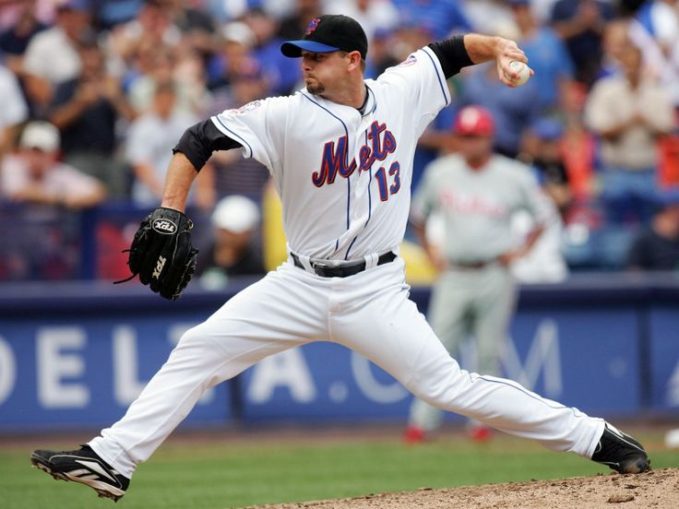
Another flamethrower who eventually found a home in Flushing, Billy Wagner‘s prime years were largely spent destroying opposing hitters across the league, and the Mets were no exception.
From the time he debuted in Houston in 1995 to his last appearance with the Phillies ten years later, Wagner owned a career 2.40 ERA and a 3.81 K/BB ratio. Against the Mets, he pushed it all a little further, posting a 2.23 ERA and upping the K/BB ratio to 4.15. Only seven relievers appeared in as many games as Wagner did (37) during this stretch, and of the 21 who appeared in at least 30, only one pitcher finished ahead in K/9, only future three others (including future Mets Braden Looper and Felix Heredia) also went undefeated, and nobody held hitters to a lower average (.162), on-base (.243), or slugging percentage (.250).
In career terms, Wagner ranks just 22nd in appearances with 46, but 11th in strikeouts with 64. At 0.770, he owns the lowest WHIP among relievers to pitch in at least 30 games against the Mets, and the .152 opponent average ranks third behind Franco and lefty specialist Javier Lopez.
The Met offenses of the mid-to-late-1990s were a class of their own, but Wagner and a small handful of other relievers still held their own. Trevor Hoffman, though not as successful as his left-handed counterpart, still limited Met bats to a .546 OPS that ranks 15th all-time, and his 33 saves rank third. Robb Nen‘s stats with the Marlins and Giants are also hard to ignore, particularly the 1.76 ERA in 40 games, though the Mets also had some fun against him in that 2000 divisional series. And while he didn’t win much in his days with the Expos and went an even 4-4, Ugueth Urbina‘s 12.4 K/9 and 17 saves both manage to eke out Wagner.
Kenley Jansen
Looking out across the field of active relievers, Craig Kimbrel (1.41 career ERA, 14.1 K/9, .525 OPS) stands out as one particularly qualified option to put on a roster of Met killers. They’ve only faced Josh Hader five times since his debut in 2017, but the one hit and 22 strikeouts in 30 plate appearances should not be presented with children in the room. Combine both elements of tenured and frustrating, however, and your end result is 29 games (and three postseason affairs) with Dodgers’ shutdown artist Kenley Jansen.
Among relievers with as many innings to their name as Jansen (28.1), only three have an ERA lower than his 0.95 (Franco, Abernathy, and Peter Moylan). Across the ten seasons that the Mets have been able to face Jansen, they’ve only managed to score a run in three. In fact, they haven’t eked out a run against him since July of 2015, amounting to just two hits and a walk in their last 38 trips to the plate and striking out 15 times. A Pete Alonso triple in May of 2019 was the only dent the Amazin’s could put in Jansen’s most recent campaign, and six of the other 12 plate appearances ended in punchouts.
Even in the 2015 NLDS, a winning effort characterized by a number of timely hits, the Mets were more-or-less suffocated by that cutter, managing just one hit on a groundball double from Juan Lagares, walking three times, and leaving everybody on the bases.
There are 28 active relievers in baseball who have made at least 20 appearances against the Mets. Jansen is the only pitcher in this sample to register both an ERA and WHIP below one, and he’s just one of two to keep us without a homer in that stretch (the other being David Robertson, who has appeared in nine fewer games). To make matters even scarier, he has a complete monopoly over the slash lines, leading in average (.124), on-base (.204), and slugging percentage (.206).
Stealing a playoff series from the Dodgers five years ago was sweet, if not miraculous, given the threat Jansen posed. But considering the Mets have gone 7-20 against them since, I’d guess Jansen and his spotless ledger have both enjoyed the reunions.