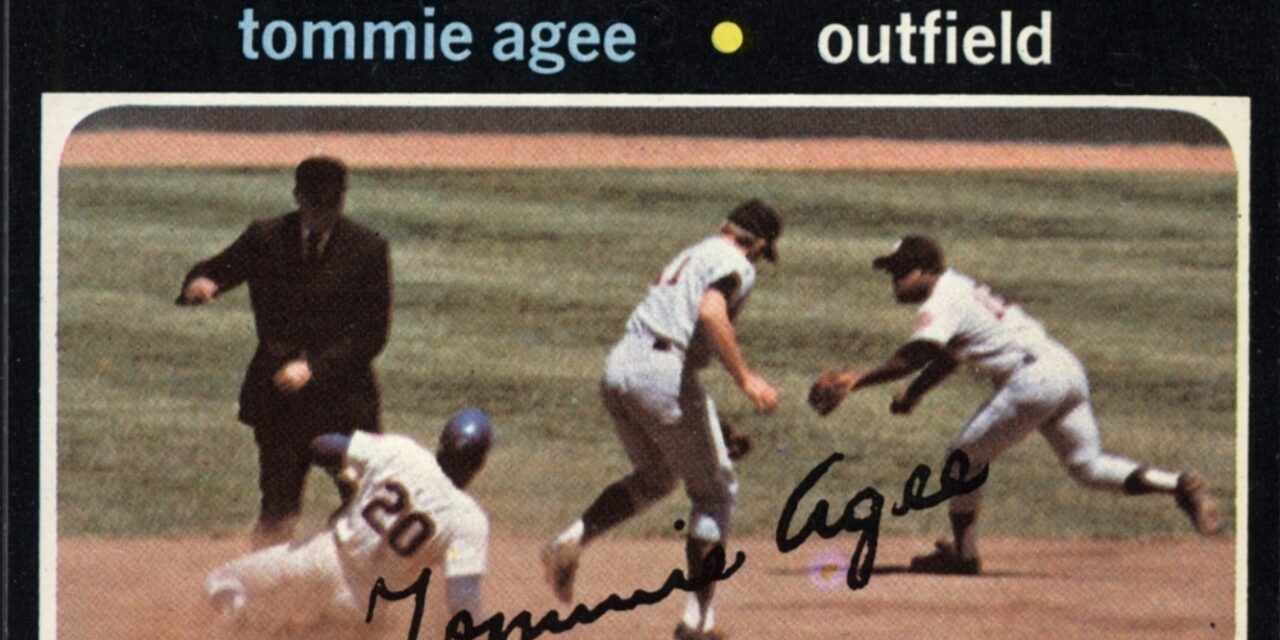
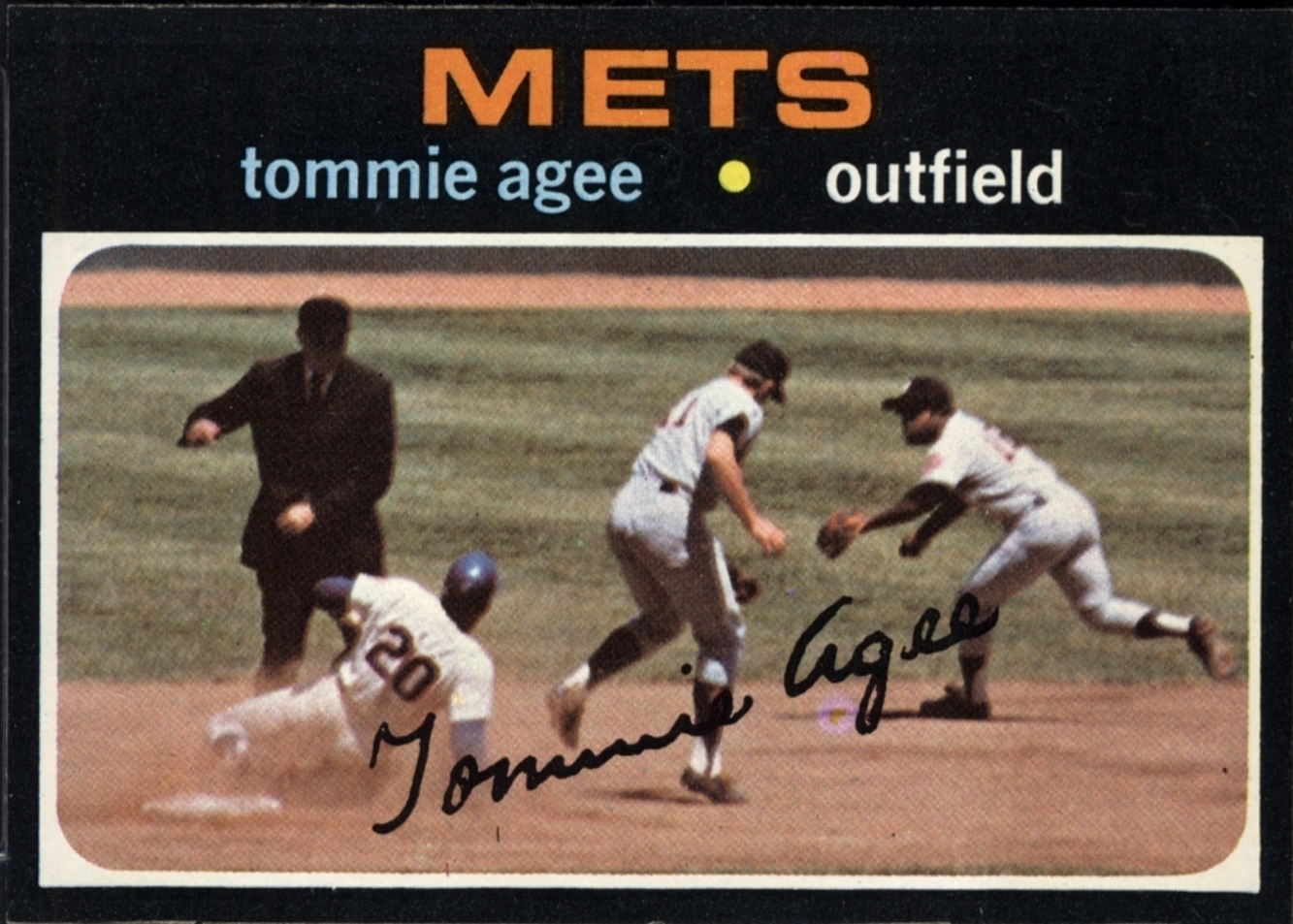
MMO previously analyzed the 1973 Topps Tommie Agee card to determine the date, venue, and other players and umpire shown on that particular card as well as the unseen batter. Today, we’re going to turn the clock back just a bit further and see, armed with our trusty Sherlock Holmes deerstalker hat, if we can’t solve the mysteries presented on the 1971 Topps Tommie Agee card #310 from the set.
1. When was the game played?
We see Agee sliding into second while Astros second baseman Joe Morgan and the shortstop, who has a “1” as the second number on his uniform attempt to retrieve the ball. From the grass outfield we know that the game must be at Shea as the Astrodome had astroturf. From the lighting, the game is a day game, and from the minimal shadows, we’re looking for a play relatively early during the game.
Turning to baseball-reference, the Mets hosted the Astros in three day games in 1970, on May 30, 31 and August 19th. Reviewing the box scores in reverse date order, Tommie Agee did not have a stolen base on August 19, nor in the first game of the doubleheader on the 31st which leaves the game on May 30 as a likely date. Indeed, in the bottom of the first Agee walked and promptly stole second. Therefore, the game this picture was taken was the May 30 game at Shea against the Houston Astros.
2. Who is the shortstop?
Denis Mennke played short that day for the Astros. While not having the Hall of Fame career that Joe Morgan had, Menke played 13 seasons in the majors between 1962 and 1974, accumulated 28.1 bWAR and was a two-time All Star, including 1970. In 1970, his uniform number was 11, consistent with the second “1” we can see on the card.
3. Now that we know the three players – Agee, Morgan and Menke, who is the umpire?
The second base umpire that day is Ken Burkhart. Both a pitcher and an umpire in MLB, as a pitcher, Burkhart had a lifetime 27–20 record with a 3.84 E.R.A. across 519.2 innings. As a rookie in 1945 with the Cardinals, Burkhart posted an 18–8 mark with 22 starts and 20 relief appearances; his 18 victories and .692 winning percentage each tied him for third in the National League, while his 2.90 ERA ranked him seventh. His promising playing career was derailed when his arm was injured, and he retired at the end of the 1949 season and started his umpiring career.
A well regarded umpire chosen to umpire 3 different World Series and multiple All Star games, the play shown here was before a rather controversial play in the 1970 World Series. In Game 1 of the World Series that year between the Reds and Orioles, Burkhart collided with Orioles catcher Elrod Hendricks. With one out in the sixth inning and runners on the corners, pinch-hitter Ty Cline nubbed a pitch off Jim Palmer in front of the plate. Burkhart stepped forward to call a fair ball and found himself caught in the middle of a play when Hendricks – who initially intended to throw out Cline at first base – instead snatched up the ball and spun around in an attempt to tag out the runner Bernie Carbo coming home from third.
Hendricks tagged Carbo with his mitt while holding the ball in his other hand. Burkhart, who was knocked to the ground and had his back to the play, was in no position to make a correct call, called Carbo out.
Replays showed that Hendricks tagged Carbo with an empty glove and Carbo missed the plate, although he did touch the plate on his way back to the dugout. The score remained tied at 3–3, with the Orioles eventually winning he game 4–3, and the Series in 5 games.
4. Who was the Houston battery that surrendered the stolen base to Agee?
Larry Dierker was the pitcher and Johnny Edwards was the catcher making the throw that appears to have gotten away from Morgan and Menke.
5. Did Agee score that inning?
No, he didn’t. After stealing second, a wild pitch sent Agee to third. Despite having a man on third with no outs, the Mets failed to score as Harrelson struck out, Cleon Jones popped to second, and Shamsky grounded out to the pitcher.
6. Did the Mets win the game?
Yes, the Mets won the game 4 – 3 with a three-run rally in the 8th.
7. Were the pictures for any other 1971 Topps cards taken from that game?
As covered previously by MMO, the picture of the “Bud” Harrelson card from the 1971 Topps set was also taken from this game, and also was on a stolen base attempt at second. We are also researching another card from that set that seems likely was taken from this game.
Let’s put our collective Holmes deerstalker hat on the wall peg until next time when try to use our detective skills to determine the date and details of that card.
LGM