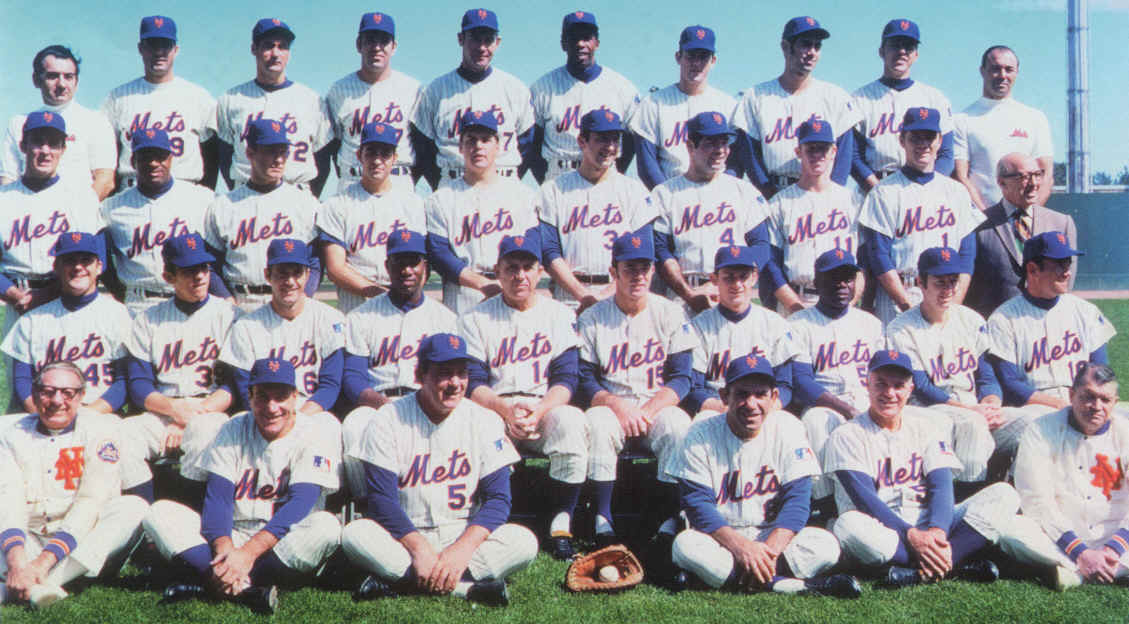
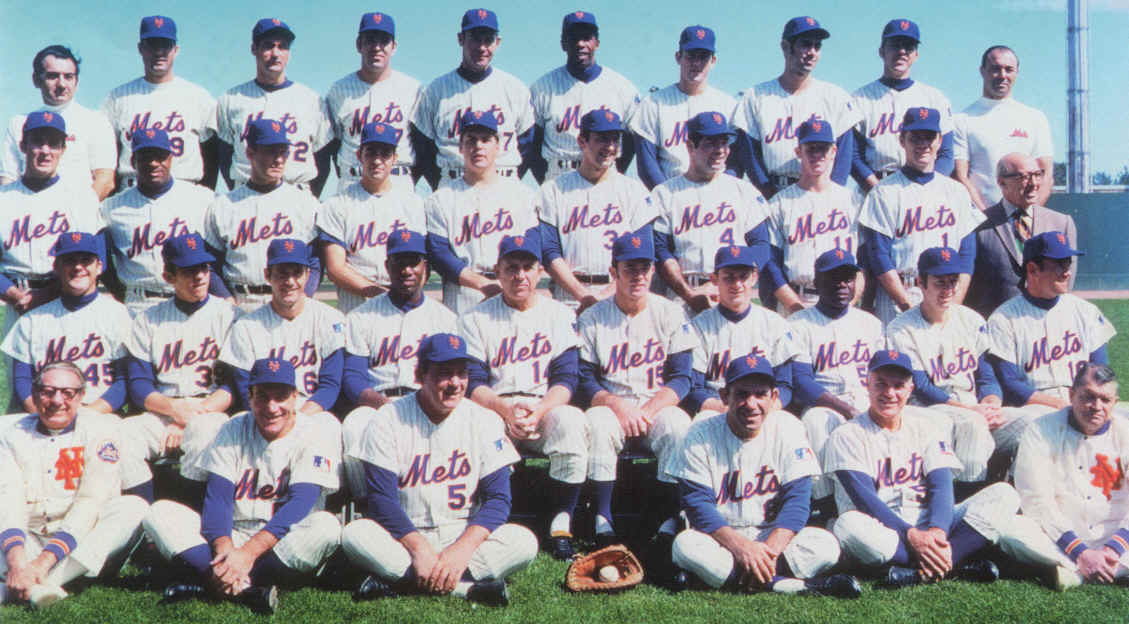
1969 New York Mets
To properly put into context the overwhelming and unexpected accomplishments of the 1969 New York Mets, one need only look at the brief history of the young franchise. Most often when a team wins a championship, they are coming off a season or two showing major improvement and give indications they are ready to take the next step. The Mets certainly gave no sign in the years prior to their glorious World Series victory in 1969 that they were ready to win it all.
And yet, somehow this nascent franchise, in just its eighth year of existence, managed to win it all in dominant fashion, winning 100 games in the regular season, then sweeping the Atlanta Braves in the NLCS before upsetting the heavily favored Baltimore Orioles in five games.
The Mets began as a hybrid, a mixture of two teams that left for California in 1957, the Dodgers and the Giants. Four years later the National League held their first expansion draft to add players to two new teams, the Houston Colt .45s and the New York Mets. The name Mets is a result of a shortening of the corporate name of the team, The New York Metropolitan Baseball Club, Inc.
During the draft, the Mets opted not to take young players but rather veterans, many of whom had ties to the Giants and the Dodgers so fans could better associate with the new team. Legendary manager Casey Stengel was hired out of retirement to lead the team, but even his managerial skills were not enough to overcome the dearth of talent on the new team.
1962-1966
The ineptitude of the 1962 Mets is well known to even the most casual of sports fans. From the moment they first stepped on a field on April 11, 1962, against the St. Louis Cardinals to their 120th loss of the season to the Chicago Cubs on September 30, they were the poster boys of losing. They became known as the ‘Lovable Losers’ and the New York fans soaked it up, as they flocked to the Polo Grounds to see their new team fumble and bumble their way to a last-place finish, a mere 60 1/2 games behind the division champs, the San Francisco Giants.
Gil Hodges hit the first home run in franchise history on opening day, but the Mets lost anyway. In fact, they lost their first nine games to start their history. The Mets first win came against the Pittsburgh Pirates, 9-1, on April 23.
In 1963, the Mets won 11 more games than in their debut season, finishing 51-111 and like 1962, finished in last place in the National League. The ’63 team is remembered for Mets outfielder Duke Snider recording his 2000th hit and later his 400th home run in a two-month span. Both feats were accomplished against the Cincinnati Reds. Snider made the All-Star team as a member of the Mets in 1963, his eighth All-Star appearance.
The Mets received a new home in 1964. After playing their first two seasons at the Polo Grounds, the former home of the New York Giants, the Mets moved to Flushing, Queens. There, a multi-purpose state-of-the-art edifice awaited them called Shea Stadium. The Mets went 53-109 in 1964, but the year was best remembered by a perfect game thrown at them by Jim Bunning of the Philadelphia Phillies. The date was June 21, 1964 (Father’s Day) and the Shea faithful rooted for Bunning to complete his historic feat. He struck out John Stephenson to end the game marking the first perfect game in the National League since 1880.
Shea Stadium also hosted the All-Star game in 1964.
1965 saw the Mets get a new manager in Wes Westrum after Stengel fractured his left hip getting out of a car on July 25, 1965. Westrum was named interim manager in 1965 and was named the Mets second full-time manager in 1966, despite losing 48 of 67 games to end the 1965 season. Stengel retired from baseball after his hip injury.
In 1966, the Mets accomplished two early milestones in their fifth season of existence. It was the first year they did not lose 100 games, posting a 66-95 record. It was also the first time they did not finish in last place in the NL. They finished ninth, ahead of the last-place Chicago Cubs. Also of note in 1966 was that the Mets were developing promising young pitchers in their minor league system.

1967-1968
Things slowly began to turn around for the Mets in 1967. Two young pitchers named Tom Seaver and Jerry Koosman were called up to the majors. Koosman only pitched 22.1 innings in 2017, but Seaver went 16-13 with a 2.76 ERA and was named the National League Rookie-of-the-Year. Seaver also made the All-Star team, the first of his 12 All-Star appearances.
Outfielder Cleon Jones was developing into a solid hitter and catcher Jerry Grote improved his BA nearly .100 points from 1967 to 1968. Infielder Bud Harrelson, who joined the team in 1965, became the starting shortstop in 1967 and helped solidify the defense. Former Gold-Glove winner Tommie Agee was acquired in a trade with the Chicago White Sox in 1968
This influx of youth formed a new, determined clubhouse nucleus that had no interest in losing, in lovable fashion or otherwise. Though the Mets finished in last place again in 1967 going, 61-101, they improved greatly in 1968 with a 78-83 record finishing in ninth.
The Mets were managed in 1968 by Gil Hodges who was an original Mets player before being traded to the Washington Senators in May, 1963. He managed the Senators until 1967, improving the team each year. In 1968, he was brought back to New York to manage the Mets.
1969
Baseball expanded again before the 1969 season, adding four teams, the Kansas City Royals and Seattle Pilots joined the American League, the San Diego Padres and Montreal Expos joined the National League. Each league now had 12 teams and it was decided that both leagues would be split into an Eastern Division and a Western Division, with each having six teams.
No longer would the winner of the National or American League immediately go to the World Series. Instead, a best-of-five series pitting the east winner and the west winner called the Championship Series would take place to determine World Series berths.
The Mets were placed in the NL East with the Phillies, Cardinals, Pirates, Cubs, and Expos. They were chosen by most pundits to finish fourth in the new NL East ahead of the Pirates and the Expos.
The Mets began the 1969 season on Tuesday, April 8 against the Montreal Expos, the first international game in baseball history. The Mets lost that game in a slug-fest, 11-10, but won the remaining two games of the series. For posterity sake, here was the Mets Opening Day line-up:
Tommie Agee CF
Ken Boswell 2B
Ed Charles 3B
Rod Gaspar RF
Cleon Jones LF
Ed Kranepool 1B
The Mets went 9-14 in their first 23 games and a season of mediocrity seemed preordained. But the Mets won nine of their next 13 games to even their record at 18-18, the best start in the franchise’s history. They would lose their next five games, but then the Amazin Mets (a nickname coined by Casey Stengel) won a club-record 11 straight games, three in walk-off fashion. Some magic was brewing in Queens. During the streak, Mets pitchers gave up an average of only two runs per game.
Many Mets aficionados feel the final piece of the champion Mets was delivered on June 15 when Donn Clendenon was dealt to the Mets from the Expos.
The Mets won seven of eight games between June 18-24 before losing 4 straight. Their record at the end of June was 40-32 good for second place in the NL East, 7 1/2 games behind the Cubs.
New York went 13-7 from July 1-20 to reach the All-Star break at 53-39, five games behind the Cubs. The Mets sent three players to the All-Star Game in Washington D.C. in 1969, Tom Seaver, Jerry Koosman and Cleon Jones who was swatting .341 at the break and earned a starting berth. Koosman and Seaver were reserve pitchers behind starter Steve Carlton. Details of the three Mets that went to the All-Star game can be found here.
The Mets never had a record anywhere near as good as they did the first half of 1969. In their first seven years, they finished tenth and last five times and ninth two times. Amazing things were beginning to happen in Flushing. But how did the Mets finish the job and win the East and glide through the playoffs? That and much more will be discussed in The New York Mets: The Miracle Part 2.