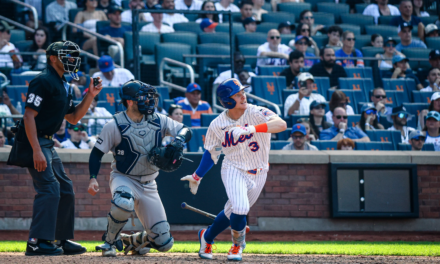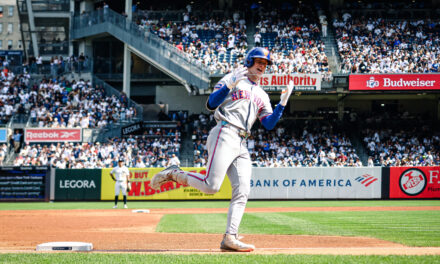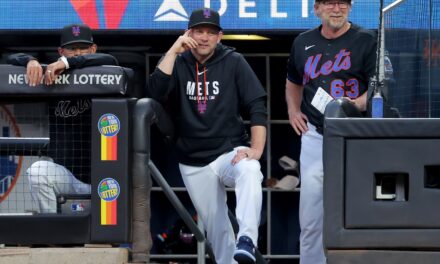


An awful season just continues to get worse for Jeurys Familia.
Just when you think his terrible on-field performance would be enough (7.81 ERA and -0.5 fWAR in 27.2 innings), he’s now on the Injured List once again. This time, it’s because of a Bennett lesion in his shoulder, which doesn’t sound fun.
While Familia has been struggling mightily for most of the season, it’s not as if the rest of the bullpen has performed well. There have been bright spots at times (mostly Seth Lugo and Edwin Diaz), but the relief corps as a group has just been cringeworthy — especially lately.
Since the Mets’ $30-million setup man will be on the shelf for a period of time, I was interested in seeing just how bad some of his numbers compare to other relief-pitcher performances in franchise history.
Spoiler: it’s not pretty.
The Obscenely-High ERA
Any way you slice it, having a pitcher post a 7.81 ERA — whether the sample size is small or big — is a sub-optimal situation. That part is obvious, but just how bad is it when looking back at what Mets relievers have done in the past?
There are a few scenarios I looked at to see where Familia stacks up for this statistic and the ones that follow. First, I looked at qualified relievers (based on innings pitched), as well as relievers with at least 20 and 30 innings pitched. No matter what the scenario, Familia’s sky-high ERA was either at or near the top.
Should Familia return from the IL to throw enough innings to qualify, he needs to be incredibly effective to not finish with the worst reliever ERA in Mets history. Three qualified relievers have finished with an ERA above 6.00 for New York: Mel Rojas in 1998 (6.05), Paul Sewald in 2018 (6.07), and Ray Daviault in 1962 (6.22).
Among relief hurlers with 30-plus innings pitched in a season, Familia has some company in the 7.00-plus ERA club: Ryota Igarashi in 2010 (7.12), Vinegar Bend Mizell in 1962 (7.34), and Rich Rodriguez in 2000 (7.78). Even if Familia didn’t throw another pitch this year, his 7.81 ERA would be the third-worst ever among Mets relievers with 20-plus innings pitched in a season. Only Pete Schourek in 1993 (7.86) and Chuck Estrada in 1967 (9.41) would be worse.
All Those Walks
While Familia is no stranger to having issues with his control, he’s taken things to another level thus far in 2019. He’s allowed 6.83 free passes per nine innings pitched, which also comes out to a 16.0% walk rate. He’s among the 10 worst in baseball for relievers with 20-plus innings, and it doesn’t get much prettier when looking at historical franchise numbers.
If he returned and sustained those numbers through the end of this season, they’d both be the third-worst in Mets history for qualified relievers. The right-hander would still be among the five worst if he eclipsed 30 innings and among the 15 worst if he doesn’t throw another pitch in 2019.
The pitch that’s been giving Familia the most trouble with regard to control is his sinker, which is something I touched upon a couple months ago. He’s tossed this offering 226 times, yet it’s produced a 19.7% walk rate and 12.1% strikeout rate. Familia’s numbers for his four-seamer don’t paint a better picture, either — while that pitch has produced a 35.7% strikeout rate, it’s been accompanied by a 14.3% walk rate.
And All That Hard Contact
Like just about everywhere else, Familia has seen his quality-of-contact numbers plummet.
Between 2015 and 2018, he allowed hard contact at the following rates: 23.9%, 20.0%, 30.0%, and 28.6%. So far in 2019, that number is all the way up at 36.7%, which is on track to be a single-season career-worst mark (shocking, right?).
If he were to return and pitch enough innings to be a qualified hurler, that number would come in a close second to Hansel Robles‘ 36.8% hard-hit rate allowed in 2016. If the benchmark was dropped to 30 innings, Familia would “fall” to fourth in the standings, while he’d be fifth if the benchmark was dropped to 20 innings.
So, this is a long way to say that if Familia doesn’t want his name plastered all over the wrong side of franchise leaderboards, he’ll need to get himself healthy and find a way to do the opposite of what he’s done since returning to Flushing. Based on the lack of consistency in his results, that’ll be hard to do, and it’ll also depend on how long he’s actually sidelined.